Getting over needle phobia usually means understanding what you fear, planning manageable practice and learning what helps you approach necessary healthcare. CBT can support that process. You do not have to jump straight to an injection or wait until you feel completely calm.
If a blood test or injection is coming up soon, contact the healthcare team now and explain the difficulty. They can discuss support for that appointment while you consider longer-term help.
Start with what you are afraid of
Needle phobia, sometimes called trypanophobia, can involve injections, blood tests or other procedures involving needles. The same situation can bring different fears: pain, fainting, panicking, losing control or being judged for your reaction.
Try completing this sentence: “The part I am most afraid of is …” A specific answer gives you and a therapist something useful to work with. “I will faint” needs a different discussion from “I will panic and the nurse will be annoyed.” A history of fainting also needs attention from the healthcare team.
Understand the avoidance cycle
Putting off an appointment may bring immediate relief. It can also leave you with the belief that avoiding was the only thing that kept you safe. The next appointment then feels just as threatening.
CBT explores that pattern without blaming you for it. You look at the feared prediction, your physical response and what you do to cope. The aim is to build more choice around healthcare, rather than make a rule that you must never feel anxious.
Build a gradual practice plan
Exposure-based therapy is a recognised approach for high needle fear. It involves approaching relevant situations in planned steps, with a chance to test a prediction and review what happened. Assessment helps establish suitable steps and any medical precautions.
A starting point might be reading a brief description of a blood test, discussing the procedure with a nurse, or looking at a simple drawing agreed with your therapist. These are examples, not a ladder everyone should follow. Your starting point, pace and support need to fit your own circumstances.
Before a practice step, ask: “What do I predict, and what could this step help me find out?” Afterwards, record what you noticed, what remains uncertain and what you want to discuss next. Learning can happen while some anxiety remains.
Medical procedures belong with qualified healthcare staff. Do not handle needles, create injuries, attempt injections or deliberately bring on fainting as a home exercise.
Fictional example: Jordan keeps cancelling because they expect to panic and be criticised. Their first agreed step is a short call to explain the fear and ask how support can be arranged. The call is uncomfortable, but Jordan discovers they can ask a question while anxious. That is one piece of learning, not proof that every later step will be easy.
Make a separate plan for the appointment
Preparing for a necessary blood test is different from a planned therapy experiment. You can ask for appropriate support during a procedure. Looking away, having someone with you or using a position agreed with staff does not need to be removed just to prove a point.
A short checklist can help you explain what you need:
- Tell the team what you fear and whether you have fainted before.
- Ask what positioning, communication and support can be arranged.
- Agree how you will let staff know if you feel unwell.
- Follow the instructions for your particular test, including food, drink and medicines. Ask the team if anything is unclear.
Do not change prescribed medication or fasting instructions on the basis of an online guide. If fear is stopping necessary care, tell the healthcare team rather than waiting for therapy to remove the fear first.
What if you feel faint around needles?
Some people with blood or injection fears have a response involving a drop in blood pressure and fainting. Others mainly experience panic symptoms. Feeling dizzy alone does not establish what is happening, and new or unexplained fainting needs medical assessment.
Applied tension is different from relaxation. It uses muscle tension to help counter a blood-pressure drop and may be considered when a fainting response is relevant. Ask an appropriately qualified professional whether it fits your health and circumstances. It is not a technique everyone with needle fear needs.
Tell the staff immediately if you feel faint during a procedure and follow their guidance. Do not rely on a general breathing exercise or an online worksheet as a substitute for that support.
When professional support may help
If fear is repeatedly affecting appointments or decisions about your health, discuss support with a GP, your healthcare team or a CBT therapist. You can ask what NHS talking-therapy options are available locally.
Useful questions for a therapist include: “How would we choose a first step?”, “How would you take my fainting history into account?” and “What support would an actual procedure need?”
Online CBT can provide space for assessment, planning and reviewing practice. Its suitability is individual, and the medical part of an injection or blood test still needs appropriate healthcare staff. Read about online CBT for needle phobia with Shav to understand the service and how to ask about a FREE first consultation.
Prepare what you want the team to know
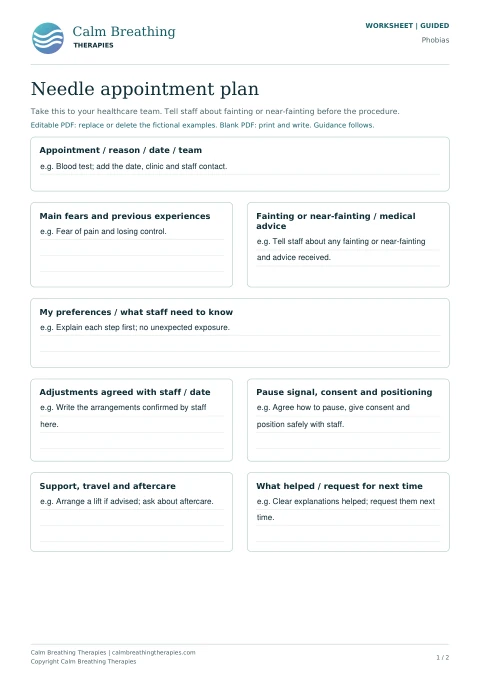
The needle appointment plan gives you space to note your main concern, fainting history, agreed support and the questions you want to ask. It is free to download, with no sign-up.