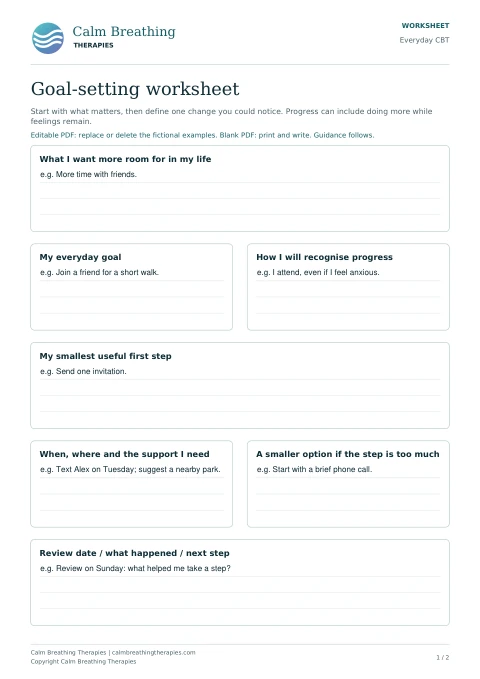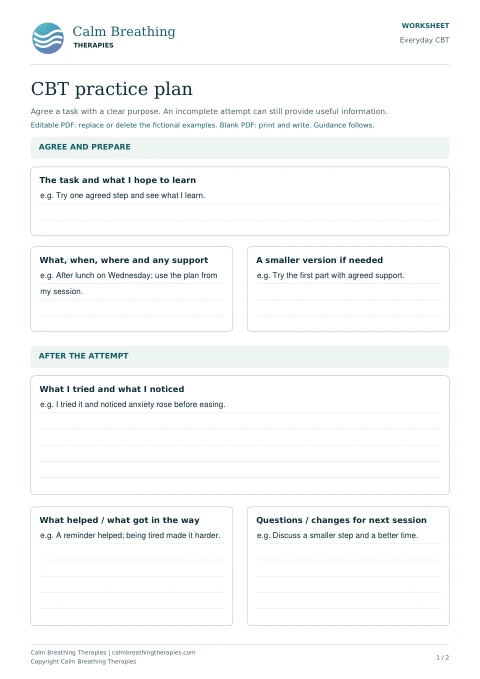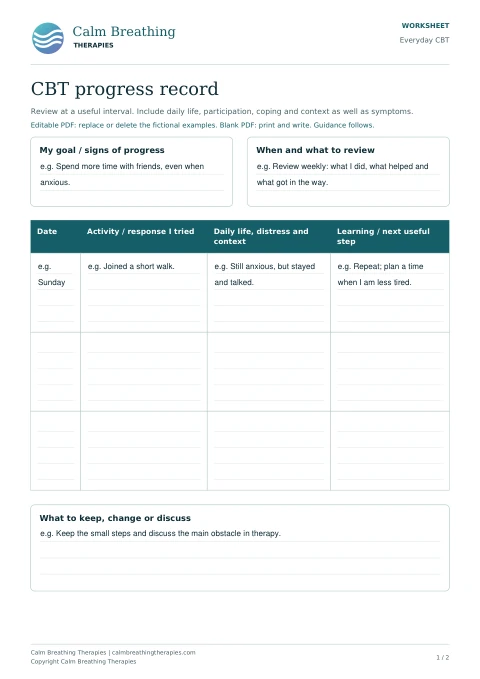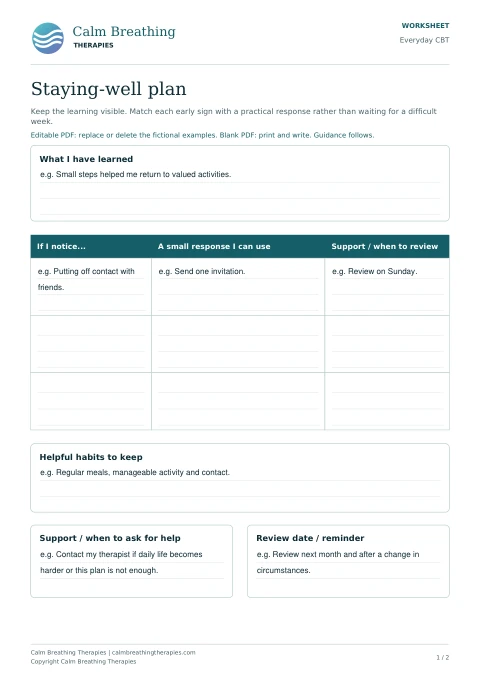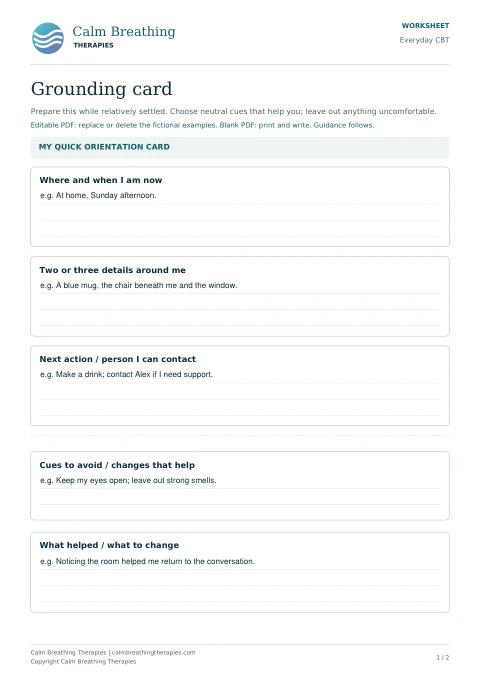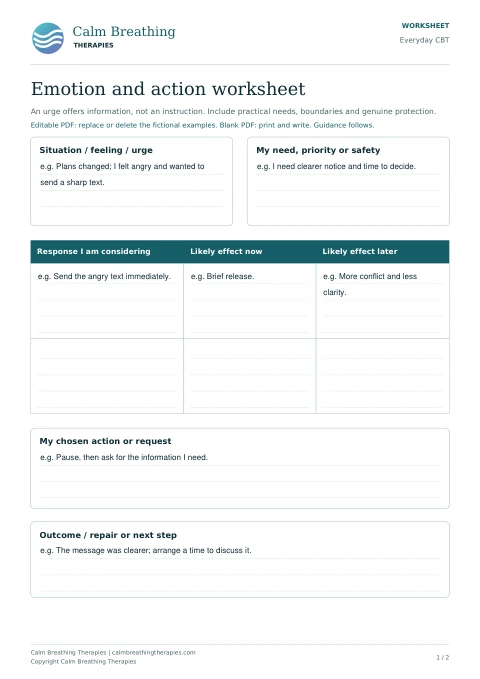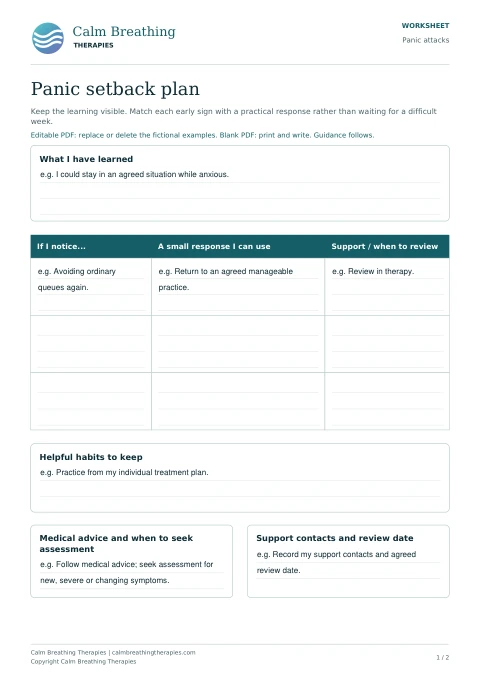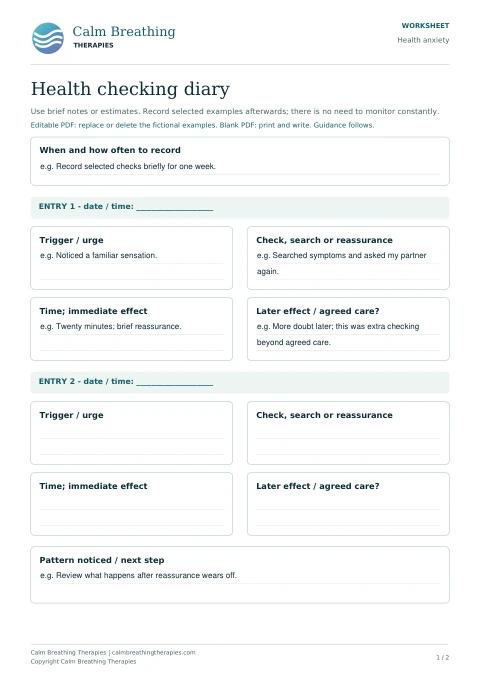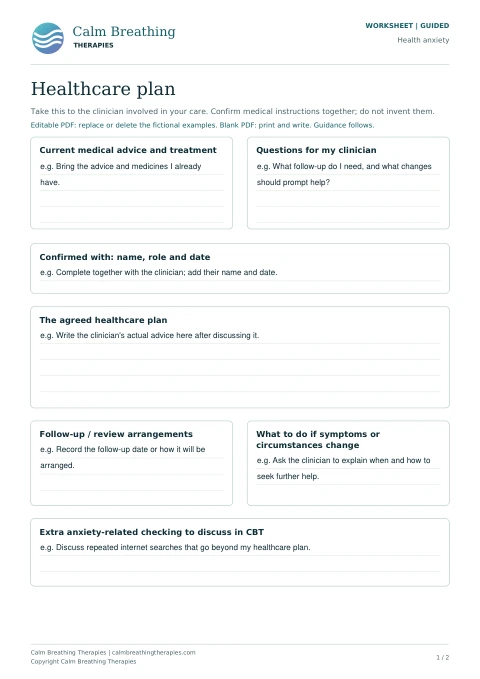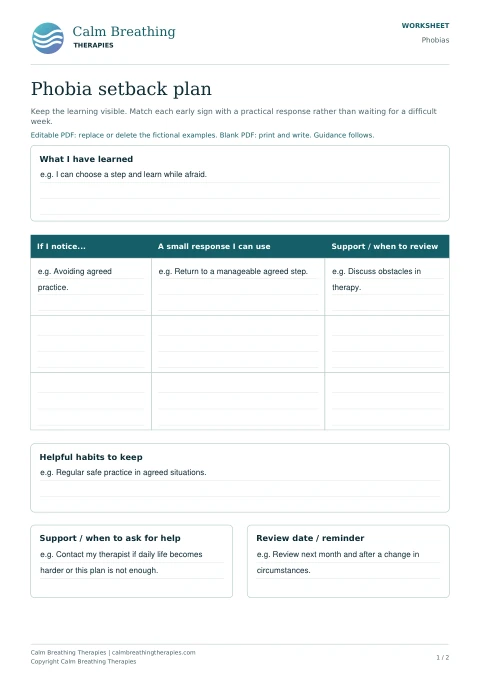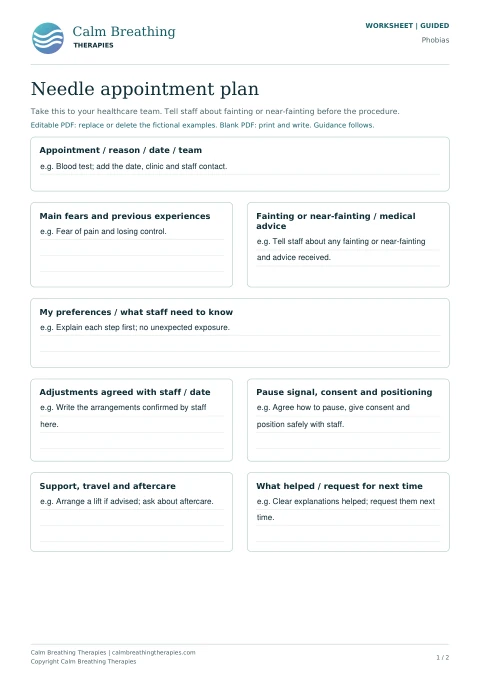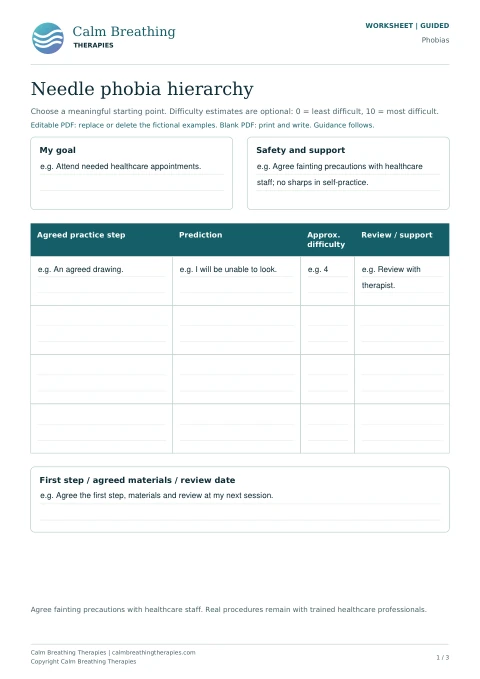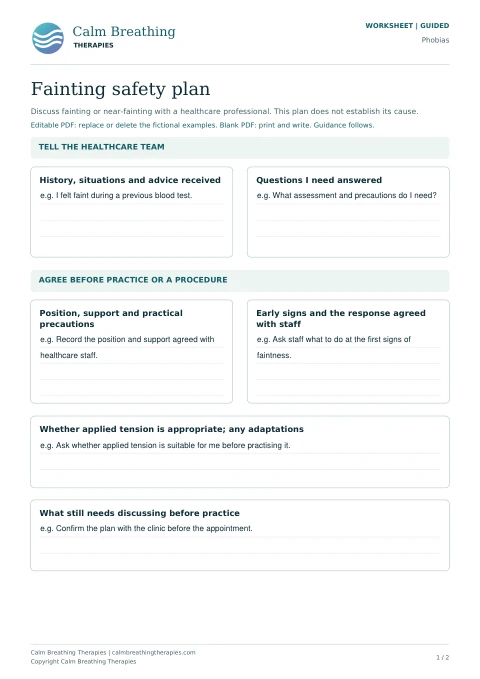
Practical tools. At your pace.

Free CBT Self-Help Resources & Worksheets

Find free CBT worksheets, templates and self-help resources for everyday use.

Preview original CBT worksheets, diagrams and practical exercises for anxiety, panic attacks, phobias, OCD, low mood and more. Download individual fillable PDFs or a complete topic toolkit, with each worksheet first and guidance afterwards.

82 free worksheets · 10 toolkits · No email address or payment needed

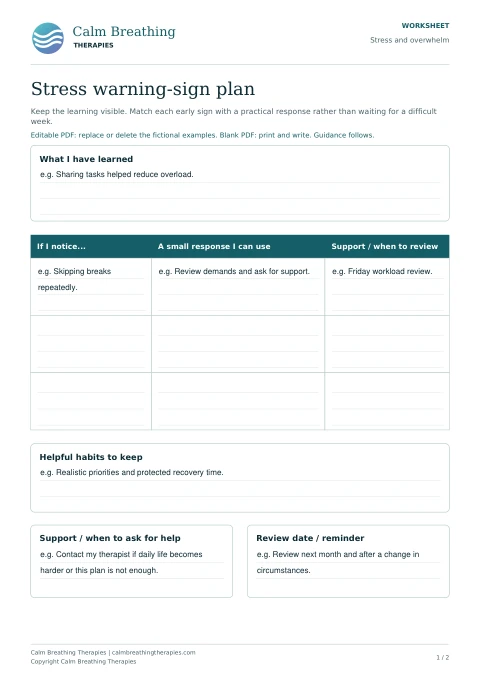
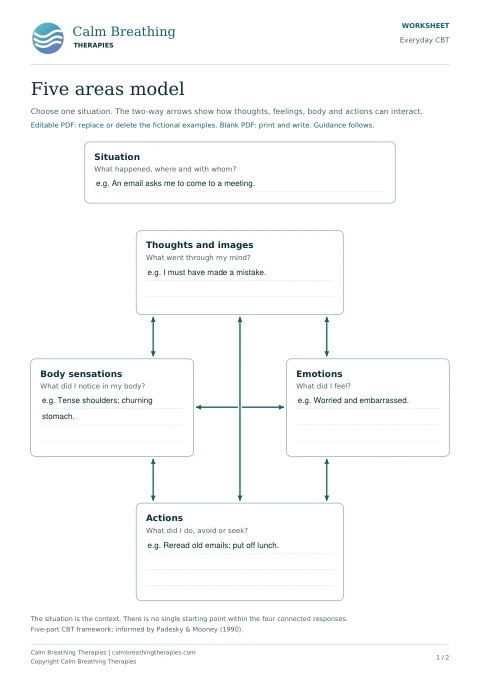
Worksheet with editable fictional examples: Five areas model View worksheet
The actual Five Areas worksheet. Select to enlarge.
Browse the 10 topic toolkits
The worksheet library

Preview the worksheets

Search for a topic or technique, then select a template to enlarge it. All downloads are free.

Everyday CBT tools15 worksheets

A worksheet can help you put a difficult moment into words, notice a pattern and choose something useful to try. Explore the full toolkit and guidance.

Branded CBT assessment worksheet with space for a recent example and notes View worksheet
First appointment

CBT assessment worksheet

Prepare for a first CBT appointment or make notes with a therapist. Includes a recent example, patterns, health, support and goals.

4 pages · A4 · Fillable PDF · 863 KB

Read the guidance

Use the first three pages to note what you would like help with, one recent difficult moment, wider patterns, health, support and goals. The final page is a concise prompt sheet for a therapist to use during an appointment.

How to use it

  1. Choose the fillable PDF to type in a PDF reader, or print the blank version. Brief notes are enough; use another sheet if needed.
  2. Leave anything you would rather discuss in person. You do not need to complete the form before asking for support.
  3. Keep the completed copy private and agree any sharing with your therapist. Typing in the PDF does not submit information to this website.

The form supports an assessment conversation. It is not a diagnostic questionnaire, a complete clinical assessment or a safety score. If you need urgent help, contact appropriate urgent or emergency services rather than wait for the form to be read.

Guidance: NHS: cognitive behavioural therapy; NICE: shared decision making; NICE: self-harm assessment and care.
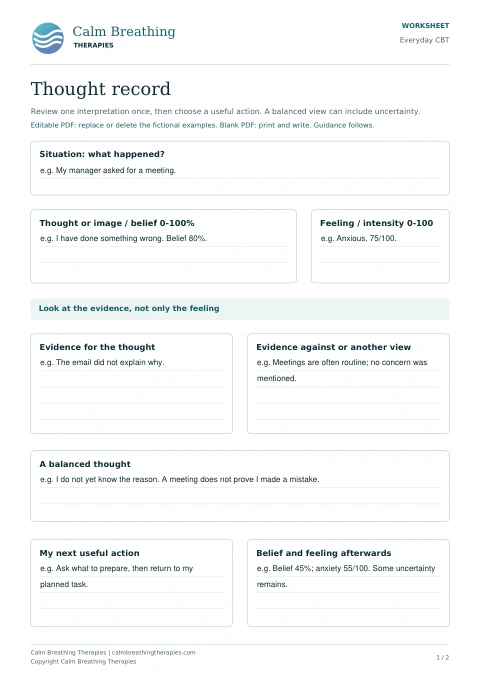
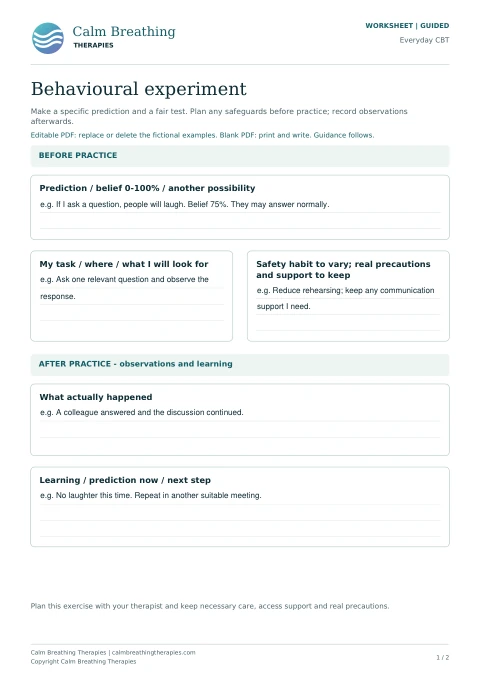
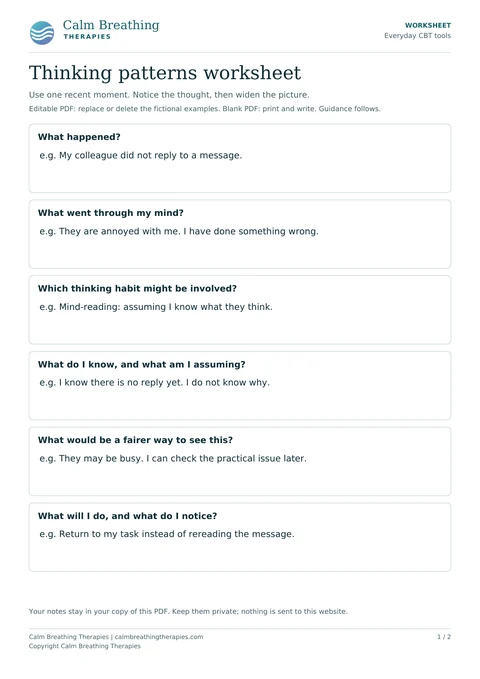
Thinking patterns worksheet: six clear prompts with short editable fictional examples View worksheet
Free worksheet

Thinking patterns worksheet

Spot a thinking habit, check what you actually know and choose a fairer response. Includes a short thinking-patterns guide.

2 pages · A4 · Fillable PDF · 841 KB

Read the guidance and example

When we are upset, the mind can jump to a conclusion before we have the whole picture. This sheet helps you notice a thinking habit and respond more fairly. A pattern is a description of a thought, not a label for you.

How to use it

  1. Write one situation and the thought or image that upset you.
  2. Use the brief guide below if a thinking habit fits. You can leave this box blank.
  3. Separate observations from assumptions. Include facts that do not fit your first conclusion.
  4. Write a believable response and a useful next action. Notice what happens; you do not have to feel better immediately.

In the editable PDF, replace or delete each fictional example. Your notes stay in your saved copy and are not sent to this website.

A fictional example

Amina sees two friends talking without her and thinks, 'They do not want me around.' She notices mind-reading. She has not heard their conversation. Her fairer response is, 'I do not know what they are discussing; I can say hello and see.' She joins them rather than using their first expression as a test of whether she belongs.

Keep in mind

Do not use this sheet to explain away real mistreatment, discrimination or practical danger. Sometimes the useful response is a boundary, problem-solving or support. Repeatedly analysing the same thought can become another worry loop; one brief pass may be enough.

Review your learning

Did this help me act with a wider view, rather than find a perfectly reassuring answer?

Sources informing this original worksheet: Beck, J. S. (2020). Cognitive Behavior Therapy: Basics and Beyond (3rd ed.). Guilford Press.. These sources do not endorse the resource.

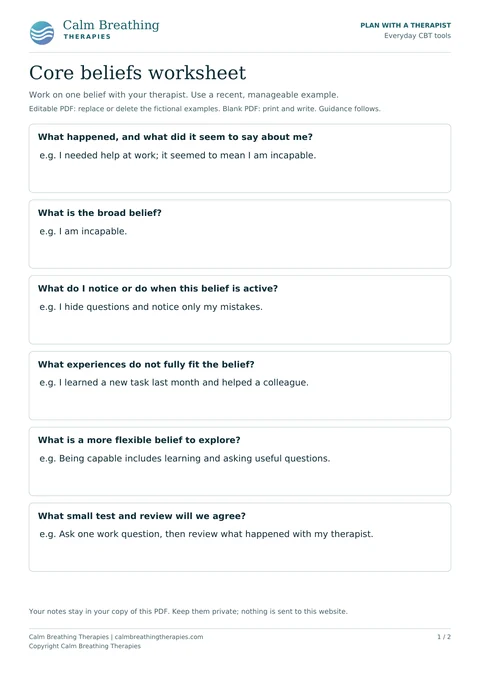
Core beliefs worksheet: six clear prompts with short editable fictional examples View worksheet
Plan with a therapist

Core beliefs worksheet

Explore a broad belief about yourself, notice what keeps it convincing and plan a small way to test a more flexible view with a therapist.

2 pages · A4 · Fillable PDF · 842 KB

Read the guidance and example

A core belief is a broad idea about yourself, other people or the world. It can feel like a fact, especially when you are low or anxious. This sheet supports a shared conversation about one belief and a more flexible alternative; it is not a search for something wrong with you.

How to use it

  1. Start with a recent situation rather than detailed memories of the past.
  2. Name the broad belief in your own words. Treat it as a working idea, not a diagnosis.
  3. Notice how attention, avoidance or rules may keep it convincing. Include experiences it overlooks.
  4. Agree a believable alternative, a safe small test and how you will review the learning with your therapist.

In the editable PDF, replace or delete each fictional example. Your notes stay in your saved copy and are not sent to this website.

A fictional example

After a difficult meeting, Ben concludes, 'I am useless.' With his therapist, he notices he counts mistakes but dismisses preparation and support he gives others. They explore, 'I have skills and limits, and I can learn.' He plans to ask one clarifying question at the next meeting and record what he learns, without grading his whole worth from the outcome.

Keep in mind

Broad beliefs can be connected with painful experiences. You do not need to revisit trauma or disclose private history on this sheet. Pause if it becomes overwhelming. Choose any behavioural test with your therapist; avoid tests involving danger, humiliation or pressure to prove your worth.

Review your learning

What would let me hold the old belief less rigidly, even if it still feels convincing?

Sources informing this original worksheet: Beck, J. S. (2020). Cognitive Behavior Therapy: Basics and Beyond (3rd ed.). Guilford Press.; NICE (2022). Depression in adults: treatment and management. NG222.. These sources do not endorse the resource.

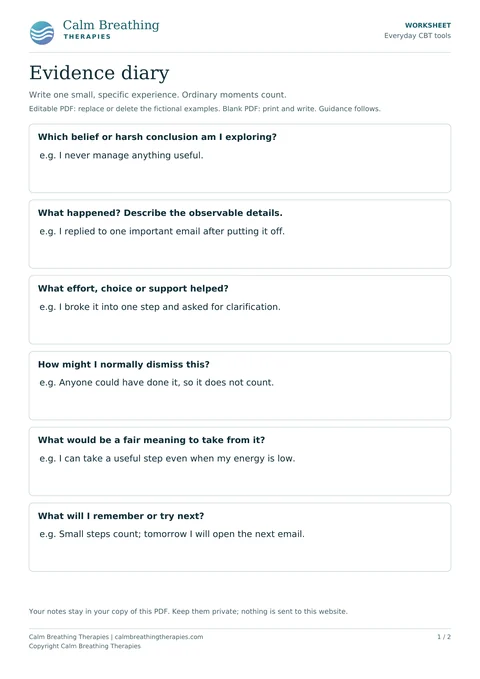
Evidence diary: six clear prompts with short editable fictional examples View worksheet
Free worksheet

Evidence diary

Record specific experiences that a harsh belief overlooks. Include effort, support and small actions without forcing positive thinking.

2 pages · A4 · Fillable PDF · 841 KB

Read the guidance and example

When a harsh belief is familiar, the mind may notice what supports it and dismiss everything else. This diary helps you collect concrete experiences it overlooks. The aim is a fuller view, not a list of achievements or proof that every day went well.

How to use it

  1. Choose one belief you want to examine, rather than monitor everything about yourself.
  2. Record a specific event close to when it happens. Include kindness, persistence, learning, asking for help or resting when needed.
  3. Notice any automatic dismissal. Ask whether you would dismiss the same event for somebody else.
  4. Write a fair meaning. Review a few entries together at an agreed time rather than repeatedly checking the diary.

In the editable PDF, replace or delete each fictional example. Your notes stay in your saved copy and are not sent to this website.

A fictional example

Maya believes, 'I let everyone down.' She records telling a friend honestly that she could not meet that evening and suggesting another day. Her first response is, 'That is nothing.' A fuller view is that she communicated clearly and cared about the friendship while respecting her limits. The entry is useful information, not a demand to become a perfect friend.

Keep in mind

Include support from others; needing help does not cancel your contribution. Do not turn the diary into a daily performance target or repeatedly read it to feel completely certain about yourself. If no example comes to mind, leave it and revisit with support.

Review your learning

What has this helped me notice that my usual belief leaves out?

Sources informing this original worksheet: Beck, J. S. (2020). Cognitive Behavior Therapy: Basics and Beyond (3rd ed.). Guilford Press.; NICE (2022). Depression in adults: treatment and management. NG222.. These sources do not endorse the resource.

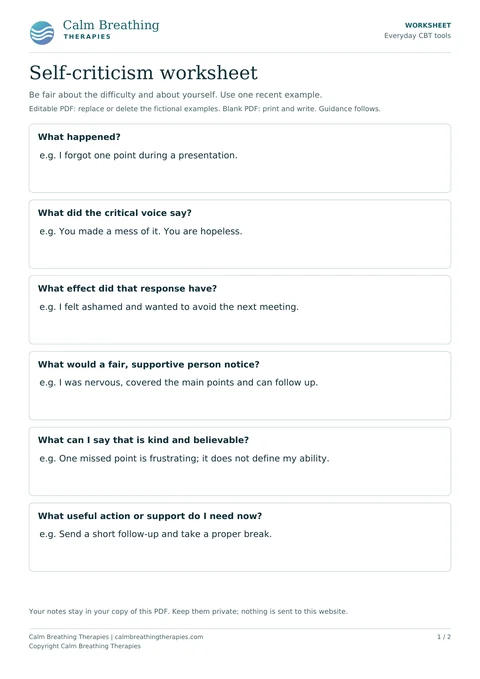
Self-criticism worksheet: six clear prompts with short editable fictional examples View worksheet
Free worksheet

Self-criticism worksheet

Respond to a harsh thought with accuracy and kindness, then choose a practical next step. Includes space to recognise real pressures and needs.

2 pages · A4 · Fillable PDF · 842 KB

Read the guidance and example

Self-criticism can feel as though it will keep us motivated or prevent mistakes. A harsh response may also leave us ashamed, stuck or afraid to try. This sheet helps you keep any useful information while responding in a fairer and more supportive way.

How to use it

  1. Write the event separately from the judgement you made about yourself.
  2. Notice the effect of the criticism. Does it help you learn, or make you withdraw or overwork?
  3. Imagine a fair supporter who knows the full context. Include pressures, needs and anything you did manage.
  4. Write a response you can believe and choose a useful next step, such as repairing a mistake, resting or asking for help.

In the editable PDF, replace or delete each fictional example. Your notes stay in your saved copy and are not sent to this website.

A fictional example

After cancelling a plan because she was exhausted, Leah calls herself selfish. She notices this pushes her to agree to more than she can manage. A fair response is, 'My friend matters and my energy matters. I can explain and offer another time.' She sends one clear message instead of repeatedly apologising and checking whether the friendship is secure.

Keep in mind

A supportive response does not mean denying a mistake or accepting harmful treatment from others. You can take responsibility for an action without attacking your whole character. If supportive wording feels false, begin with a neutral description of the facts or discuss it with a therapist.

Review your learning

Did this response make space for learning and a useful action?

Sources informing this original worksheet: Beck, J. S. (2020). Cognitive Behavior Therapy: Basics and Beyond (3rd ed.). Guilford Press.; NICE (2022). Depression in adults: treatment and management. NG222.. These sources do not endorse the resource.

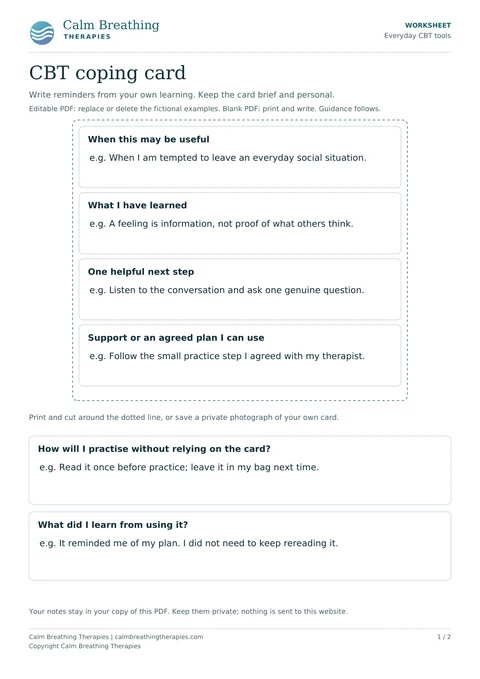
CBT coping card: six clear prompts with short editable fictional examples View worksheet
Free worksheet

CBT coping card

Keep a brief reminder of your own CBT learning and an agreed next step. A portable card for everyday practice, with space to review how you used it.

2 pages · A4 · Fillable PDF · 842 KB

Read the guidance and example

A coping card holds a few words from what you have already learned in CBT. It can help you remember a useful action when the mind is busy. Make it personal and believable. The card is a reminder, not a promise that nothing difficult will happen.

How to use it

  1. Choose one situation and use learning you actually believe, rather than a general positive slogan.
  2. Write a short reminder and one action that fits your treatment plan. Agree any exposure step with your therapist.
  3. Keep a copy or photograph if useful. Practise using the action, sometimes without consulting the card.
  4. Review whether the card supports participation or has become something you feel you must check before you can cope.

In the editable PDF, replace or delete each fictional example. Your notes stay in your saved copy and are not sent to this website.

A fictional example

Alex writes, 'I do not know exactly how I will come across. I can listen and contribute one point.' At a familiar meeting he reads it once, then puts it away. Later he tries the same action without the card. The learning is that he can participate with uncertainty, not that the card protects him from feeling anxious.

Keep in mind

Repeated rereading for certainty can become reassurance or a safety behaviour. If you feel unable to act without the card, review its use with your therapist. This is not a crisis or medical safety plan and must not replace either. Use a separate agreed support plan if urgent help is needed.

Review your learning

Did the card help me use a skill, and can I gradually rely more on the learning itself?

Sources informing this original worksheet: Beck, J. S. (2020). Cognitive Behavior Therapy: Basics and Beyond (3rd ed.). Guilford Press.; NICE (2011, updated 2020). Generalised anxiety disorder and panic disorder in adults: management. CG113.. These sources do not endorse the resource.

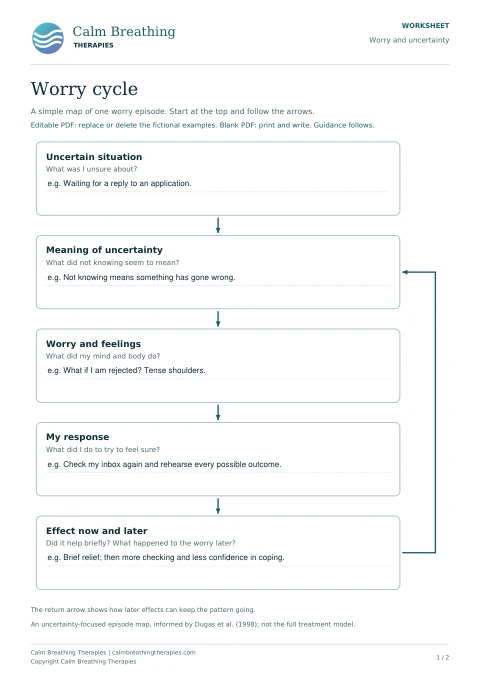
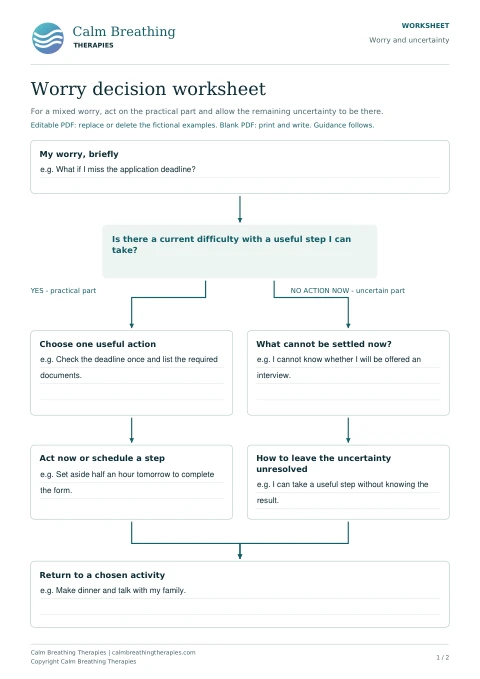
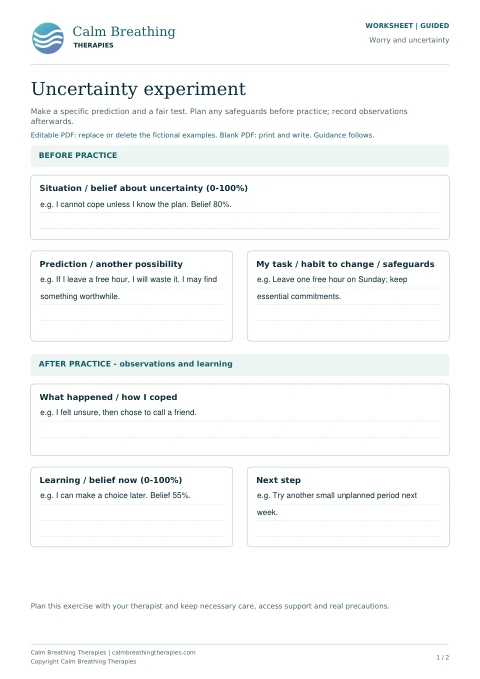
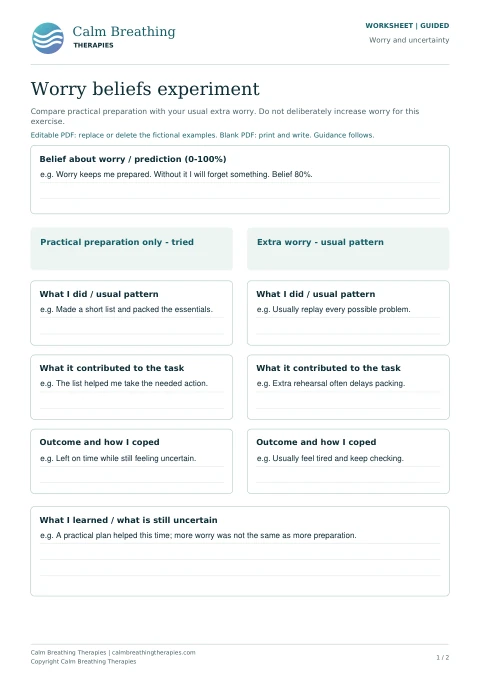
Worry & anxiety8 worksheets

When worry moves from one “what if” to the next, trying to think harder can leave you feeling less certain. Explore the full toolkit and guidance.

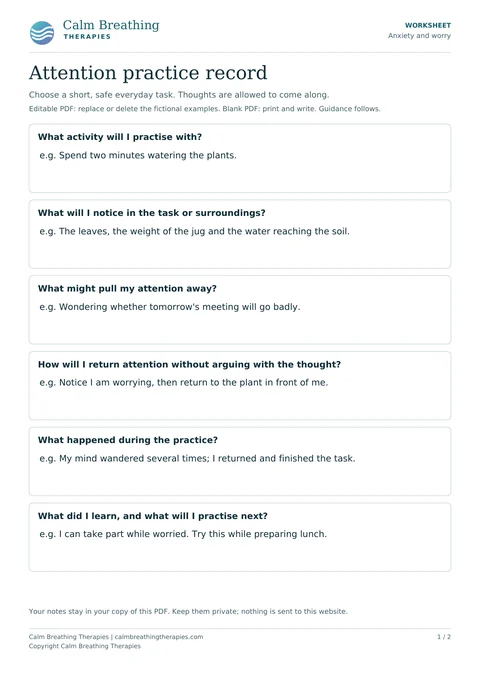
Attention practice record: six clear prompts with short editable fictional examples View worksheet
Free worksheet

Attention practice record

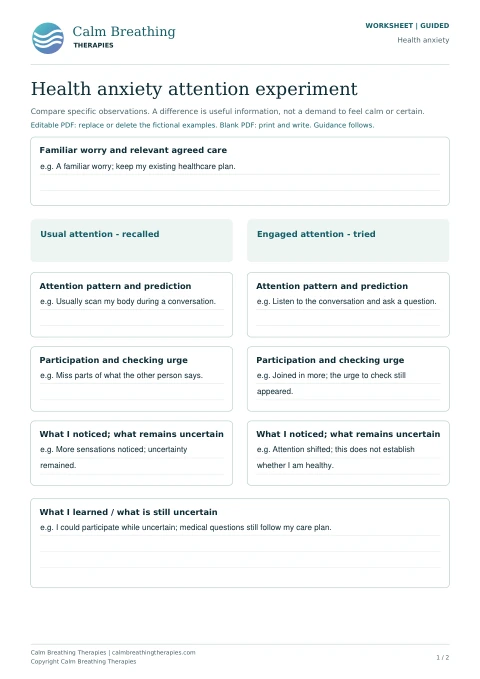
Practise returning attention to an everyday task while allowing worry to be present. Record what you tried and what helped you take part.

2 pages · A4 · Fillable PDF · 842 KB

Read the guidance and example

Worry can pull attention away from what we are doing. Attention practice means noticing this and gently choosing where to place your attention next. The aim is flexibility and participation, not an empty mind or immediate relief from anxiety.

How to use it

  1. Pick a safe, ordinary task you want to take part in. Start briefly; adapt the activity to your senses, energy and concentration.
  2. Choose a few details of the task to notice, without needing to scan for every detail.
  3. When the mind wanders, acknowledge it and return to the activity. You do not need to push the thought away or repeat a phrase perfectly.
  4. Record participation and learning afterwards. Practise occasionally rather than whenever you need certainty that you are calm.

In the editable PDF, replace or delete each fictional example. Your notes stay in your saved copy and are not sent to this website.

A fictional example

Before a meeting, Sam notices repeated predictions about making a mistake. While making tea, he attends to the cup, the kettle sound and the sequence of the task. His mind wanders and he returns. The predictions are still there when he finishes; he has practised choosing an activity alongside worry rather than waiting until he feels ready.

Keep in mind

Do not practise during driving, crossing roads or any task needing undivided safety attention. This is not a way to ignore an urgent problem or medical symptoms. Stop or change the exercise if it increases distress or disconnection, and discuss this with your therapist if needed.

Review your learning

Could I return to what I was doing, even with some worry present?

Sources informing this original worksheet: NICE (2011, updated 2020). Generalised anxiety disorder and panic disorder in adults: management. CG113.; Centre for Clinical Interventions. Worry and rumination: overview of attention practice within CBT self-help.. These sources do not endorse the resource.

Panic attacks7 worksheets

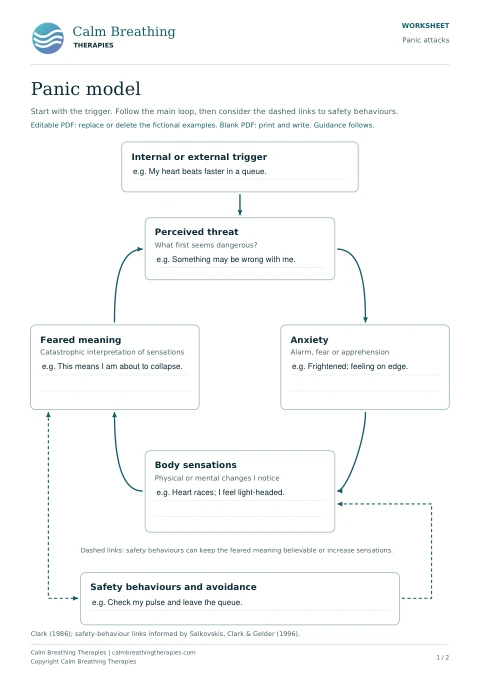
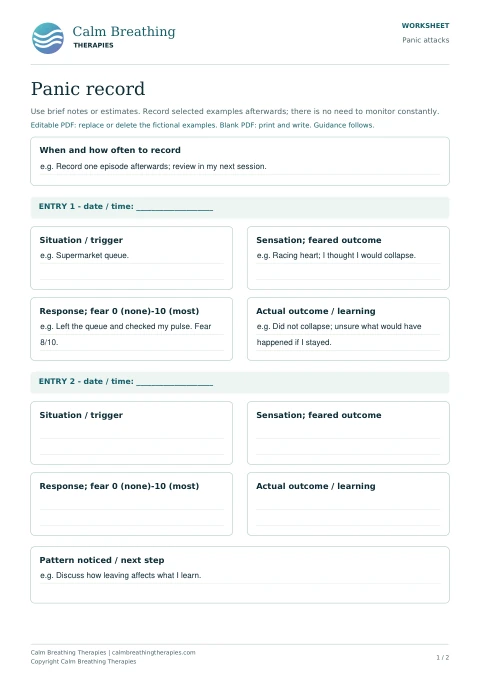
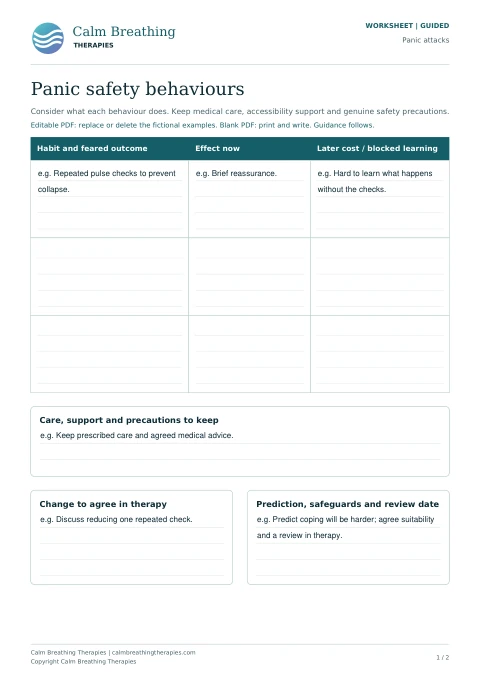
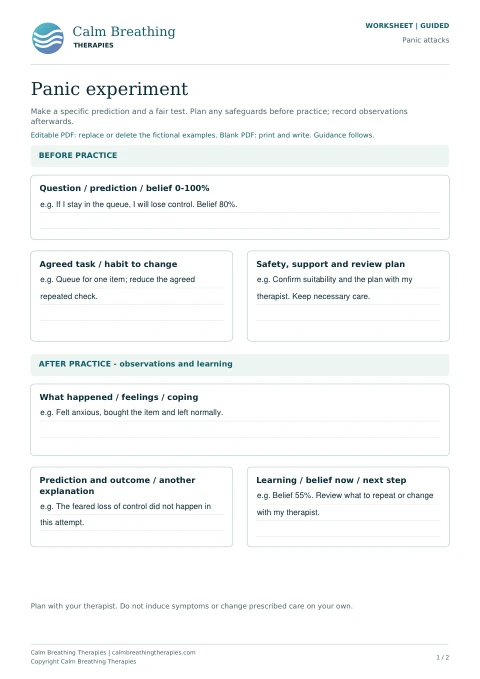
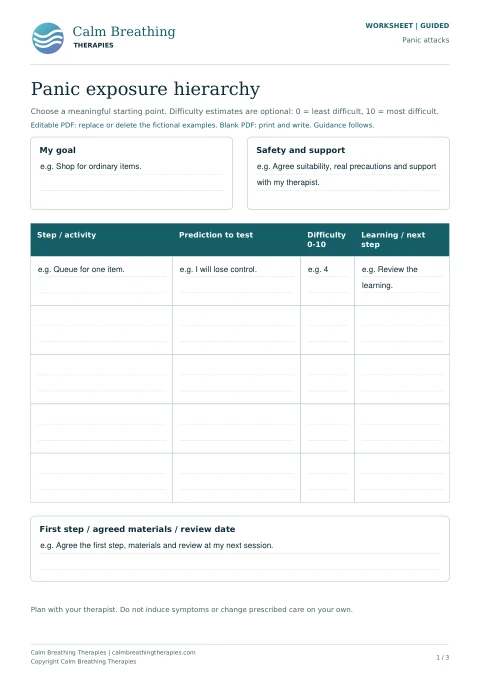
Panic can feel frightening, and fear of another attack can begin to decide where you go and what you do. Explore the full toolkit and guidance.

Health anxiety7 worksheets

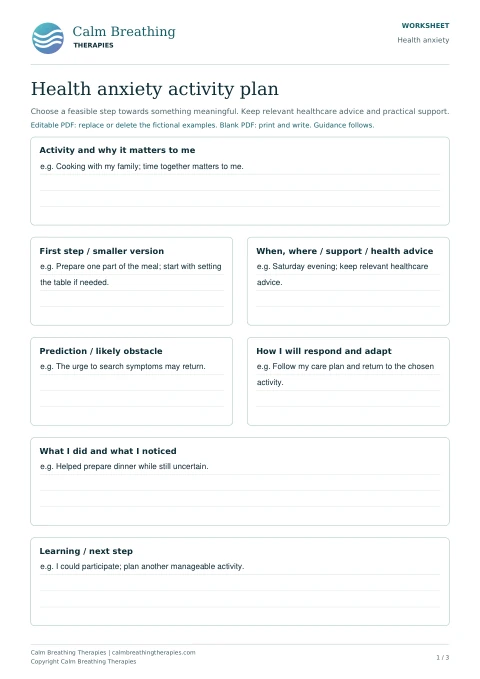
Health anxiety can involve repeated symptom searches, body checking, reassurance or avoiding healthcare and everyday activities. Explore the full toolkit and guidance.

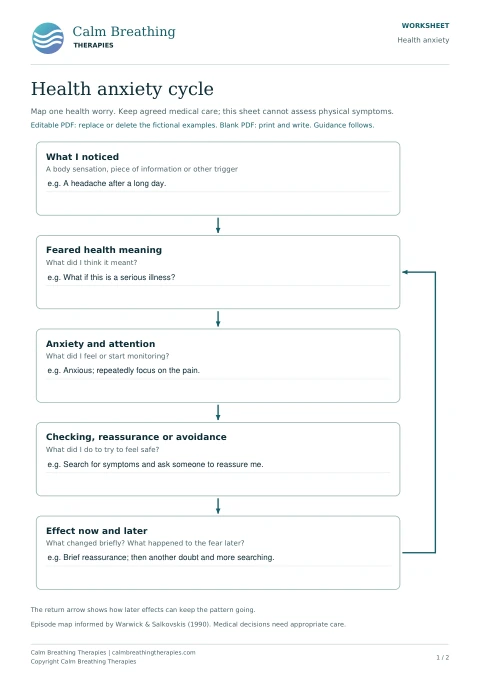
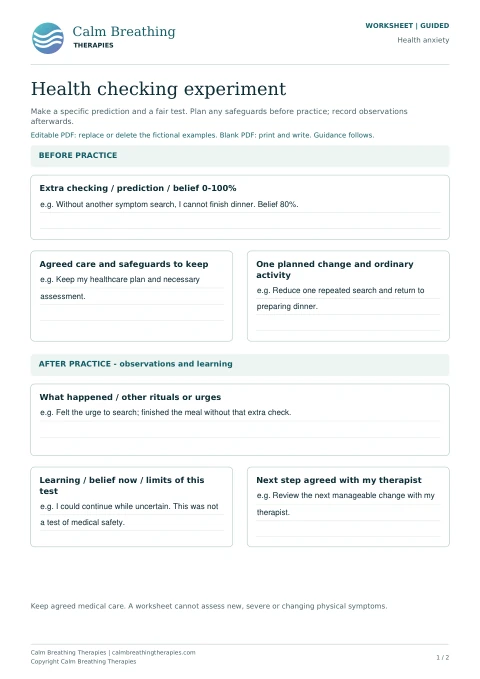
Health anxiety: two explanations: six clear prompts with short editable fictional examples View worksheet
Plan with a therapist

Health anxiety: two explanations

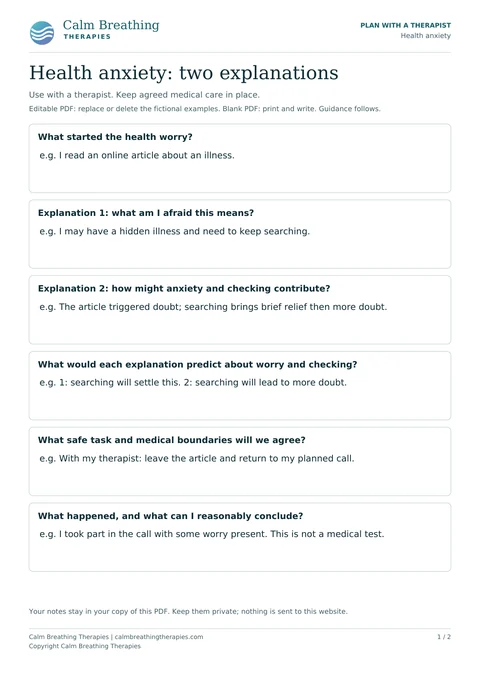
Compare a feared health interpretation with an anxiety-and-checking explanation, then agree a safe learning task with a therapist. Medical care remains separate.

2 pages · A4 · Fillable PDF · 842 KB

Read the guidance and example

Health anxiety can make a feared interpretation feel like the only explanation. With your therapist, consider whether anxiety, attention and checking also help explain the pattern. This sheet examines the worry process; it cannot establish whether a physical illness is present or absent.

How to use it

  1. Choose one episode and separate what you noticed from what you feared it meant.
  2. Write the feared explanation and an alternative about the anxiety process. Both anxiety and a physical health condition can be present.
  3. With your therapist, compare predictions about attention, checking, reassurance and daily activity. Do not create symptom tests or try to prove the absence of illness.
  4. Agree a safe small task within your medical care plan, then record what it teaches about the worry process and what remains uncertain.

In the editable PDF, replace or delete each fictional example. Your notes stay in your saved copy and are not sent to this website.

A fictional example

Priya reads about an illness and repeatedly searches for further signs. Her feared explanation is that stopping would be irresponsible. An alternative is that searching is increasing doubt and the urge to check. Within her agreed care plan, she closes the article and returns to a phone call. She learns she can remain involved despite uncertainty; the exercise tells her nothing definitive about her medical health.

Keep in mind

Keep prescribed treatment, necessary tests and agreed medical appointments. Do not use this sheet to decide whether a symptom needs assessment or to delay urgent care. Seek appropriate medical advice for new, severe, changing or unexplained symptoms. A therapist-guided experiment must not involve unsafe exertion, stopping medicines or withholding needed care.
Review your learning

What did this show about attention, reassurance or checking, without turning learning into a guarantee?

Sources informing this original worksheet: Warwick, H. M., & Salkovskis, P. M. (1990). Hypochondriasis. Behaviour Research and Therapy, 28(2), 105-117. doi:10.1016/0005-7967(90)90023-C.; NHS. Health anxiety.. These sources do not endorse the resource.
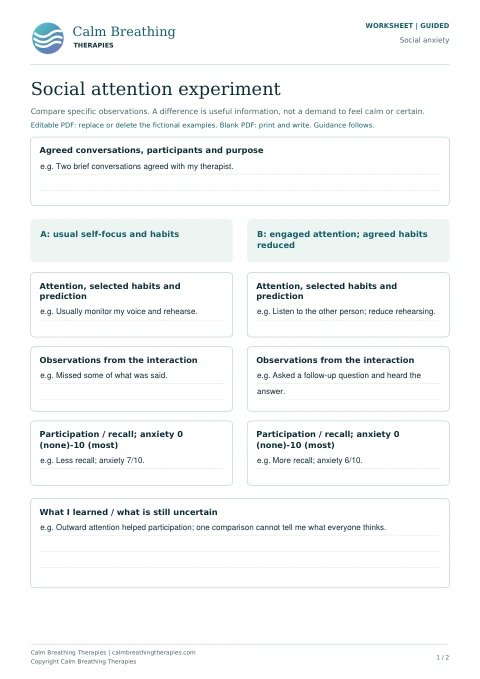
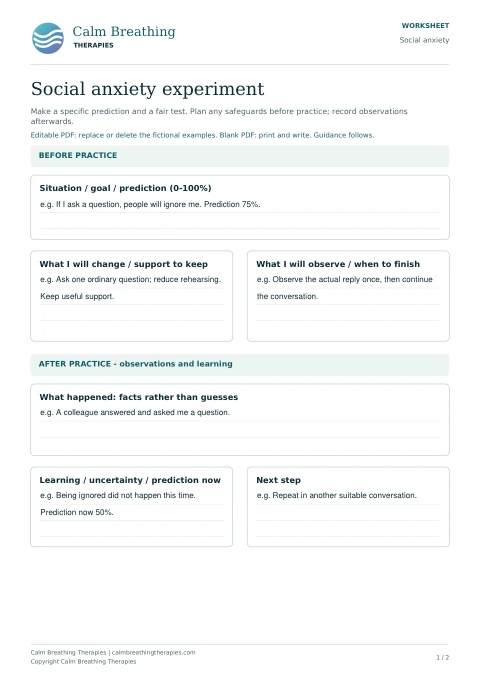
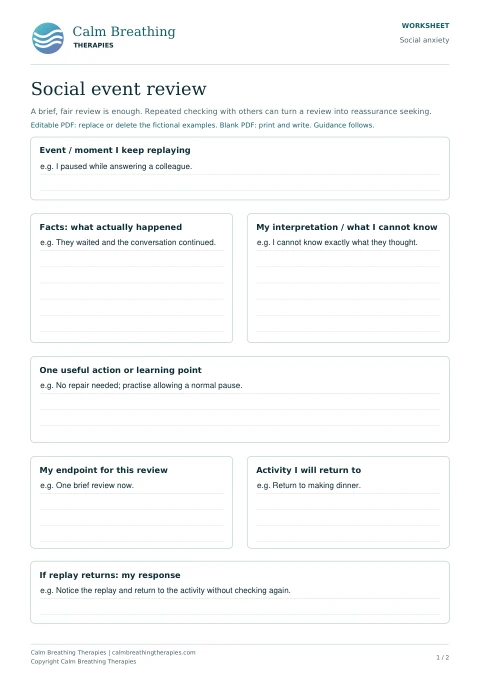
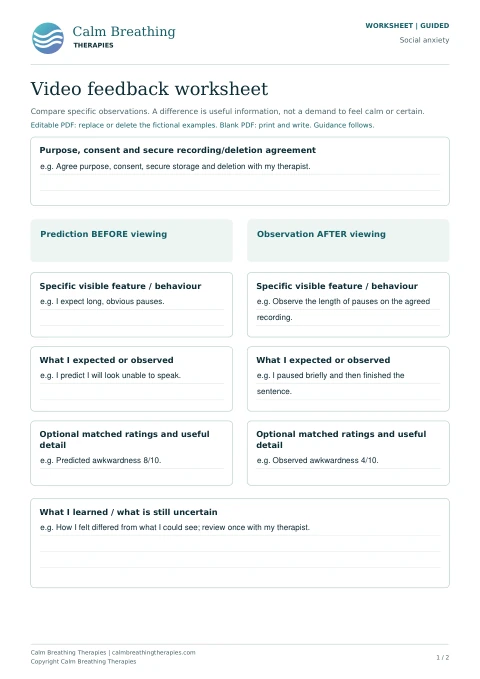
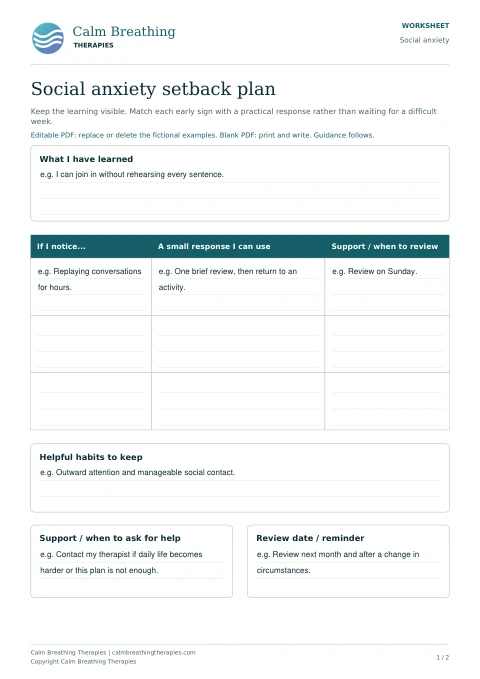
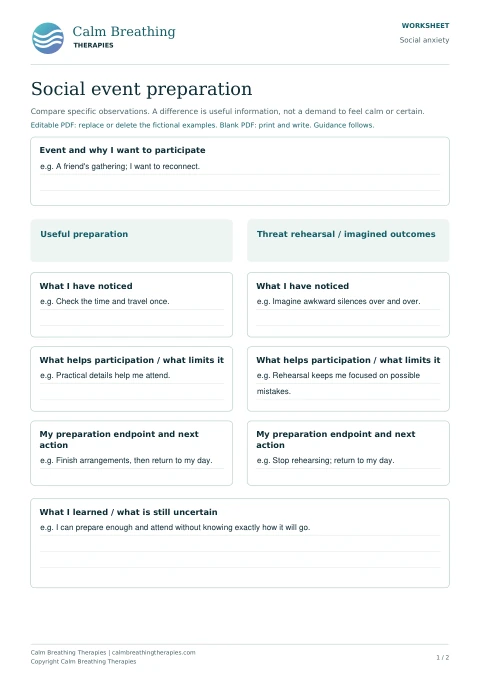
Social anxiety7 worksheets

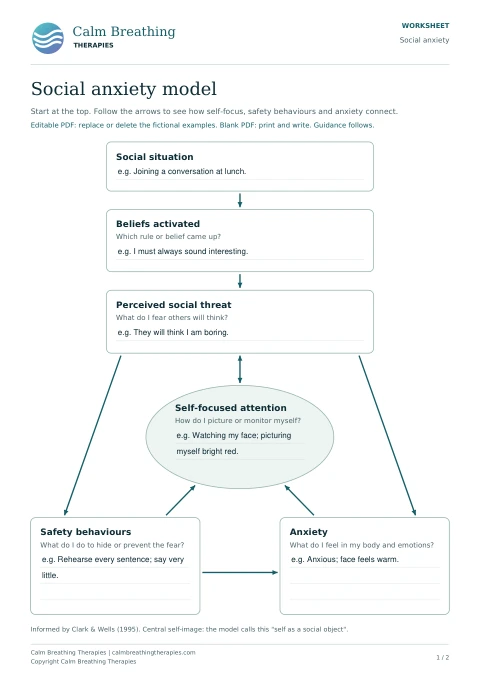
Social anxiety can pull your attention towards how you think you look, sound or come across. Explore the full toolkit and guidance.
Phobias11 worksheets

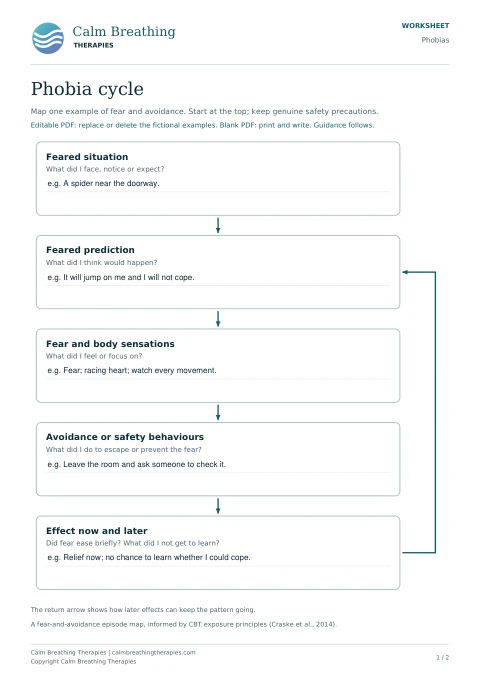
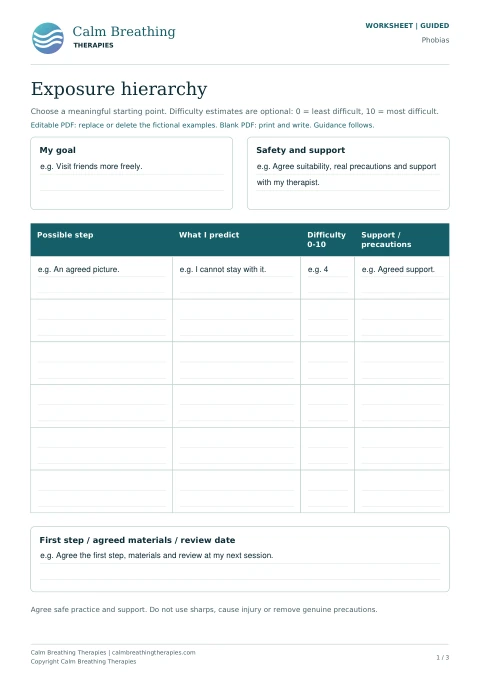
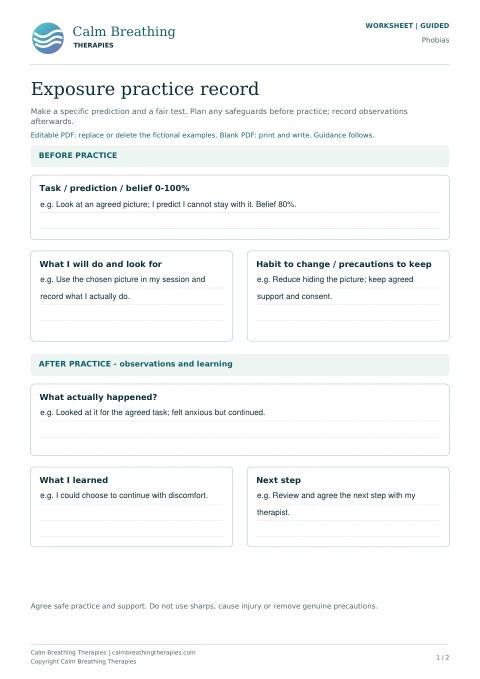
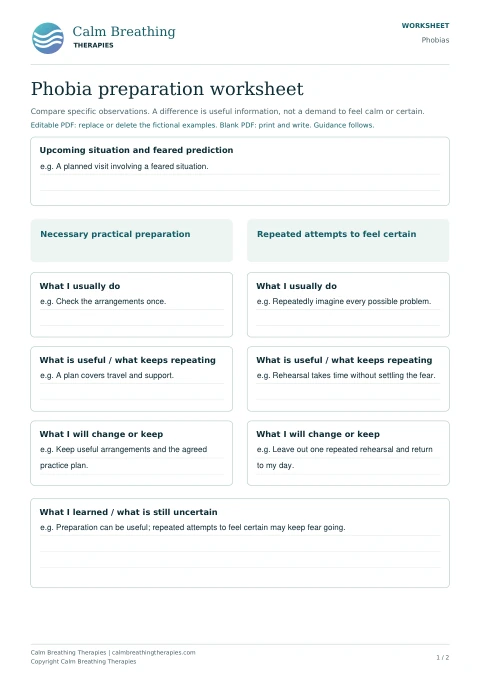
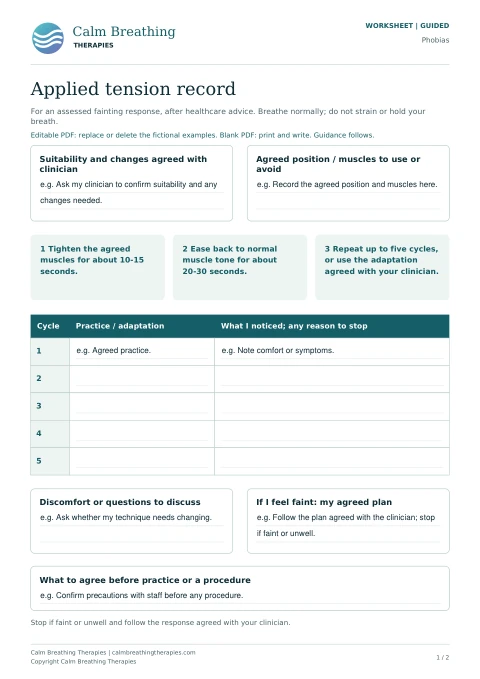
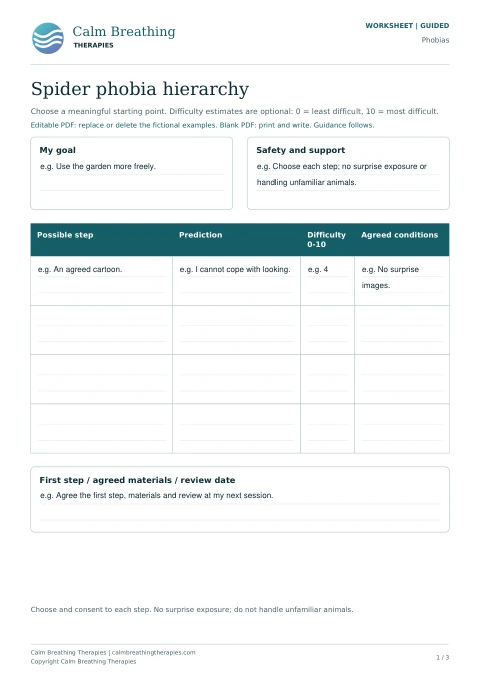
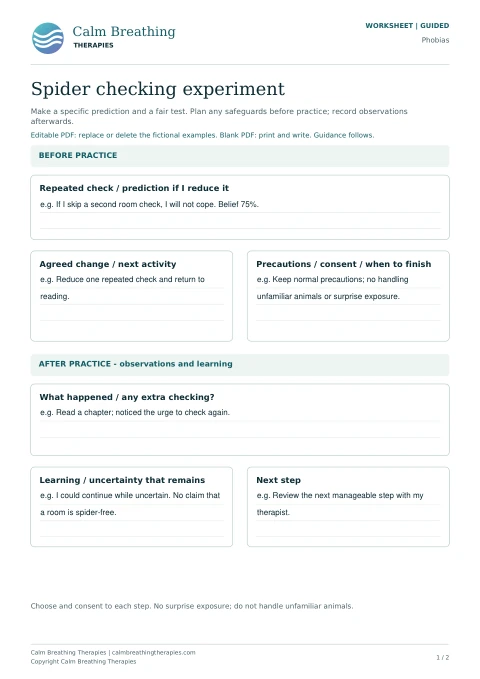
A phobia can shrink everyday choices: postponing a blood test, avoiding a room or planning a journey around a fear. Explore the full toolkit and guidance.

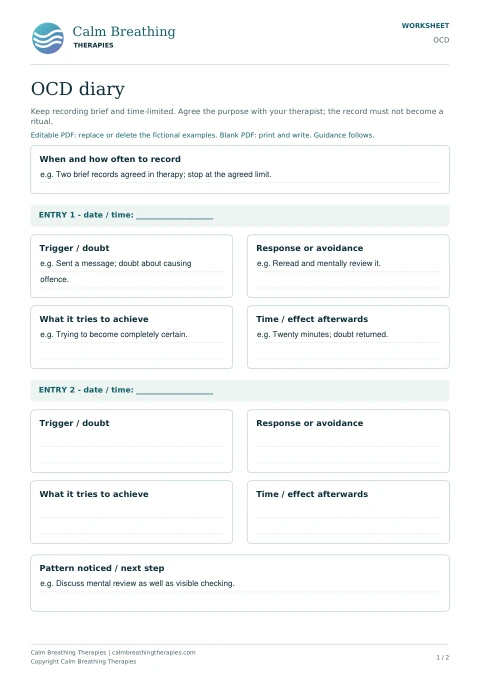
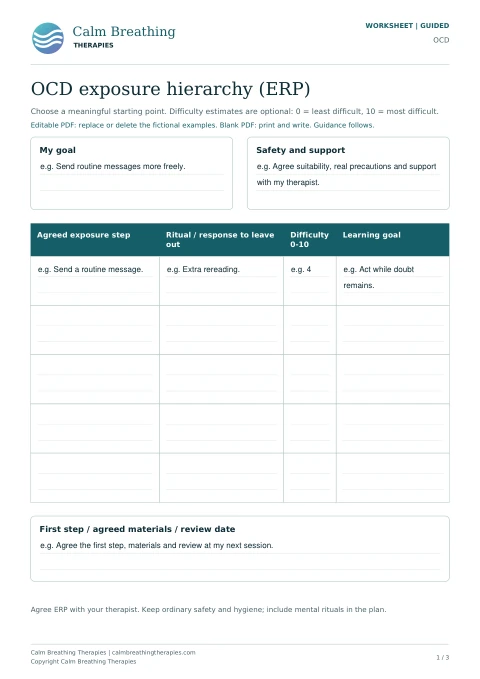
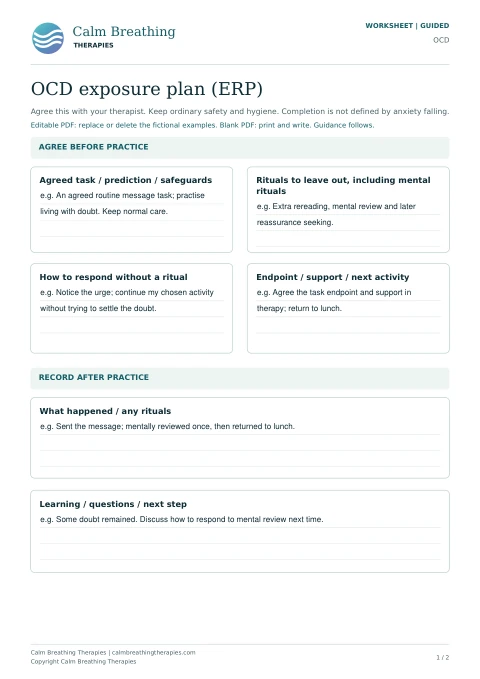
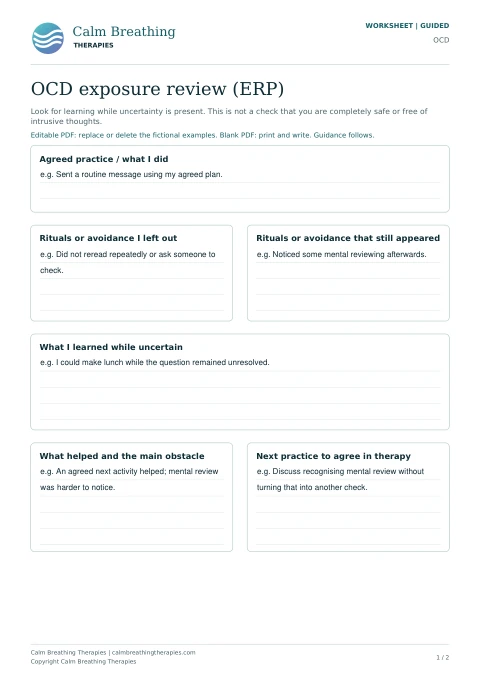
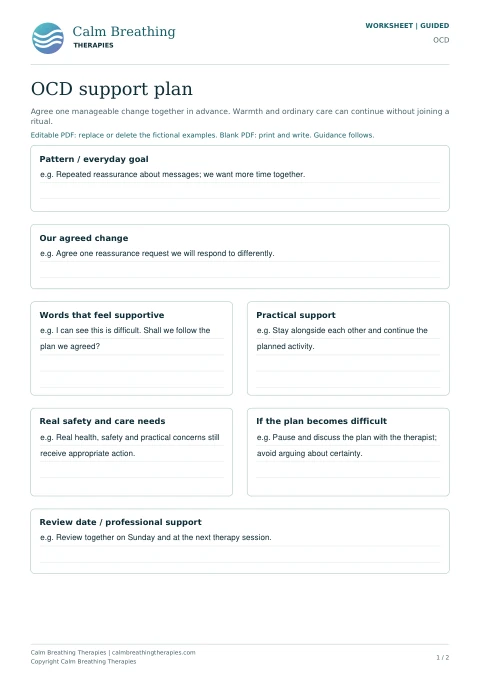
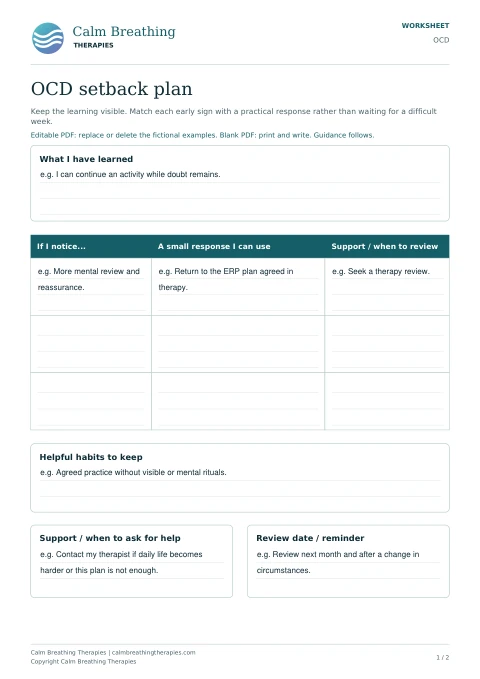
OCD7 worksheets

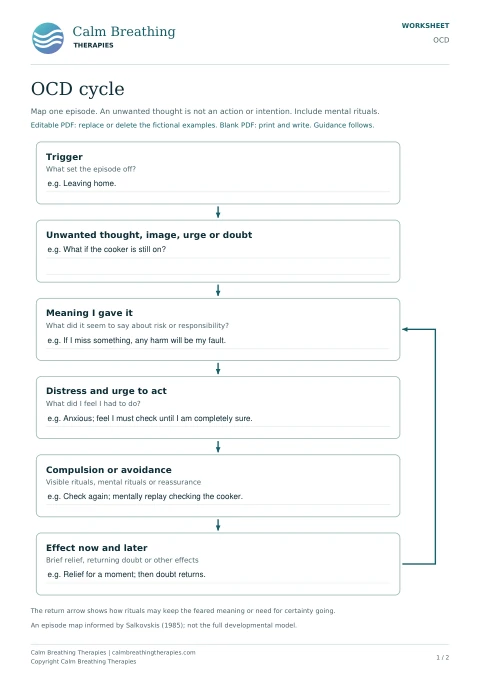
OCD can involve unwanted thoughts, images, urges or a feeling that something is unfinished, followed by actions intended to settle doubt. Explore the full toolkit and guidance.

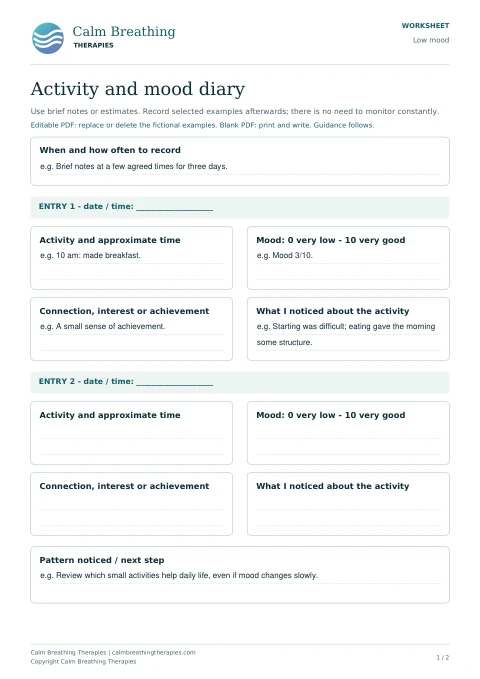
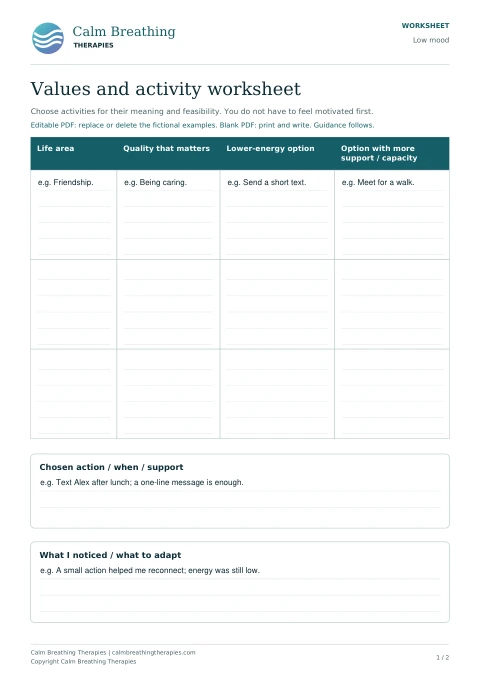
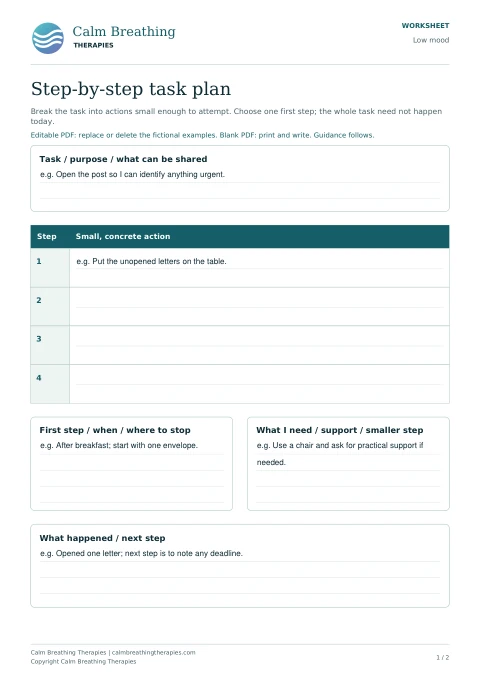
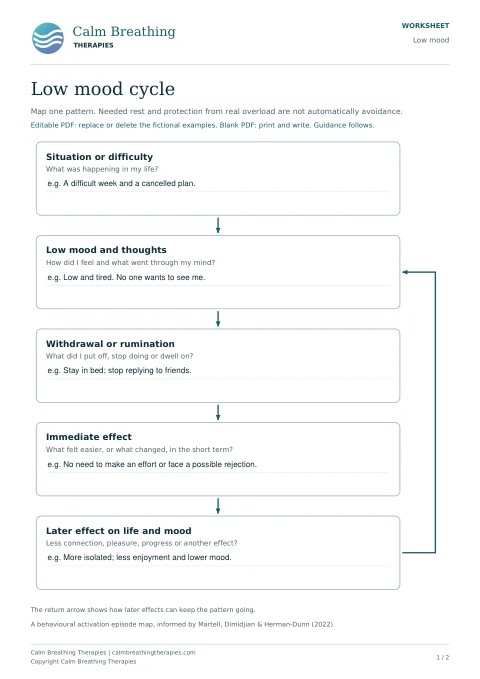
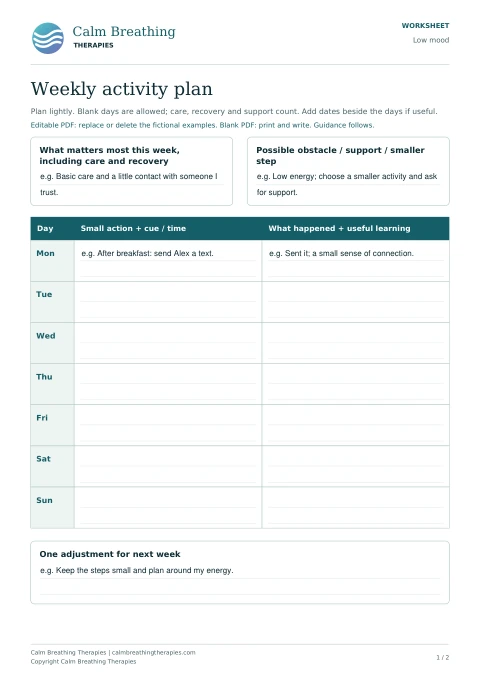
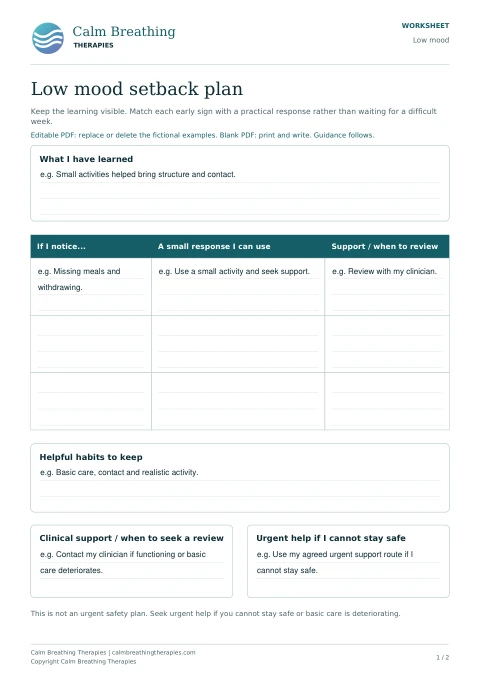
Depression & low mood7 worksheets

When mood and energy drop, it can become harder to do the things that bring connection, interest or a sense of accomplishment. Explore the full toolkit and guidance.

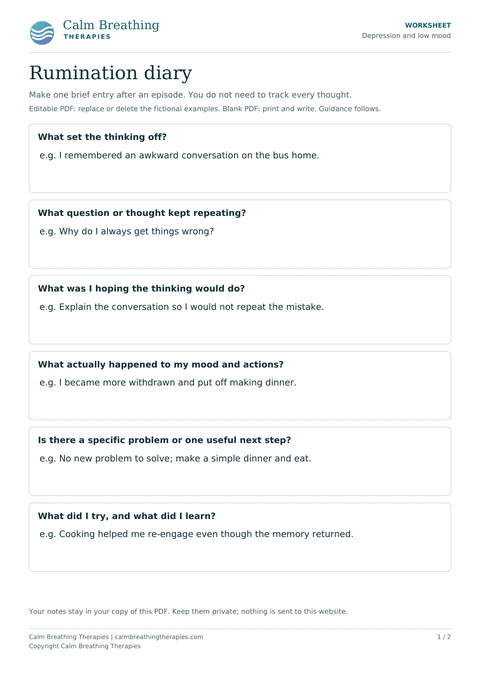
Rumination diary: six clear prompts with short editable fictional examples View worksheet
Free worksheet

Rumination diary

Notice repetitive thinking, its immediate effects and a practical way to re-engage. Distinguishes useful reflection from going over the same ground.

2 pages · A4 · Fillable PDF · 842 KB

Read the guidance and example

Rumination means repeatedly going over a difficulty, often with broad questions such as 'Why am I like this?' Reflection can be useful when it brings new understanding or a next step. This diary helps you notice when thinking has become stuck and try a more concrete response.

How to use it

  1. Notice the episode and make a short note afterwards, rather than monitor your mind continuously.
  2. Ask whether the thinking is producing new information, a decision or a specific action.
  3. If there is a practical problem, describe it in concrete terms and plan one step. If you are circling the same question, gently return to a chosen activity.
  4. Review whether the response helped you take part in life. Success does not require the thought to disappear.

In the editable PDF, replace or delete each fictional example. Your notes stay in your saved copy and are not sent to this website.

A fictional example

Omar spends the evening asking why he is falling behind. Each answer leads to another judgement. He changes the question to, 'What is one thing I need to do this evening?' He prepares tomorrow's lunch. The worry about falling behind returns, but he can notice it and continue. In therapy he later considers whether there is a practical workload issue to address.

Keep in mind

This is not an instruction to suppress thoughts, ignore grief or avoid a real problem. It is also not a substitute for trauma-focused work. If persistent low mood, intrusive memories or repetitive thinking seriously affects daily life, seek individual assessment and support.

Review your learning

Did I move towards a useful action, new understanding or something I value?

Sources informing this original worksheet: Watkins, E. R. (2008). Constructive and unconstructive repetitive thought. Psychological Bulletin, 134(2), 163-206. doi:10.1037/0033-2909.134.2.163.; NICE (2022). Depression in adults: treatment and management. NG222.. These sources do not endorse the resource.

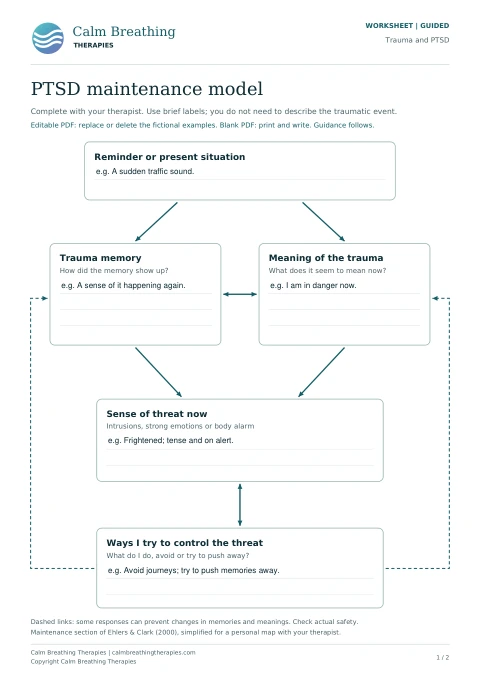
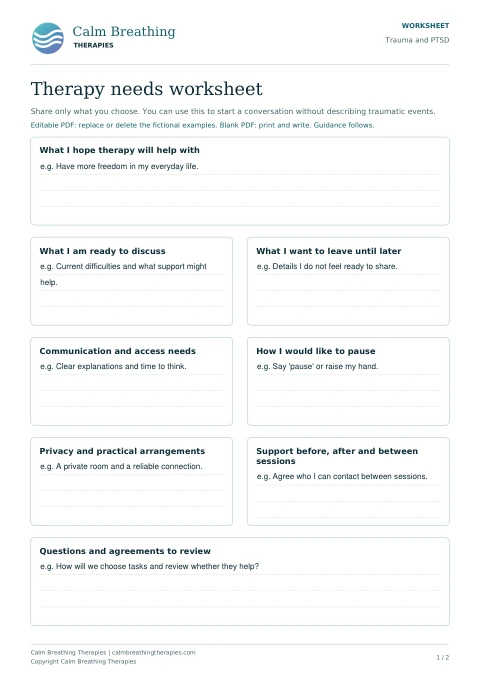
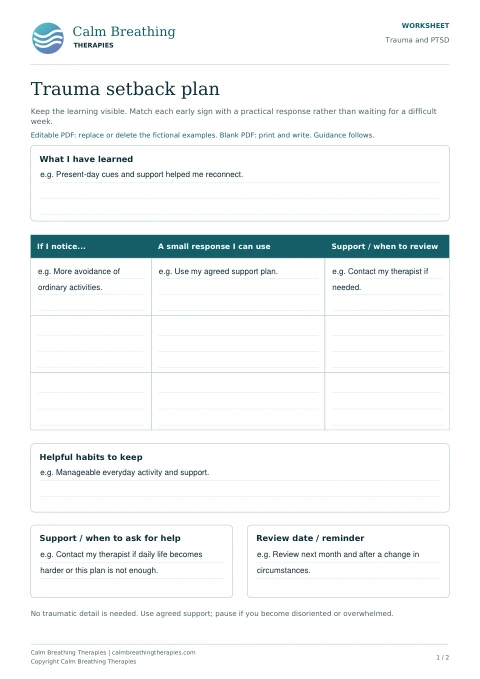
Trauma & PTSD7 worksheets

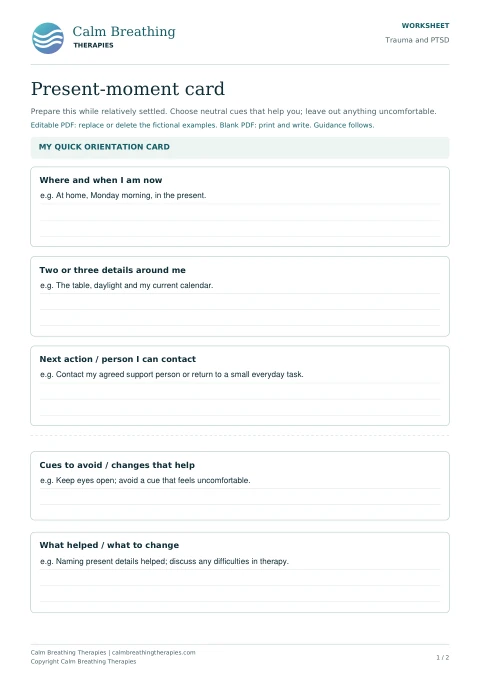
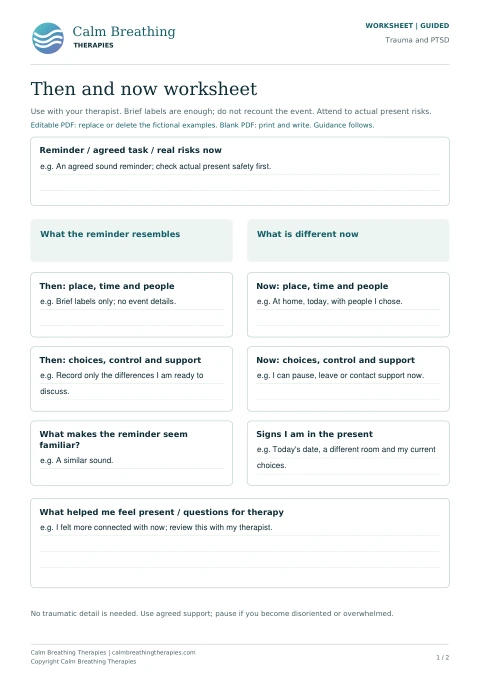
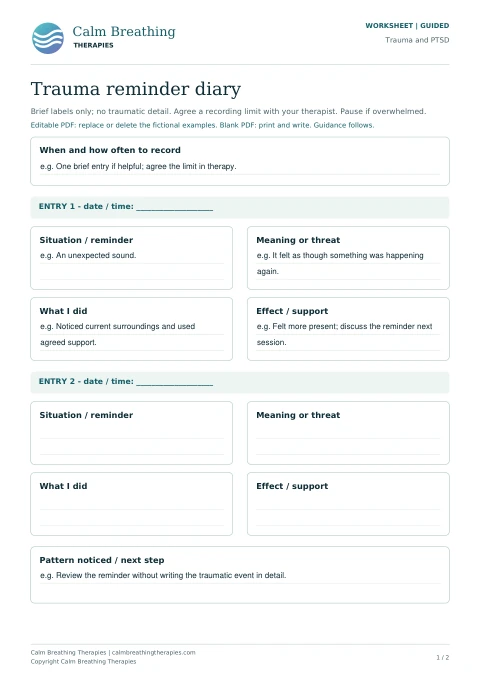
After trauma, reminders can feel as though the event is happening again, and ordinary life can become organised around avoiding threat. Explore the full toolkit and guidance.

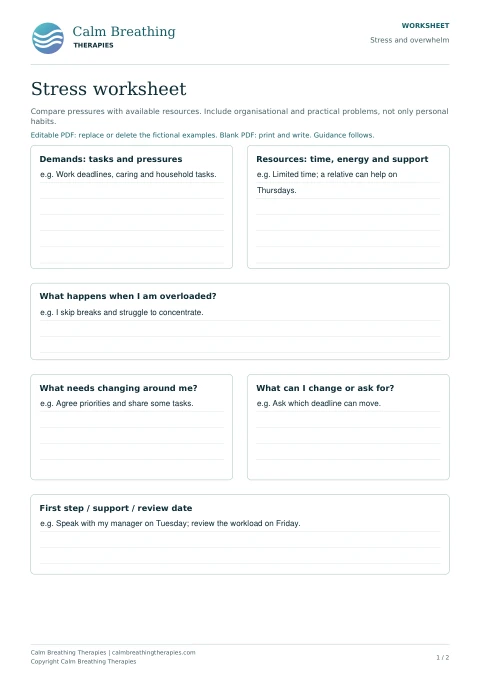
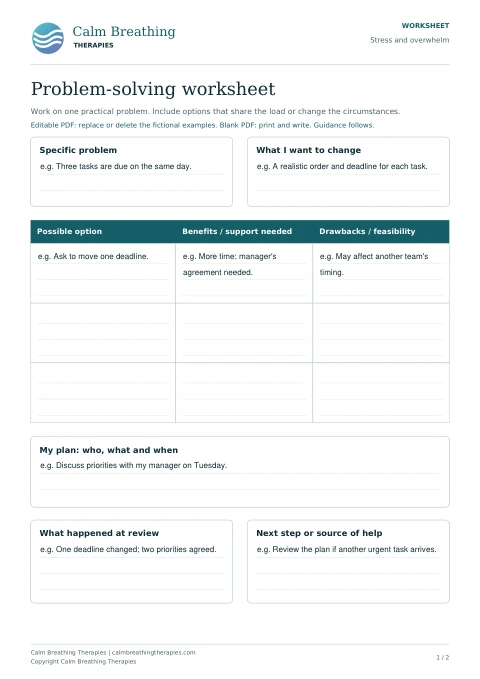
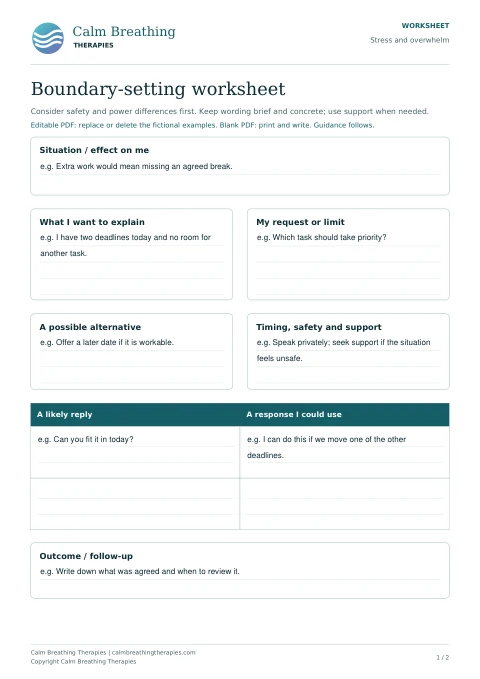
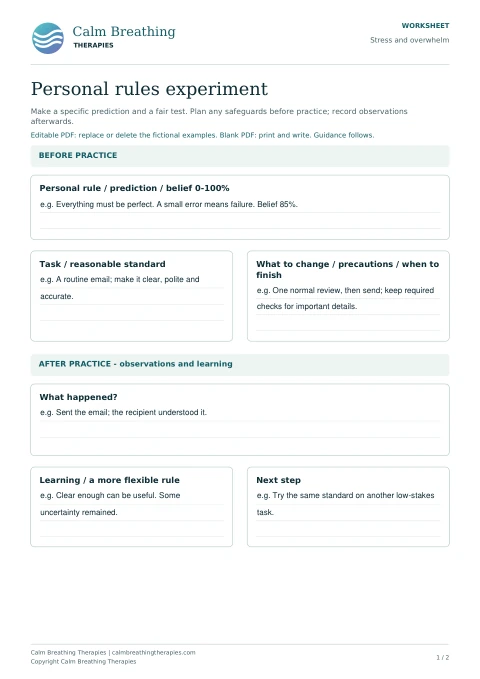
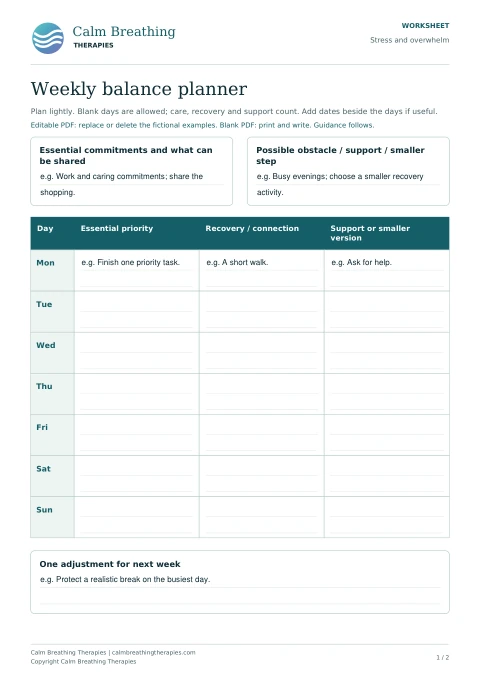
Stress & overwhelm6 worksheets

Stress often reflects real demands as well as the way you respond to them. Explore the full toolkit and guidance.

Choose what fits you

You do not need to work through everything. Start with understanding the difficulty, then choose one manageable task. Resources marked “Plan with a therapist” need individual guidance. These materials support learning and therapy; they do not provide a diagnosis or replace assessment.

For young people aged 16–17, tasks and support need adapting with a suitably trained therapist. These are not resources for children. For immediate or urgent concerns, use appropriate support rather than a worksheet: read the existing urgent-help information.

Print or type. The worksheet comes first in every individual PDF, with guidance afterwards. Choose “Editable PDF · examples” for a short fictional example in each box or first diary entry. Select the text to replace or delete it in a PDF reader, then save a private copy. Later diary entries and table rows are blank. Choose “Blank PDF · print” for writing by hand. Browser PDF viewers vary. The complete toolkits contain blank printable sheets.

Read online. Read step-by-step guidance, a fictional example and the worksheet prompts as HTML under “Read the guidance and example”. You can use those prompts in your own notes. Completed answers are not collected by this site.

How these resources connect with CBT

CBT looks at what keeps a difficulty going and chooses practical ways to change that pattern. Different problems call for different approaches. A worry diary explores worry and responses to uncertainty; panic work focuses on feared meanings of body sensations; exposure planning helps test a particular fear. Repeatedly challenging every thought is not the right task for everyone.

The resources include fictional worked examples, clear instructions and writing space. They draw on recognised models and guidance, with references in the PDFs and on each topic page. They are original materials, not copies of third-party worksheets. Read about the evidence, suitability and use of the library.

Worksheets can support between-session learning in online CBT therapy across the UK, including CBT by text or SMS when that format is appropriate. A therapist helps select and adapt tasks around your goals and circumstances.

Support when you want it

Sometimes it helps to work through it together.

These resources can be a useful starting point. If you are considering CBT, a FREE 5–10 minute consultation gives you space to discuss whether it might be suitable for you. There is no pressure to book.

Online CBT for people aged 16 and over across the UK. Suitability and the format of therapy are assessed individually.

Optional support

Found these resources helpful?

I've made these CBT resources freely available to help make practical psychological information more accessible.

If you've found them useful and would like to support the development of more free resources, you're welcome to make a small voluntary contribution.

There's absolutely no obligation, and all resources will remain free.

Make an optional contribution on Stripe (opens in a new tab)

The link also works if the embedded button does not load. Stripe handles payment securely; this website does not collect card details. Contributions support a private therapy business, not a registered charity, and are not Gift Aid donations. Contributing does not affect access to therapy or resources. About the Stripe button.

Worksheet preview

WhatsAppFree first call