OCD can involve unwanted thoughts, images, urges or a feeling that something is unfinished, followed by actions intended to settle doubt.
Download free CBT worksheets for OCD, including OCD cycle diagrams, diary templates and tools for recognising compulsions and mental rituals. ERP planning worksheets are designed for use with appropriate therapeutic guidance rather than unsupervised exposure.
Preview the actual templates below. Worksheets come first in every PDF, with guidance afterwards.
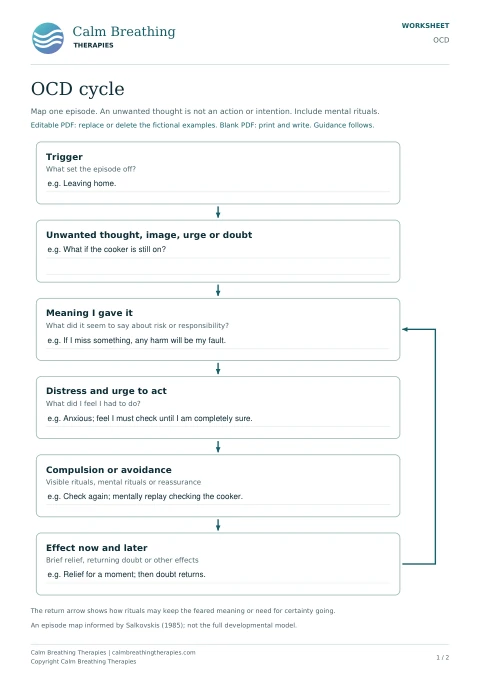
OCD is not defined simply by the topic of an unwanted thought. What you believe the thought means, and what you feel driven to do about it, matter too. Checking, seeking reassurance, repeating or mentally putting something right may bring relief but leave the demand for certainty intact. This map helps you and your therapist make sense of one recent episode. It is a starting point for assessment and planning, not a test of whether your thoughts are acceptable.
How to use it
Use a brief label for one trigger; no detailed disclosure is needed.
Add the unwanted thought, image, urge or doubt, then the meaning you gave it. A thought is not proof of risk or intention.
Describe distress and the urge to act, followed by compulsions or avoidance. Include mental reviewing and reassurance.
Write what changed immediately and later. Follow the return arrow: did relief fade or the need for certainty return?
Use the map with your therapist to choose a treatment focus. Avoid repeatedly completing it to prove you are safe or a good person.
A fictional worked example
After sending an ordinary email, Maya has the thought that she may have typed something offensive without noticing. She interprets the possibility as a responsibility to be completely certain. She rereads the message, remembers each sentence and asks her partner whether she is a considerate person. Relief lasts a few minutes before another doubt appears about an attachment. Her map shows that the repeated reviews offer short-term relief while making certainty feel increasingly necessary. The therapy question is how she can respond differently to the recurring doubt, not how to prove every future email can never contain a mistake.
Keep in mind
Keep descriptions brief and private. If completing the map becomes repeated checking or a search for reassurance, stop and discuss that pattern with your therapist. Ordinary unwanted thoughts occur outside OCD too; diagnosis and assessment require the wider clinical picture.
Worksheet prompts
Trigger: What set the episode off?
Unwanted thought, image, urge or doubt
Meaning I gave it: What did it seem to say about risk or responsibility?
Distress and urge to act: What did I feel I had to do?
Compulsion or avoidance: Visible rituals, mental rituals or reassurance
Effect now and later: Brief relief, returning doubt or other effects
Reflect
What response brings short relief but leaves me needing another round?
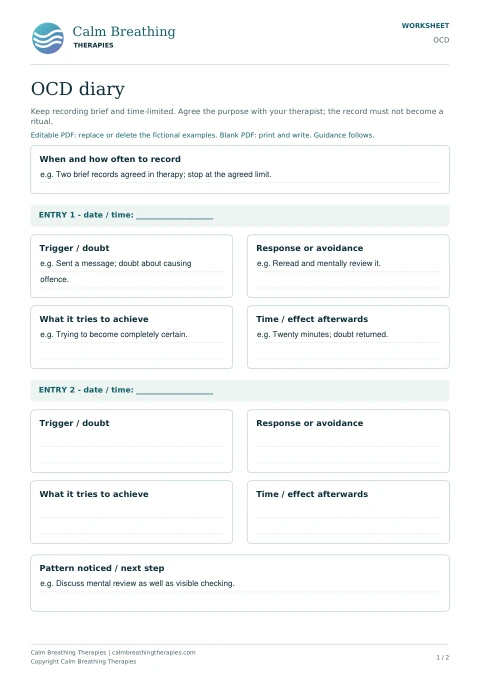
Some compulsions look like sensible checking from the outside; others are almost invisible. Their function can be to prevent a feared outcome, cancel a thought or achieve a particular feeling. This diary helps you notice that function and the impact on your day. It is not a request to count every thought. Agree a small sample with your therapist, such as one or two episodes, and use approximate notes rather than chasing a completely accurate record.
How to use it
Choose a short recording period and a small number of examples.
Note the trigger and what you felt you needed to make certain or put right.
Record the response, including reviewing, reassurance, online searching or avoidance.
Estimate time and the effect on ordinary activity; precision is unnecessary.
Review patterns once with your therapist and choose a possible treatment target.
A fictional worked example
Dev notices a recurring doubt after speaking to friends. Over two days he records two examples rather than every conversation. One involves twenty minutes of mentally checking his tone; another involves asking a friend whether he sounded rude and rereading the reply. Both responses are aimed at feeling certain he has not offended anyone. His estimates are rough, but they show that reassurance and mental review belong to the same pattern. He also notices missing the start of a film while reviewing. This gives treatment a concrete aim: returning attention to chosen activities without completing each certainty check.
Keep in mind
A diary can become a ritual if you repeatedly revise it, track every intrusion or ask others to confirm its accuracy. Keep it brief and use estimates. Do not stop necessary care, prescribed monitoring or ordinary safety checks solely because an item appears in the diary.
Worksheet prompts
When and how often to record
Trigger / doubt
Response or avoidance
What it tries to achieve
Time / effect afterwards
Pattern noticed / next step
Reflect
Which response is most connected to the life I want to reclaim?
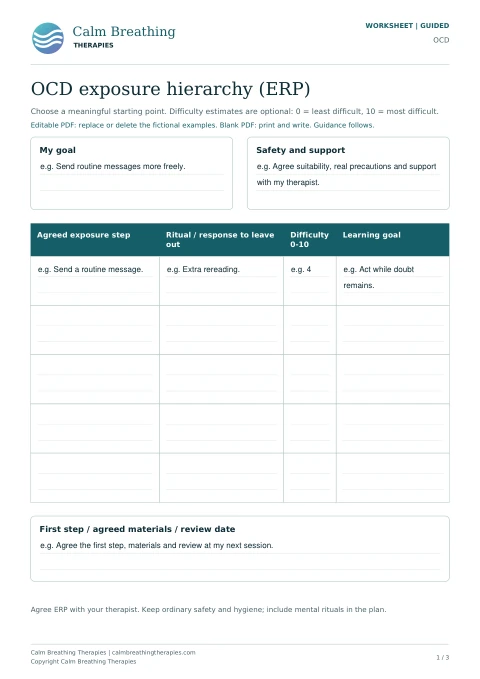
Exposure and response prevention means approaching an agreed trigger while practising a different response to the urge to carry out a ritual. A useful ladder describes actions clearly enough to try and review. Difficulty ratings help you choose a workable starting point; they are not a test of courage. Each step needs a learning goal and a plan for responding without a ritual. The ladder can change as you discover what keeps the problem going, including mental rituals, avoidance or demands to feel exactly right.
How to use it
With your therapist, choose one everyday goal that OCD restricts.
Define ordinary care and safety requirements before discussing exposure.
List a range of small, relevant steps with the compulsive response to leave out.
Estimate difficulty from 0-10 and note the learning each step could offer.
Agree a starting step, support and review point. Adjust the ladder as learning develops.
A fictional worked example
Priya wants to finish routine messages without repeated checking. With her therapist she distinguishes a normal practical check from repeated reviews aimed at feeling perfectly certain. Her first steps involve sending an ordinary non-sensitive message after the agreed routine check, then allowing uncertainty without rereading or mentally replaying it. Later steps involve slightly more important messages. They exclude medical instructions, financial transactions and safety-critical work from this starter ladder. Difficulty estimates help Priya choose a feasible beginning, but the main goal is to reclaim time from checking. She can revise the plan when an overlooked mental ritual becomes apparent.
Keep in mind
Plan ERP with a suitably trained therapist. Do not create genuine hazards, violate consent, compromise hygiene guidance or omit required safety checks. Examples are illustrative, not instructions for your situation. Choose manageable practice and agreed support; do not use overwhelming exposure to prove commitment.
Worksheet prompts
My goal
Safety and support
Agreed exposure step
Ritual / response to leave out
Difficulty 0-10
Learning goal
First step / agreed materials / review date
Chosen step / prediction
What I will look for
Habit to change / support to keep
When, where and agreed endpoint
What actually happened
Learning / next agreed step
Reflect
Does each step specify both what I approach and what compulsive response I practise leaving out?
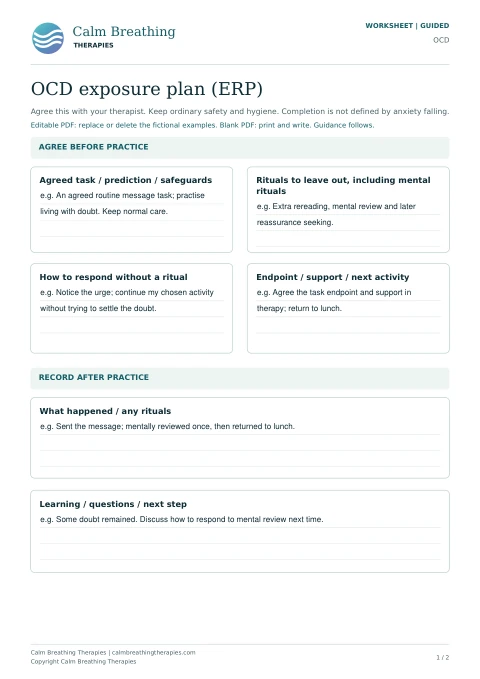
A clear ERP plan helps you face an agreed trigger without carrying out a ritual to try to cancel the thought or feeling. Before practice, identify what OCD asks you to do and how you will respond to that urge, including later checking or seeking reassurance. The aim is to learn that you can make choices while uncertainty or discomfort is present. Feeling calmer may happen, but it is not the only sign of useful practice and should not become a rule for deciding when you are allowed to finish.
How to use it
Agree a manageable exercise, its purpose and ordinary safety boundaries with your therapist.
Write the prediction or discomfort you are willing to make room for.
Identify visible rituals, mental rituals and delayed reassurance to leave out.
Agree a reasonable endpoint, support and what ordinary activity follows.
After practice, note what you did and learnt; review difficulties without punishment or restarting rules.
A fictional worked example
Ben's agreed practice is sending a routine reply without rereading it repeatedly afterwards. His therapist helps him include mentally reconstructing the message in the plan for responding without a ritual. He predicts he will be unable to work unless he checks. The endpoint is completing the agreed task and moving into his planned work period, rather than waiting until doubt reaches zero. During practice he starts mentally reviewing, notices and redirects to his work without beginning the whole exercise again. Doubt remains, but he completes part of his task. He records that continuing was possible while unsettled and plans to discuss the hidden review at his next session.
Keep in mind
Use only exercises agreed as suitable in treatment. Maintain required medical care, medication, safety procedures and safeguarding. Seek guidance if you cannot distinguish a ritual from necessary action. This sheet does not assess intent or risk and should never be used to dismiss new safety concerns.
Worksheet prompts
Agreed task / prediction / safeguards
Rituals to leave out, including mental rituals
How to respond without a ritual
Endpoint / support / next activity
What happened / any rituals
Learning / questions / next step
Reflect
What did I learn about choosing an action while leaving some doubt unresolved?
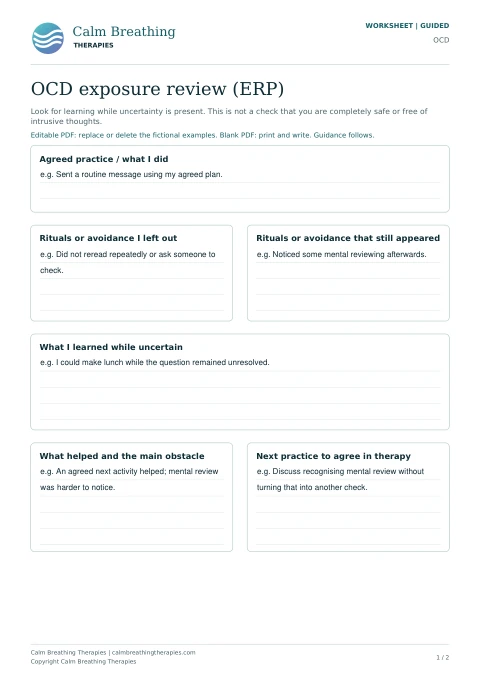
After ERP practice, it is easy to judge success by whether you felt calm or became sure that nothing bad could happen. A learning review asks different questions: what did you approach, which responses did you change and what did you discover about continuing with uncertainty? This worksheet helps you identify useful progress and practical adjustments. If a ritual occurred, record it without blame. The next step is to understand what happened, not to repeat the exercise until it feels perfectly completed.
How to use it
Record the agreed practice and the choice you managed to make.
Notice visible and mental rituals, reassurance or avoidance. Do not turn the review into another check.
Describe learning about discomfort, uncertainty and valued activity.
Identify one obstacle and a manageable adjustment with your therapist.
Choose the next practice or repeat for learning, rather than to erase doubt about this attempt.
A fictional worked example
Lena practised leaving a harmless item slightly out of her preferred alignment while preparing lunch. She left it in place, but later recognised repeating a phrase silently until it felt safer. Her first judgement was that the whole attempt was wasted. In review, she notes that she stayed with an ordinary task while uncomfortable and identified a previously hidden ritual. She and her therapist agree to make that ritual explicit in the next plan and keep the starting step manageable. They do not require her to redo the session that evening until it feels right. The review ends with one clear learning point and a next step.
Keep in mind
Review at an agreed time and keep notes brief. Repeatedly rating, analysing or asking whether practice was 'correct' may become another compulsion. Discuss persistent distress, new rituals or increasing avoidance with your therapist; adjust the plan and support rather than escalating intensity on your own.
Worksheet prompts
Agreed practice / what I did
Rituals or avoidance I left out
Rituals or avoidance that still appeared
What I learned while uncertain
What helped and the main obstacle
Next practice to agree in therapy
Reflect
What useful learning remains, even if this practice did not feel complete or calm?
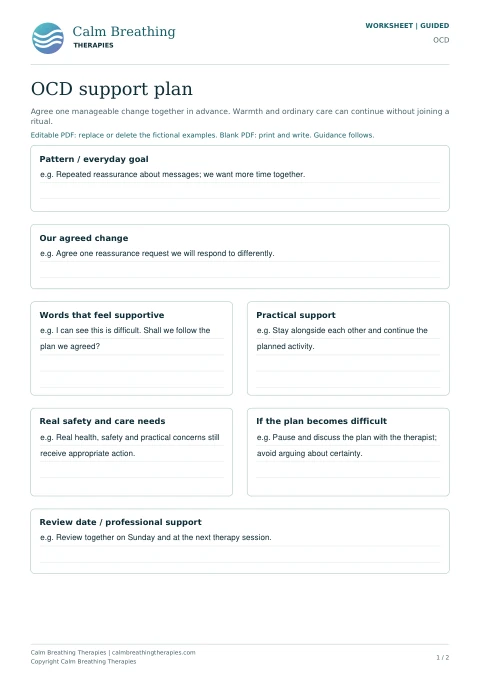
When someone you care about is distressed, reassurance is an understandable response. In OCD, repeated answers or helping with rituals can become part of the cycle even when everyone is trying to help. This sheet supports a conversation with the person and, where possible, their therapist. It identifies one pattern to change gradually and the emotional or practical support that will remain. The aim is collaboration, not withholding affection, dismissing distress or suddenly refusing every request for help.
How to use it
Discuss the plan at a settled time, with the person’s agreement.
Identify one repeated reassurance request or ritual supporters are drawn into.
Agree a small change, compassionate wording and alternative support.
Clarify genuine safety concerns and practical information that still need a response.
Choose a review date and discuss difficulties without blame, threats or surprise exposure.
A fictional worked example
Tom repeatedly asks his sister to confirm that a routine message did not offend someone. Together with his therapist, they agree to reduce this repeated checking in one specific situation. His sister will say, 'I can hear this is difficult. We agreed I would help you stay with your plan rather than review the message again. Shall we make tea together?' They agree that she will still discuss actual conflicts and new practical information. The plan starts during a manageable week and includes a review. It does not make his sister responsible for policing rituals or require her to manage distress alone.
Keep in mind
Supporters must not force exposure, hide reassurance as a test, punish rituals or withhold essential care. Agree boundaries and seek professional help if conflict or distress rises. For young people, plans need developmentally appropriate consent, family involvement and safeguarding rather than an adult plan applied unchanged.
Worksheet prompts
Pattern / everyday goal
Our agreed change
Words that feel supportive
Practical support
Real safety and care needs
If the plan becomes difficult
Review date / professional support
Reflect
How can we remain warm and connected without repeatedly answering the same certainty question?
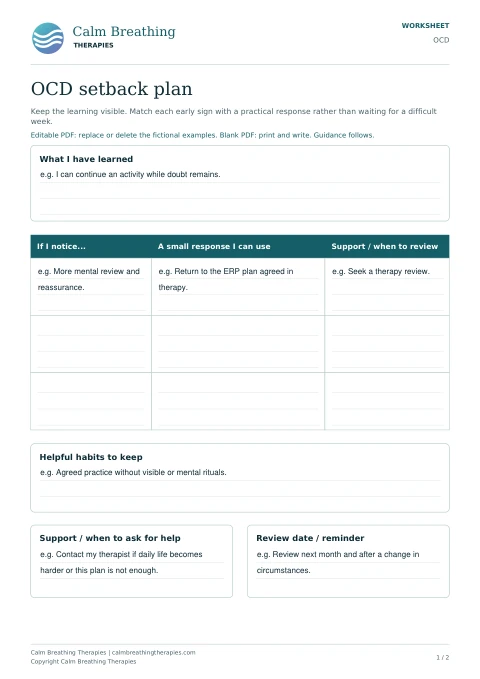
OCD can change themes or return more strongly during stress, illness or change. A maintenance plan focuses on the response pattern rather than memorising reassurance about a particular fear. Use this sheet to record the choices that helped you reclaim time, the early signs that rituals are growing and how to restart manageable practice. Progress does not depend on never having intrusive thoughts again. It involves more freedom to choose what you do when doubt, discomfort or an unfinished feeling appears.
How to use it
Describe meaningful changes in daily life and the learning behind them.
List early signs: more reassurance, mental reviews, avoidance or rules.
Write a manageable response using skills already agreed in therapy.
Identify pressures that may need practical help, rest or treatment review.
Record who to contact and when; keep medical treatment changes with your prescriber.
A fictional worked example
After a period of improvement, Aisha notices that her checking has moved from household tasks to reviewing conversations. Rather than concluding she has a completely new problem, she recognises the familiar demand to feel certain. Her plan is to describe the new pattern briefly, return to the response-prevention principles learnt in therapy and seek a review if it continues to expand. She also arranges practical support during a stressful move. Her goal is to spend evenings with her family rather than review every conversation. She keeps ordinary responsibilities and any prescribed treatment in place, and avoids making the plan itself a reassurance ritual.
Keep in mind
A setback plan is not a substitute for reassessment when symptoms change or functioning deteriorates. Seek support promptly if rituals interfere with basic care, nutrition, sleep or essential responsibilities. Do not reduce medication or disregard genuine health and safety needs as a way of demonstrating progress.
Worksheet prompts
What I have learned
If I notice...
A small response I can use
Support / when to review
Helpful habits to keep
Support / when to ask for help
Review date / reminder
Reflect
What pattern needs my attention, rather than another attempt to settle the thought’s content?
Print or type. The worksheet comes first in every individual PDF, with guidance afterwards. Choose “Editable PDF · examples” for a short fictional example in each box or first diary entry. Select the text to replace or delete it in a PDF reader, then save a private copy. Later diary entries and table rows are blank. Choose “Blank PDF · print” for writing by hand. Browser PDF viewers vary. The complete toolkits contain blank printable sheets.
Read online. Read step-by-step guidance, a fictional example and the worksheet prompts as HTML under “Read the guidance and example”. You can use those prompts in your own notes. Completed answers are not collected by this site.
How to use these OCD and ERP worksheets
OCD can involve unwanted thoughts, images, urges or a feeling that something is unfinished, followed by actions intended to settle doubt. Some compulsions are visible; others happen silently through reviewing, counting or checking feelings. This toolkit helps you describe the pattern and prepare for CBT that includes exposure and response prevention (ERP). The aim is greater freedom from rituals, not absolute certainty about every thought. The ERP planning sheets are for work agreed with a suitably trained therapist. They do not provide a list of exposures everyone should attempt or ask you to abandon ordinary health and safety measures.
Begin with the cycle map and a short ritual diary. Note the purpose of a response: repeated reassurance, mental checking or a private rule can function like a visible compulsion. You do not need a perfect inventory or graphic descriptions of intrusive thoughts. A brief, agreed record is usually more useful than monitoring every thought or checking whether you completed the worksheet correctly.
Build an ERP ladder with your therapist around situations that matter in everyday life. Specify both the trigger and the response you will practise leaving out, including mental neutralising and delayed checking. Keep normal hygiene, medical care, workplace procedures and safeguarding responsibilities. A hierarchy is a collaborative planning aid, not a contract to complete every step or a demand for overwhelming distress.
Review what you learnt about responding to uncertainty, rather than whether you achieved certainty or made anxiety disappear. The supporter worksheet helps someone offer warmth without being pulled into repeated reassurance, through a plan agreed in advance. Use the keeping-progress plan to notice new rituals and return to a manageable next step. If treatment is not helping, review the formulation and level of support.
Suitability and support
ERP can be demanding and must fit an individual assessment. Use the guided sheets with a suitably trained clinician, especially with severe symptoms, complex needs or uncertainty about risk. Intrusive thoughts alone do not establish a diagnosis or determine risk. These adult-oriented materials need developmental adaptation for ages 16-17, with appropriate family involvement and safeguarding. Never change prescribed medication or required medical monitoring as an exposure.
Cognitive-behavioural understanding of OCD informed by Salkovskis (1985), combined with exposure and response prevention as recommended in NICE CG31. The focus is on meanings, responsibility, uncertainty, rituals, avoidance and how short-term relief can maintain the cycle.
Original materials for Calm Breathing Therapies. The cited organisations do not endorse these worksheets. Evidence, use and limitations · Version 3.0 · 26 October 2026.
Support when you want it
Sometimes it helps to work through it together.
These resources can be a useful starting point. If you are considering CBT, a FREE 5–10 minute consultation gives you space to discuss whether it might be suitable for you. There is no pressure to book.
Online CBT for people aged 16 and over across the UK. Suitability and the format of therapy are assessed individually. You can also read about how CBT for OCD works.

 View worksheet