
Online CBT for social anxiety
You may worry about being judged, hold back in conversations or spend hours replaying what you said.
Ask about a free first call Watch my short video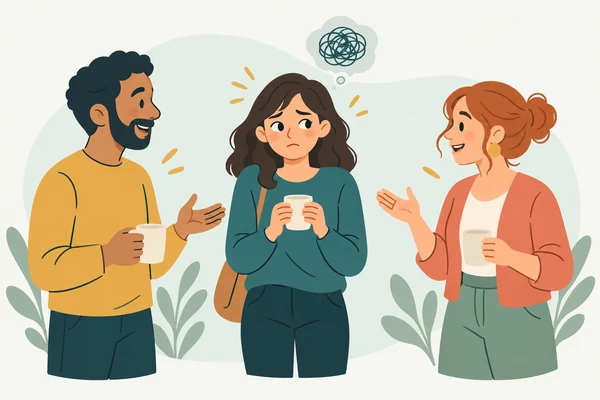
What you might notice
Social anxiety involves fear of being negatively judged, embarrassed or rejected. It can affect conversations, meetings, eating in public or everyday interactions. You might rehearse what to say, monitor how you look or sound, avoid situations, or replay them afterwards.
How CBT can help
CBT looks at the predictions and self-focused attention that maintain this cycle. We plan experiments to test what you fear, practise directing attention towards the situation, and gradually reduce habits used to hide anxiety. We also work on the critical replay that can follow a social event.

What could progress look like for you?
Take part more freely in conversations or situations, with less time spent monitoring yourself or reviewing mistakes. We’ll choose goals that are meaningful to you and review how the work is going.
General information, not a diagnosis. Your experience and goals guide our assessment and the plan we agree together.
Further reading and sourcesSocial anxiety: bring attention back to the conversation
When you are busy checking how you look or sound, it can be harder to take part in the conversation. In this video, I explain a small shift in attention you can practise.
Try listening to the person’s words and allowing an ordinary reply. You can join in even if you still feel a little anxious.
Read the key points
The video explores checking your face, hands and words during conversations. It invites you to return attention to what the other person is saying and take part without aiming for a perfect response.
How the cycle can keep going
This example shows one way the pattern can be maintained. Your own triggers and responses may look different.

Read the cycle step by step
- Trigger: Joining a group conversation
- Meaning: They’ll notice my anxiety and think badly of me.
- Feelings and attention: Anxiety and self-monitoring; words feel harder to find.
- Response: Keep quiet, rehearse replies or avoid eye contact.
- What keeps it going: Replay perceived mistakes; fear of judgement grows.
The short-term response can make the pattern more likely to repeat. This is an illustration, not a diagnosis or an individual formulation.
The things we do to feel safer
Some habits help us feel more in control, but can also stop us discovering how we would cope without them. In this video, I introduce safety behaviours and why noticing them is a useful first step.
For social anxiety, this might mean rehearsing every sentence or avoiding eye contact. We can explore your own pattern together, without asking you to change everything at once.
Watch on TikTok (opens in a new tab)Social anxiety: pauses in conversation
A pause can feel much longer when you are anxious. Notice the pressure to fill every silence.
A few seconds of silence can bring thoughts such as “They think I am boring” or “I need to say something”. Try listening to the other person rather than monitoring yourself. An ordinary pause does not need rescuing; you can let the conversation have some space.
Browse this and the other free CBT videosWhich conversations or situations would you like to feel more able to take part in?
A free 5–10 minute consultation is a chance to talk about what you need and whether we could work well together.
Request a callback