Social anxiety can pull your attention towards how you think you look, sound or come across.
Find free CBT self-help worksheets for social anxiety, including tools to notice anxious predictions, self-focused attention and safety behaviours. Download fillable templates and plan small, considered changes at your own pace.
Preview the actual templates below. Worksheets come first in every PDF, with guidance afterwards.
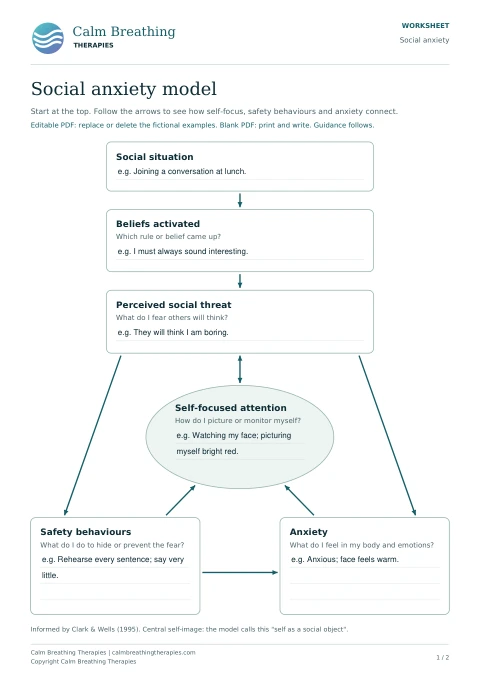
This worksheet follows the main relationships in Clark and Wells’ cognitive model of social anxiety. A social situation can bring up rules or beliefs, which shape a feared judgement. Attention then turns towards how you imagine you look to others. Anxiety and attempts to hide or prevent it can strengthen that self-image. The central oval is called "self as a social object" in the model: experiencing yourself as you imagine others see you, rather than relying on what you can observe.
How to use it
Start at the top with one recent, manageable social situation.
Add a rule or belief it brought up, such as "I must always sound interesting". Then write the judgement you feared.
In the centre, describe what you watched or pictured about yourself. This imagined view is not proof of how others saw you.
In the lower boxes, name anxiety and what you did to hide it or prevent judgement. These actions are called safety behaviours.
Follow each arrow and discuss whether the link fits. Safety behaviours can increase anxiety, while feelings and behaviour can feed your self-image. Anticipatory worry and replay afterwards can also matter; use the separate planning or post-event review sheet if helpful.
A fictional worked example
At a team lunch, Nia thinks, "I must always sound interesting." She fears colleagues will find her boring. She pictures herself bright red and watches her face for heat. To avoid saying the wrong thing, she rehearses sentences and says little. This makes joining in harder and can increase anxiety. The warm feeling and her silence then seem to confirm the picture of looking awkward. Her therapist helps her compare this impression with observable evidence, and plan a suitable attention and safety-behaviour experiment.
Keep in mind
Include real context. Bullying, racism, exclusion or an inaccessible setting may need practical action and support. Do not label necessary communication aids or chosen boundaries as safety behaviours. If this map feels overwhelming, complete it with a therapist rather than reconstructing every interaction.
Worksheet prompts
Social situation
Beliefs activated: Which rule or belief came up?
Perceived social threat: What do I fear others will think?
Self-focused attention: How do I picture or monitor myself?
Safety behaviours: What do I do to hide or prevent the fear?
Anxiety: What do I feel in my body and emotions?
Reflect
Which connection in my cycle gives me a practical question to test?
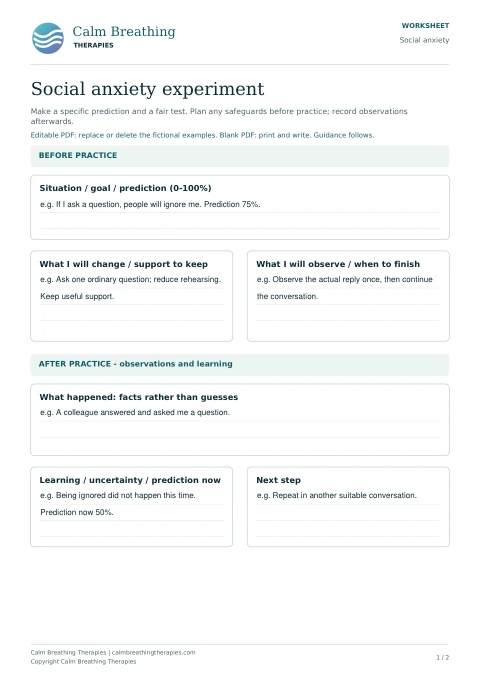
A thought such as 'Everyone will think I am awkward' is difficult to test because you cannot read minds. A behavioural experiment narrows it to something observable and explores what happens when you change a habit that keeps anxiety going. The purpose is learning, not earning a perfect reaction. An ordinary pause or a mixed response can still help you find out whether you can participate and respond flexibly without all your usual precautions.
How to use it
Choose a safe interaction connected to something you want to do.
Specify an observable prediction and estimate its likelihood from 0-100%.
Choose one anxiety-related precaution to reduce, keeping genuine safety and communication needs.
Agree what you will observe, then take part without repeatedly checking your performance.
Record facts, any uncertainty and a practical next test. Re-rate the original prediction.
A fictional worked example
Owen predicts an 80% chance that asking a question in a small training group will make people laugh and the trainer dismiss him. He usually keeps quiet or apologises repeatedly. He plans to ask one relevant question without a long apology, then listen to the answer. The trainer answers; another person says they were wondering the same thing. Owen still feels hot and notices one person looking away, whose reason he does not know. He records both facts rather than guessing. He lowers his prediction to 40% and plans another question at the next session, allowing for different responses.
Keep in mind
Choose ordinary, respectful interactions. Do not disclose private information, break workplace rules or deliberately provoke people to test a belief. Keep disability accommodations. If the situation involves harassment, coercion or significant risk, discuss support and protection rather than treating it as an experiment.
Worksheet prompts
Situation / goal / prediction (0-100%)
What I will change / support to keep
What I will observe / when to finish
What happened: facts rather than guesses
Learning / uncertainty / prediction now
Next step
Reflect
What did I learn about taking part, even if I could not know what everyone thought?
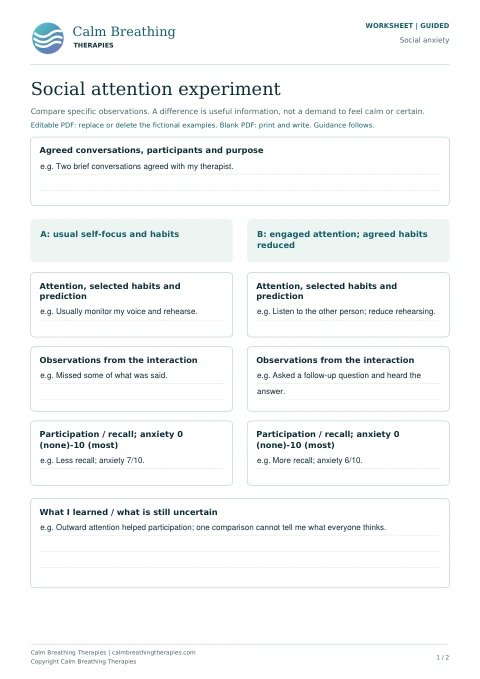
Social anxiety can make you watch yourself while also trying to prevent signs of nervousness. This can use attention that would otherwise help you connect with the situation. A guided comparison lets you experience whether these strategies help or get in the way. You and your therapist plan two brief, similar interactions, changing attention and selected safety behaviours. The comparison explores their combined effect; it does not prove that any one habit causes all your anxiety.
How to use it
Agree two brief, similar conversations with your therapist and a willing participant.
Identify your usual self-focus and one or two safety behaviours. Predict their effects.
In the first interaction, notice the usual pattern without intensifying distress.
In the second, engage with the speaker and reduce the agreed habits. Do not force eye contact.
Compare engagement, what you remember and observable responses; discuss limitations and further practice.
A fictional worked example
With her therapist, Sara has two short chats about everyday interests with a consenting colleague. In the first she notices monitoring her voice and preparing each answer before the question ends. In the second she listens for the other person's meaning and allows a less rehearsed reply. She feels some nerves in both, but remembers more of the second conversation and asks a follow-up question. Her therapist helps her distinguish these observations from a new rule that she must focus outward perfectly. They note that the two conversations were not identical and agree to practise flexibly in another familiar setting.
Keep in mind
Use this as a therapist-guided exercise. Do not deliberately increase self-consciousness for a prolonged period or remove genuine access needs. Agree the participants and boundaries in advance. If the comparison becomes a performance test or causes marked distress, pause and review the method together.
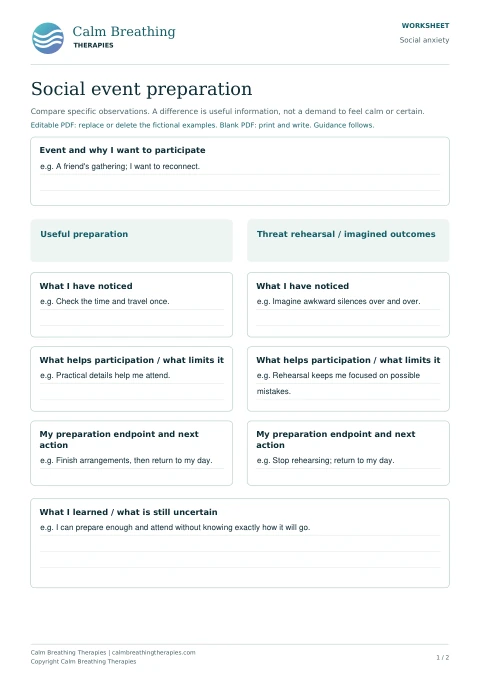
Before a social event, planning can turn into repeatedly imagining mistakes, scanning old memories or trying to script every possible exchange. This often leaves you more preoccupied when the event arrives. This worksheet separates preparation with a clear purpose from anxious rehearsal that offers no new information. You will identify what you actually need, make room for uncertainty and choose one way to participate. The aim is enough preparation for the task, not a rule against preparing.
How to use it
Name the event and one personally meaningful reason for taking part.
List practical tasks with a clear finish, such as checking the time or preparing required notes.
Notice repeated rehearsals, imagined disasters and old memories that are not adding useful information.
Choose one modest participation intention and where to place attention when replay starts.
Afterwards, record what helped and what needs adjusting, without a lengthy performance review.
A fictional worked example
Before a friend's birthday meal, Imran spends an hour rehearsing how to explain his job. His useful preparation is knowing the venue, travel plan and any access arrangements. He completes those tasks, then notices that another imagined conversation is making him less available to the present. His intention is to ask one friend how their new job is going and listen to the answer. He allows a little uncertainty about what he will say next. At the meal there are pauses, but also a conversation about football. Afterwards he notes that repeated rehearsal was not necessary for every exchange to happen.
Keep in mind
Some events genuinely require rehearsal or advance information, and some people need predictability or communication support. Keep those needs in the plan. This is about reducing repetitive threat rehearsal, not attending unsafe events or forcing yourself into contact you do not want.
Worksheet prompts
Event and why I want to participate
What I have noticed
What helps participation / what limits it
My preparation endpoint and next action
What I learned / what is still uncertain
Reflect
What counted as useful preparation, and where did preparation stop helping?
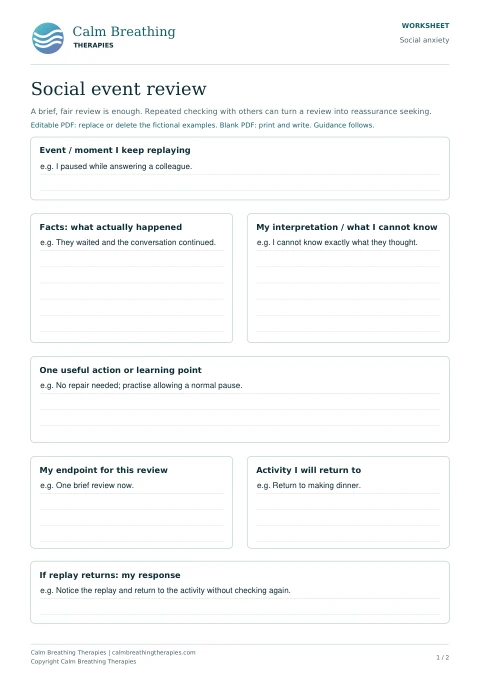
After a conversation, your mind may replay a few uncomfortable moments while leaving out everything ordinary. The replay can feel like problem solving even when it produces no new action. This worksheet provides a short review with a clear endpoint. It helps you include observable information, recognise what remains unknown and decide whether anything needs doing. You are not trying to establish that the interaction was flawless or prevent every unwanted memory from returning.
How to use it
Choose one interaction and allow a brief review at a planned time.
Write what a camera or listener could have observed, separately from your interpretation.
Include the whole interaction, not only the moment that felt awkward.
Identify one useful action, if needed; otherwise leave uncertainty unresolved.
Close the review and return to a chosen activity when the replay reappears.
A fictional worked example
After giving an update, Beth repeatedly remembers losing her place. Her first conclusion is that the whole meeting was a disaster. In a brief review she records that she paused, checked one note, continued and answered a question. Nobody commented on the pause; this does not reveal everyone's private opinion. One useful action is to organise her notes more clearly next time. She then returns to cooking rather than asking colleagues several times whether she sounded foolish. The replay comes back while she washes up. She recognises it as the same review, lets it be there and continues with the task.
Keep in mind
Do not use the sheet to repeatedly prove that people approved of you. If there was a genuine mistake or hurtful behaviour, a proportionate repair may help. Ongoing bullying or discrimination requires support; it should not be dismissed as an anxious interpretation.
Worksheet prompts
Event / moment I keep replaying
Facts: what actually happened
My interpretation / what I cannot know
One useful action or learning point
My endpoint for this review
Activity I will return to
If replay returns: my response
Reflect
Has this review produced a useful action, or am I being pulled into the same question again?
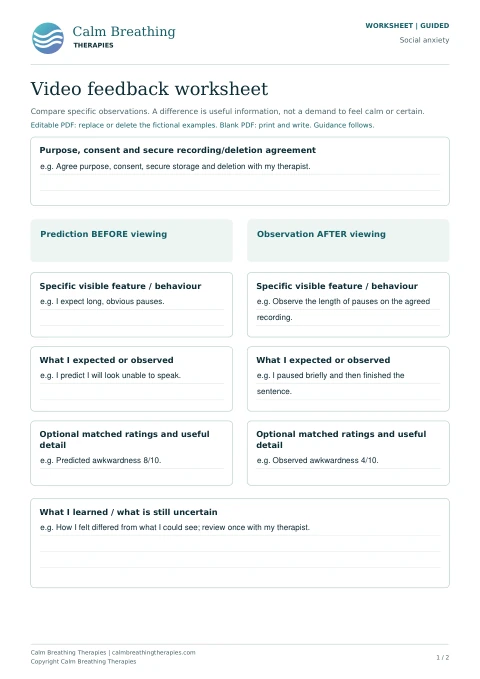
Feeling visibly anxious and appearing that way are not always the same. Carefully prepared video feedback can help you compare a feared impression with observable evidence. This sheet supports a therapist-led exercise; watching yourself without preparation can instead trigger criticism and checking. Agree exactly what question the recording should answer, ensure the relevant features can be seen or heard and view the interaction fairly. The exercise is about social predictions, not evaluating your attractiveness or producing a polished performance.
How to use it
Agree the clinical purpose, participants, consent, storage and deletion plan before recording.
Describe the specific feared impression and what you predict the recording will show.
Check that the recording could capture the feature being tested, without intrusive close-ups.
View with your therapist, attending to the whole interaction as you would to another person.
Compare prediction and observations, discuss feelings-versus-evidence, then agree how to use the learning.
A fictional worked example
With consent, Ali and his therapist record a brief practice conversation. He predicts that his voice will be inaudible for most of it and that every pause will seem very long. They check the sound before beginning and agree to delete the recording after the planned review. Before watching, Ali describes the predicted pattern. With guidance, he watches the whole exchange rather than searching frame by frame for flaws. His voice is audible and there are ordinary pauses from both people. He still remembers feeling intensely anxious. The distinction becomes useful evidence for a later conversation experiment, rather than something to check repeatedly.
Keep in mind
This requires therapist guidance and informed consent from everyone recorded. Never record people secretly or upload therapy recordings to public services. Agree secure handling and deletion. If appearance checking, shame or distress increases, stop and discuss whether another approach is more suitable.
Worksheet prompts
Purpose, consent and secure recording/deletion agreement
Specific visible feature / behaviour
What I expected or observed
Optional matched ratings and useful detail
What I learned / what is still uncertain
Reflect
What difference did I notice between my felt impression and what was observable?
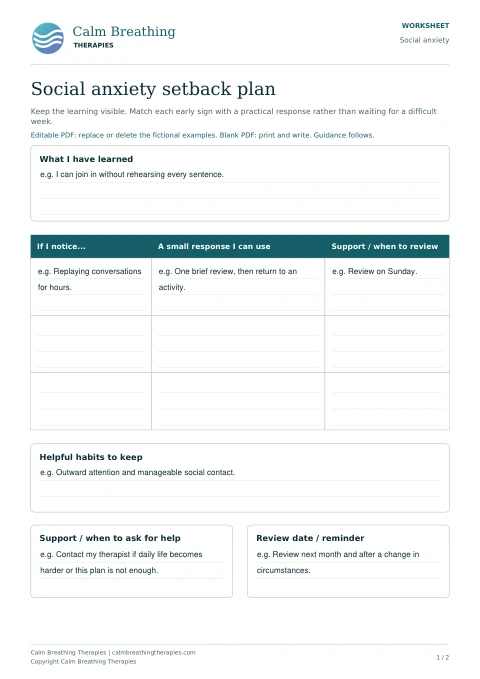
Progress may mean speaking a little more freely, returning to a valued activity or spending less time replaying conversations. Anxiety can still rise around change, tiredness or unfamiliar groups. This worksheet helps you preserve the learning that made a difference and recognise when the old pattern is returning. It is not a promise to stay confident all the time. A setback is information about what support or practice is needed, rather than proof that earlier progress has disappeared.
How to use it
Describe concrete changes in participation and daily life, as well as how you feel.
Record the experiments and attention shifts that taught you most.
Identify early signs of renewed rehearsal, self-monitoring, avoidance or replay.
Choose a small response for each sign and a realistic practice rhythm.
Name who to contact if difficulties persist, and set a date to review the plan.
A fictional worked example
During therapy, Freya began contributing to familiar meetings without scripting every sentence. Starting a new role brings back hours of preparation and evening replay. Her early warning sign is cancelling informal chats, followed by repeated checks of whether she sounded competent. Her plan is to revisit one useful experiment, make a small contribution at the next manageable meeting and keep a short factual review afterwards. She asks a trusted colleague for practical induction information rather than repeated reassurance about her performance. If avoidance continues to grow, she will contact her therapist to review support. Her progress is measured by participation, not a permanently low anxiety score.
Keep in mind
Keep the plan flexible and realistic. Seek professional support if anxiety substantially restricts work, study, relationships or essential tasks. If the environment itself is unsafe or discriminatory, prioritise appropriate help and boundaries instead of increasing exposure to mistreatment.
Worksheet prompts
What I have learned
If I notice...
A small response I can use
Support / when to review
Helpful habits to keep
Support / when to ask for help
Review date / reminder
Reflect
What would help me restart gently, rather than wait until I feel completely confident?
Print or type. The worksheet comes first in every individual PDF, with guidance afterwards. Choose “Editable PDF · examples” for a short fictional example in each box or first diary entry. Select the text to replace or delete it in a PDF reader, then save a private copy. Later diary entries and table rows are blank. Choose “Blank PDF · print” for writing by hand. Browser PDF viewers vary. The complete toolkits contain blank printable sheets.
Read online. Read step-by-step guidance, a fictional example and the worksheet prompts as HTML under “Read the guidance and example”. You can use those prompts in your own notes. Completed answers are not collected by this site.
How to use these social anxiety worksheets
Social anxiety can pull your attention towards how you think you look, sound or come across. You might rehearse every sentence, hide signs of anxiety or replay a conversation afterwards. These worksheets help you investigate that pattern and practise taking part with less self-monitoring. They are based on the processes described in Clark and Wells' cognitive model, rather than a demand to become outgoing. Start with one recent interaction, then choose an exercise that fits what keeps your difficulty going. Quietness, cultural preferences and a need for communication adjustments are not problems to be corrected.
Begin with the social anxiety cycle map. Write about one situation rather than your whole social life. Notice what you predicted, where your attention went and what you did to prevent embarrassment. A therapist can help distinguish anxiety-maintaining habits from useful preparation, cultural preferences, disability accommodations and responses to actual discrimination or bullying.
Use a prediction experiment to gather observable information. The attention and safety-behaviour comparison is designed for guided practice, particularly if deliberately changing attention feels unfamiliar. Aim to engage in the interaction, not to monitor whether you are doing the technique correctly. Useful learning can happen while you still feel anxious, and one conversation cannot establish what everyone thinks.
The before-and-after worksheets help prevent useful preparation or reflection turning into hours of rehearsal and replay. Video feedback needs careful preparation, consent and a clear purpose with a therapist; it is not a reason to repeatedly film or scrutinise yourself. Review progress through participation, choice and time reclaimed, alongside changes in fear. Keep a manageable practice plan for setbacks.
Suitability and support
These are educational practice aids, not a diagnostic test or a complete treatment programme. Choose safe, ordinary social situations; exposure does not mean accepting mistreatment or abandoning personal boundaries. The adult treatment framework needs appropriate adaptation for people aged 16-17. Seek a suitably trained clinician's advice about developmental needs, bullying, trauma, neurodivergence or severe distress before planning more demanding work.
Clark and Wells' cognitive model of social anxiety (1995), as recommended among the disorder-specific approaches in NICE CG159. Exercises focus on negative predictions, self-focused attention, safety behaviours, anticipatory and post-event processing.
Original materials for Calm Breathing Therapies. The cited organisations do not endorse these worksheets. Evidence, use and limitations · Version 3.0 · 26 October 2026.
Support when you want it
Sometimes it helps to work through it together.
These resources can be a useful starting point. If you are considering CBT, a FREE 5–10 minute consultation gives you space to discuss whether it might be suitable for you. There is no pressure to book.
Online CBT for people aged 16 and over across the UK. Suitability and the format of therapy are assessed individually. You can also read about how CBT for social anxiety works.

 View worksheet