 View worksheet
Worry diary
Record triggers, worries and responses briefly to notice your own pattern.
2 pages · A4 · Fillable PDF · 131 KB
Read the guidance and example
Worry often moves quickly between topics. A short diary can help you notice the situations that start it and the responses that keep it taking up time. You do not need to capture every thought or rate yourself constantly. Choose a few ordinary examples, record them briefly after the event, and review what repeats. The useful question is what happens around the worry, as well as what the worry says.
How to use it
- Choose one or two moments a day for three days; a brief note is enough.
- Record the trigger and the main “what if” thought in your own words.
- Note worry intensity from 0-10 and your response: planning, checking, reassurance, avoidance or something else.
- Notice the immediate effect and what happened later. Review patterns at the end of the three days.
A fictional worked example
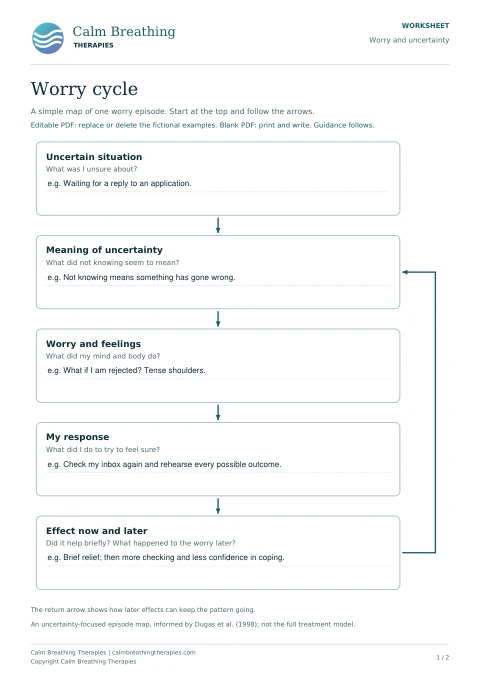
At 5 pm, Aisha notices that tomorrow’s meeting has no agenda. Her thought is, “What if I am asked something and have no answer?” Worry is 7/10. She rereads old emails for 40 minutes and asks a colleague twice what the meeting is about. She feels briefly more prepared, then thinks of another possible question. Looking at three diary entries, she notices that missing information regularly starts a search for certainty. Her next step is to discuss a small experiment around ordinary uncertainty, rather than prepare answers to every possible meeting question.
Keep in mind
Keep notes brief. If recording every thought becomes another checking task, reduce the frequency or bring the diary to therapy. This diary is not a diagnostic test. A real, urgent problem still needs a practical response rather than being put aside as worry.
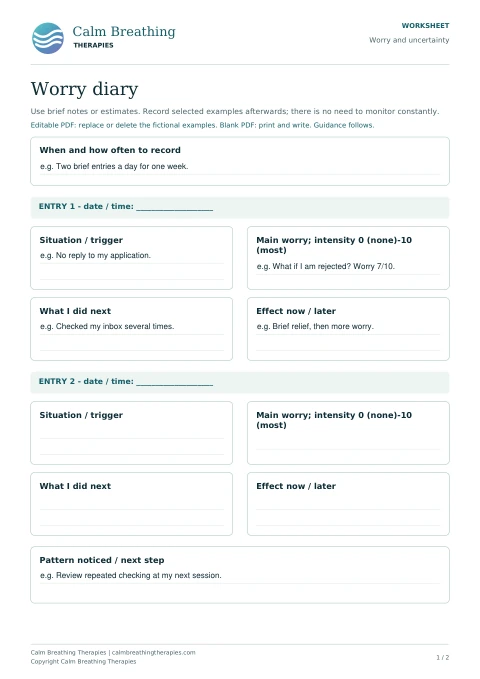
Worksheet prompts
- When and how often to record
- Situation / trigger
- Main worry; intensity 0 (none)-10 (most)
- What I did next
- Effect now / later
- Pattern noticed / next step
Reflect
Which response helped for a moment but left the worry returning later?
Sources: Dugas, M. J., Gagnon, F., Ladouceur, R., & Freeston, M. H. (1998). Generalized anxiety disorder: A preliminary test of a conceptual model. Behaviour Research and Therapy, 36(2), 215-226., NICE (2011, updated 2020). Generalised anxiety disorder and panic disorder in adults: management (CG113).