When mood and energy drop, it can become harder to do the things that bring connection, interest or a sense of accomplishment.
Explore free CBT worksheets for depression and low mood, including activity and mood diaries, behavioural activation exercises and step-by-step task plans. Printable and fillable templates can help you notice patterns and plan manageable activities.
Preview the actual templates below. Worksheets come first in every PDF, with guidance afterwards.
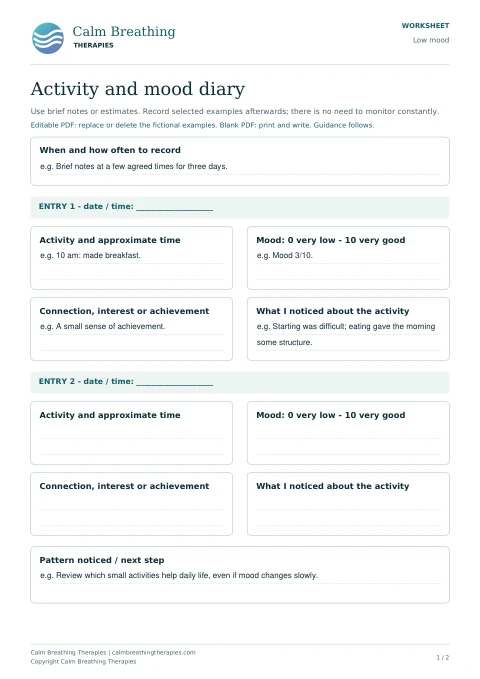
Low mood can make days blur together, particularly when you have less energy or withdraw from other people. A brief diary makes patterns more visible. It helps you notice what you are doing, what happens to mood and whether there are moments of connection, interest or accomplishment. You are collecting information rather than aiming for a busy or happy day. Include rest and ordinary self-care; their value may not show up as an immediate rise in mood.
How to use it
Choose a manageable day or part of a day to record.
Write short notes about activities, including rest and time spent thinking or scrolling.
Rate mood roughly from 0 (very low) to 10 (best for you), where helpful.
Notice any connection, interest or sense of doing something worthwhile, even briefly.
Review the pattern once and choose one small change to try.
A fictional worked example
Ellie expects that everything will feel equally empty. On Tuesday she records staying in bed scrolling, making lunch and taking a short walk to buy milk. Mood remains low, but making lunch gives a small sense of looking after herself, and greeting the shop assistant offers a moment of contact. An evening spent trying to work out why she feels this way leaves her more stuck. The diary does not prove that a walk will cure her depression. It suggests a modest next experiment: getting dressed and stepping outside for a brief, planned errand on another day, with rest afterwards if needed.
Keep in mind
Use approximate notes, not constant self-monitoring. If recording increases self-criticism, simplify the task or complete it with support. Respect physical health limits and access needs. Persistent or worsening symptoms, marked loss of functioning or difficulty with basic care call for professional assessment.
Worksheet prompts
When and how often to record
Activity and approximate time
Mood: 0 very low - 10 very good
Connection, interest or achievement
What I noticed about the activity
Pattern noticed / next step
Reflect
What useful pattern can I notice without turning it into a judgement about myself?
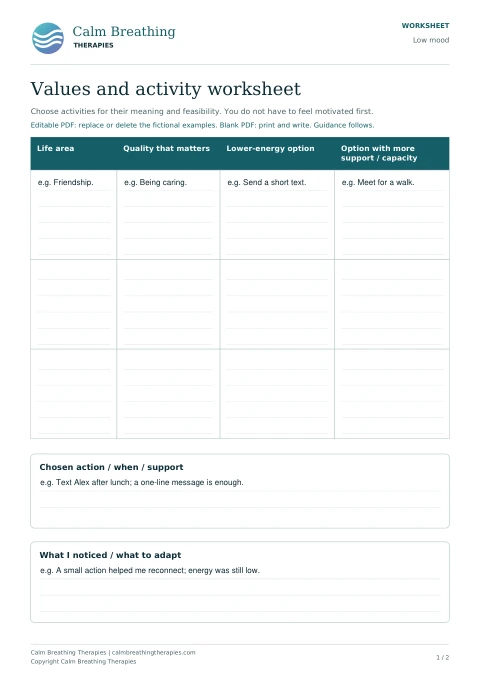
When you feel low, it may be hard to know what you want or remember what used to matter. You do not need a clear sense of enjoyment before choosing an activity. This sheet starts with directions that feel meaningful, even faintly, and turns them into practical options. A value is a way you want to live, such as being caring or curious; an activity is one small action in that direction. The menu is a source of choice, not a list of obligations.
How to use it
Choose two or three areas that matter to you, such as relationships, learning, creativity or self-care.
Describe the quality you value rather than what you think you should achieve.
List small actions at different energy levels, including low-cost and accessible options.
Choose one action that fits your current circumstances and add a time or cue.
After trying it, notice meaning or connection as well as mood, then adjust.
A fictional worked example
Sam misses feeling connected to his younger brother but has no energy for a full day out. He identifies being interested and present as a direction he values. His menu includes sending a short voice note, sharing a photograph of something they both like and arranging a ten-minute call. He chooses the voice note for Thursday afternoon. He does not suddenly feel cheerful afterwards, but he notices he acted in line with the relationship he cares about. A planned call can remain an option for another week; it is not a requirement to compensate for choosing a smaller step now.
Keep in mind
Values should reflect your choices, not pressure from other people. Financial difficulties, disability, discrimination and caring demands may limit available options and deserve practical support. Keep activities safe and accessible. If even tiny steps feel unmanageable, discuss the level of support you need with a clinician.
Worksheet prompts
Life area
Quality that matters
Lower-energy option
Option with more support / capacity
Chosen action / when / support
What I noticed / what to adapt
Reflect
Which activity moves towards something I value, at a size I can realistically attempt?
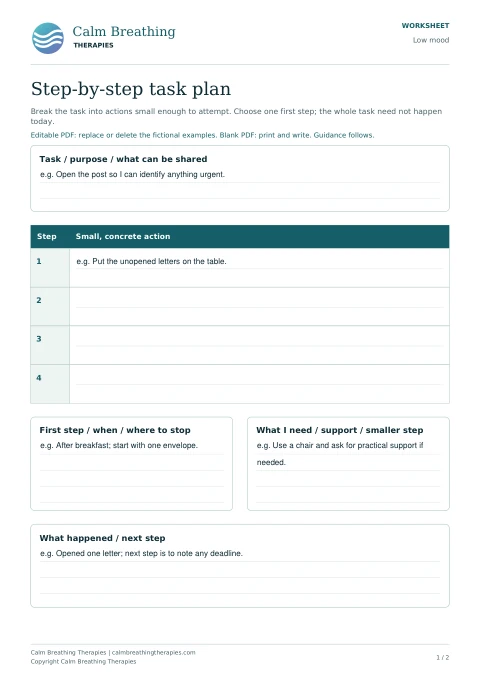
A task can feel impossible when depression affects energy, concentration and confidence. Waiting until you feel fully motivated may leave it hanging over you, while forcing a large task can exhaust you. Graded task planning turns one goal into smaller actions and chooses a workable starting point. Completion is not the only information that matters: you can learn about barriers, useful cues and support. The plan should fit your health and circumstances rather than someone else's idea of an easy task.
How to use it
Name one task and why it matters now; consider whether it can be reduced, shared or deferred.
Break it into concrete actions that can each be started separately.
Choose a first step, a realistic time and a clear stopping point.
Prepare practical support, materials or an easier fallback step.
Review what happened, credit effort and adjust the next step using what you learnt.
A fictional worked example
For weeks, Rosa has avoided sorting letters because the whole pile feels overwhelming. Her goal is to identify anything that needs prompt action, not organise every document. She plans to sit at the table after lunch and open three envelopes, with a friend available for practical support. If that is too much, the fallback is to bring the unopened pile to the table. She opens two and identifies one bill that needs advice. The task is unfinished, but she has useful information and a next step: contact the relevant service with help. The review focuses on what made starting possible, rather than demanding completion that day.
Keep in mind
Some tasks need financial, legal, medical or practical help rather than more effort. Ask for suitable support. Do not use graded activity to push through significant physical symptoms, ignore rest needs or replace a healthcare plan. Escalating difficulties with basic self-care need clinical assessment.
Worksheet prompts
Task / purpose / what can be shared
1: Small, concrete action
2: Small, concrete action
3: Small, concrete action
4: Small, concrete action
First step / when / where to stop
What I need / support / smaller step
What happened / next step
Reflect
What did I learn about making this task doable, rather than whether I did enough?
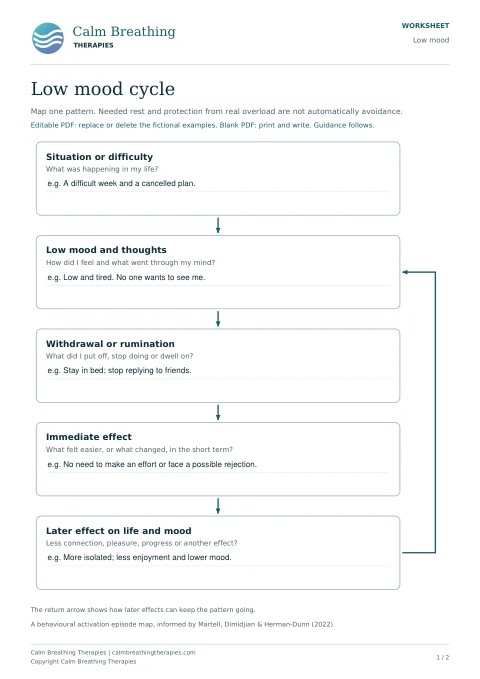
With low mood, you may withdraw or repeatedly ask why you feel this way. These responses are understandable attempts to manage something painful. The useful question is what they do over time: do they help solve a problem, or leave you more disconnected and stuck? This worksheet maps one episode and helps identify where a different response could be explored. The aim is not to ban thinking or rest. It is to notice when a response has stopped helping and make room for another choice.
How to use it
Start with one situation or difficulty.
Write the low mood and thoughts that followed.
Notice withdrawal, things you stopped doing or repeated dwelling on problems.
Record what changed immediately, then the later effects on connection, enjoyment, progress and mood.
Follow the return arrow. A small, supported activity can be planned on the separate activity or graded-task sheet. Needed rest, disability adjustments and protection from real overload still matter.
A fictional worked example
After a job rejection, Kai spends the evening asking why he always gets things wrong. He stays in his room and ignores a message from a friend. At first he avoids explaining the disappointment, but later feels more alone and has no clearer plan. His map distinguishes the real problem of finding work from the unanswerable claim that he always fails. One practical action is to ask about interview feedback tomorrow. For this evening he chooses to reply to his friend and make something to eat. The disappointment remains, but he has interrupted a pattern that was taking him further from support and useful action.
Keep in mind
Withdrawal can sometimes protect you from genuine overload or harm, and rest may be necessary. Consider context before labelling a response unhelpful. If repeated thinking concerns trauma, major loss or persistent severe distress, seek appropriate support rather than forcing an activity as the only response.
Worksheet prompts
Situation or difficulty: What was happening in my life?
Low mood and thoughts: How did I feel and what went through my mind?
Withdrawal or rumination: What did I put off, stop doing or dwell on?
Immediate effect: What felt easier, or what changed, in the short term?
Later effect on life and mood: Less connection, pleasure, progress or another effect?
Reflect
Did my response move me towards a useful action or keep the same painful question going?
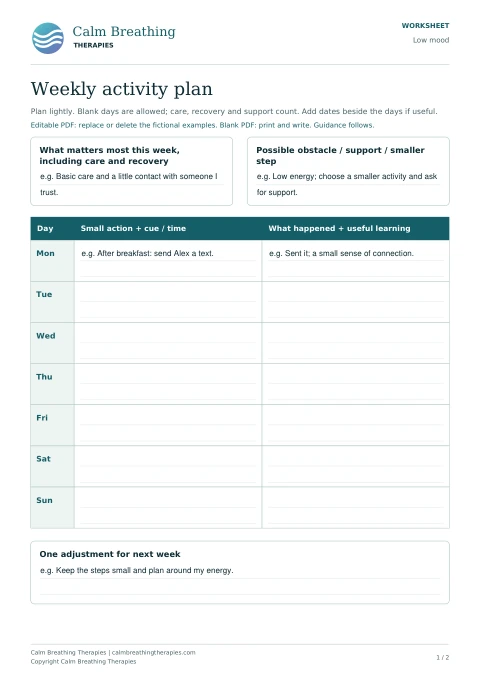
Behavioural activation is more than filling a diary. It involves choosing activities that address your own pattern of withdrawal and lack of rewarding or meaningful experiences, then learning from practice. This planner helps you schedule a modest selection of actions alongside necessary care and recovery. Start with fewer activities than you think you ought to manage. The review considers feasibility, barriers and meaning, not just whether mood improved immediately. A missed activity is information that can help shape the next plan.
How to use it
Use your diary or values menu to choose a small number of useful actions.
Schedule each with a realistic day, cue and size; include rest and practical needs.
Predict a benefit or learning question, without requiring enjoyment.
After the activity, record what happened and any connection, accomplishment or obstacle.
At the end of the period, keep, reduce or change activities based on what you learnt.
A fictional worked example
Mo's plan for the coming week contains three small actions: make breakfast before opening social media on Monday, send a message to a friend on Wednesday and spend ten minutes on a hobby at the weekend. He keeps his medical appointments and rest needs in view. Breakfast happens; the message is delayed because he feels unsure what to say; the hobby is manageable but not very enjoyable. In review he keeps breakfast, makes the message shorter and plans another brief hobby period to gather more information. He does not add extra activities as punishment for missing one or assume the plan failed because his mood stayed low.
Keep in mind
Do not create an exhausting catch-up schedule. Adapt activities to physical health, disability, resources and responsibilities. If you notice a marked change such as very little need for sleep with unusual energy or impulsivity, seek clinical advice rather than simply increasing activation.
Worksheet prompts
What matters most this week, including care and recovery
Possible obstacle / support / smaller step
Small action + cue / time
What happened + useful learning
One adjustment for next week
Reflect
What should I keep, simplify or change based on what actually happened?
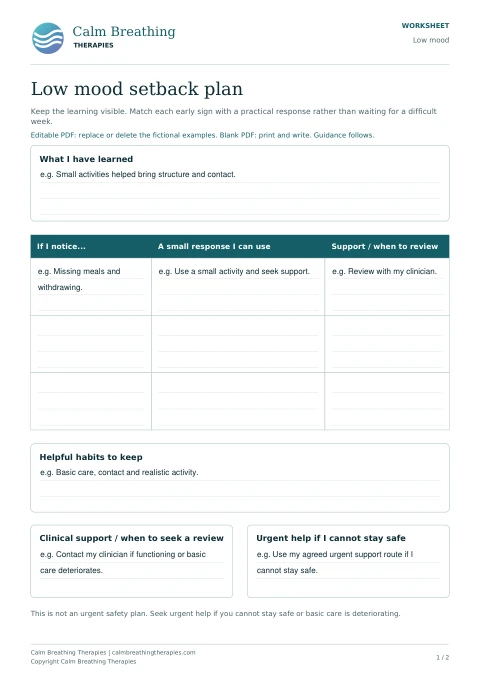
Depression can return, especially during stress or major changes, and one difficult day does not tell you what the next month will be like. A maintenance plan helps you recognise your particular early signs and respond before withdrawal or hopelessness becomes more established. It brings together routines, meaningful activity, support and treatment arrangements. The aim is to make help easier to access when energy is low. This sheet complements clinical care; it is not a substitute for an individual safety plan when one is needed.
How to use it
Record what helped, including treatment, support and practical changes rather than only personal effort.
Identify early warning signs and the difference between a bad day and a continuing pattern.
Choose a small response for each sign, with realistic support.
Write when and how you will contact a clinician if symptoms worsen or daily functioning falls.
Keep any prescribed treatment plan and review date; seek urgent help for immediate safety concerns.
A fictional worked example
After improvement, Erin notices that her first warning signs are cancelling plans, leaving meals until late and spending longer asking why things feel pointless. Her plan begins with one familiar meal routine and a short check-in with someone she trusts. If the pattern continues or basic care becomes harder, she will contact her GP or therapist to review support rather than wait until she can manage alone. She records what made previous help useful and where to find appointment details. She keeps medication decisions with her prescriber. The plan also makes clear that thoughts she may act on require urgent support, not another week of self-help.
Keep in mind
Seek urgent support if you may act on thoughts of harming yourself or cannot stay safe. Increasing difficulty eating, drinking, sleeping or caring for yourself needs clinical attention. Do not change medication independently. Agree an individual safety plan with your care team when needed.
Worksheet prompts
What I have learned
If I notice...
A small response I can use
Support / when to review
Helpful habits to keep
Clinical support / when to seek a review
Urgent help if I cannot stay safe
Reflect
What will make it easier to ask for help early, especially when energy or hope is low?
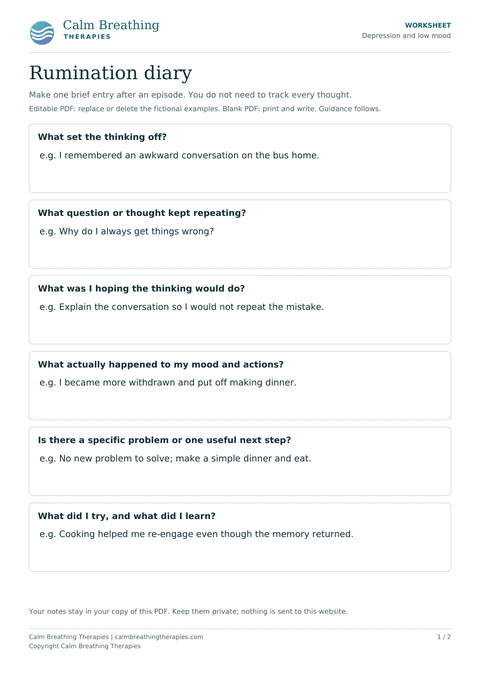
Rumination means repeatedly going over a difficulty, often with broad questions such as 'Why am I like this?' Reflection can be useful when it brings new understanding or a next step. This diary helps you notice when thinking has become stuck and try a more concrete response.
How to use it
Notice the episode and make a short note afterwards, rather than monitor your mind continuously.
Ask whether the thinking is producing new information, a decision or a specific action.
If there is a practical problem, describe it in concrete terms and plan one step. If you are circling the same question, gently return to a chosen activity.
Review whether the response helped you take part in life. Success does not require the thought to disappear.
In the editable PDF, replace or delete each fictional example. Your notes stay in your saved copy and are not sent to this website.
A fictional example
Omar spends the evening asking why he is falling behind. Each answer leads to another judgement. He changes the question to, 'What is one thing I need to do this evening?' He prepares tomorrow's lunch. The worry about falling behind returns, but he can notice it and continue. In therapy he later considers whether there is a practical workload issue to address.
Keep in mind
This is not an instruction to suppress thoughts, ignore grief or avoid a real problem. It is also not a substitute for trauma-focused work. If persistent low mood, intrusive memories or repetitive thinking seriously affects daily life, seek individual assessment and support.
Review your learning
Did I move towards a useful action, new understanding or something I value?
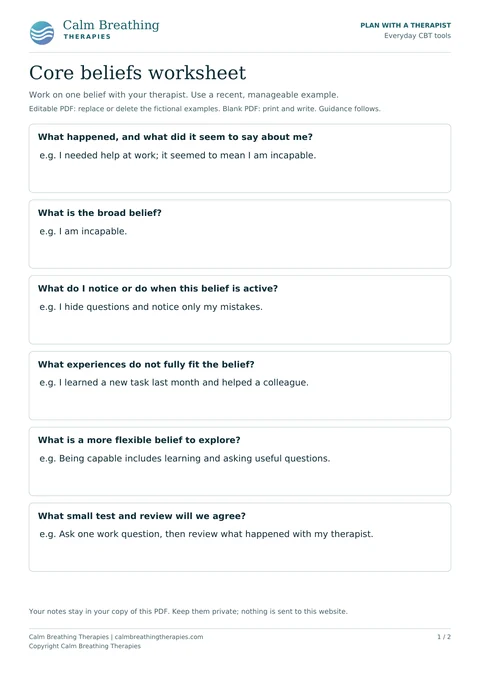
A core belief is a broad idea about yourself, other people or the world. It can feel like a fact, especially when you are low or anxious. This sheet supports a shared conversation about one belief and a more flexible alternative; it is not a search for something wrong with you.
How to use it
Start with a recent situation rather than detailed memories of the past.
Name the broad belief in your own words. Treat it as a working idea, not a diagnosis.
Notice how attention, avoidance or rules may keep it convincing. Include experiences it overlooks.
Agree a believable alternative, a safe small test and how you will review the learning with your therapist.
In the editable PDF, replace or delete each fictional example. Your notes stay in your saved copy and are not sent to this website.
A fictional example
After a difficult meeting, Ben concludes, 'I am useless.' With his therapist, he notices he counts mistakes but dismisses preparation and support he gives others. They explore, 'I have skills and limits, and I can learn.' He plans to ask one clarifying question at the next meeting and record what he learns, without grading his whole worth from the outcome.
Keep in mind
Broad beliefs can be connected with painful experiences. You do not need to revisit trauma or disclose private history on this sheet. Pause if it becomes overwhelming. Choose any behavioural test with your therapist; avoid tests involving danger, humiliation or pressure to prove your worth.
Review your learning
What would let me hold the old belief less rigidly, even if it still feels convincing?
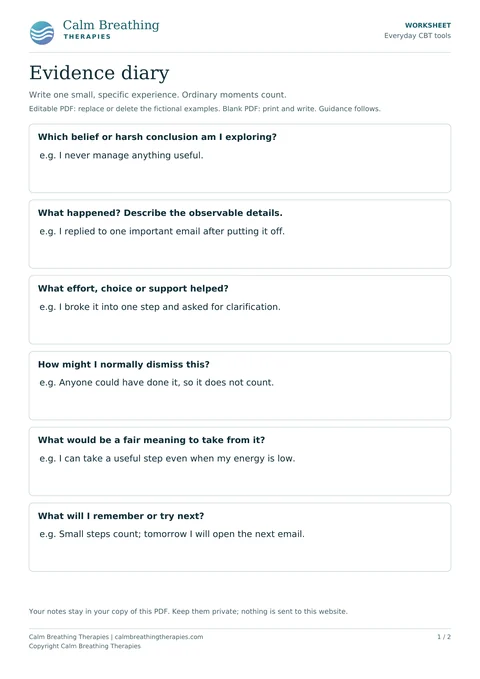
When a harsh belief is familiar, the mind may notice what supports it and dismiss everything else. This diary helps you collect concrete experiences it overlooks. The aim is a fuller view, not a list of achievements or proof that every day went well.
How to use it
Choose one belief you want to examine, rather than monitor everything about yourself.
Record a specific event close to when it happens. Include kindness, persistence, learning, asking for help or resting when needed.
Notice any automatic dismissal. Ask whether you would dismiss the same event for somebody else.
Write a fair meaning. Review a few entries together at an agreed time rather than repeatedly checking the diary.
In the editable PDF, replace or delete each fictional example. Your notes stay in your saved copy and are not sent to this website.
A fictional example
Maya believes, 'I let everyone down.' She records telling a friend honestly that she could not meet that evening and suggesting another day. Her first response is, 'That is nothing.' A fuller view is that she communicated clearly and cared about the friendship while respecting her limits. The entry is useful information, not a demand to become a perfect friend.
Keep in mind
Include support from others; needing help does not cancel your contribution. Do not turn the diary into a daily performance target or repeatedly read it to feel completely certain about yourself. If no example comes to mind, leave it and revisit with support.
Review your learning
What has this helped me notice that my usual belief leaves out?
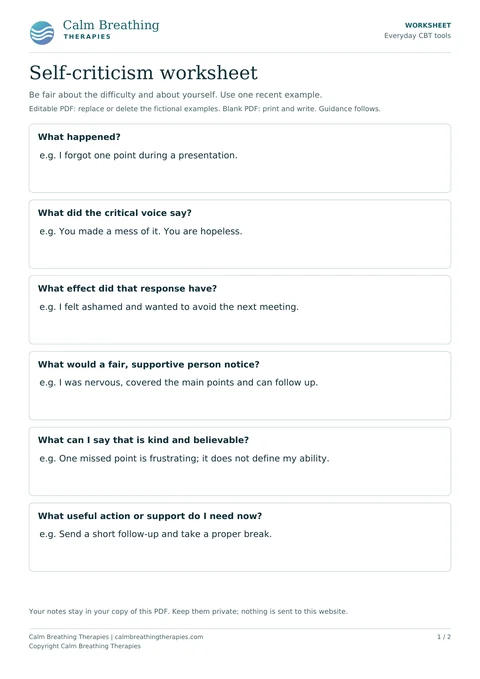
Self-criticism can feel as though it will keep us motivated or prevent mistakes. A harsh response may also leave us ashamed, stuck or afraid to try. This sheet helps you keep any useful information while responding in a fairer and more supportive way.
How to use it
Write the event separately from the judgement you made about yourself.
Notice the effect of the criticism. Does it help you learn, or make you withdraw or overwork?
Imagine a fair supporter who knows the full context. Include pressures, needs and anything you did manage.
Write a response you can believe and choose a useful next step, such as repairing a mistake, resting or asking for help.
In the editable PDF, replace or delete each fictional example. Your notes stay in your saved copy and are not sent to this website.
A fictional example
After cancelling a plan because she was exhausted, Leah calls herself selfish. She notices this pushes her to agree to more than she can manage. A fair response is, 'My friend matters and my energy matters. I can explain and offer another time.' She sends one clear message instead of repeatedly apologising and checking whether the friendship is secure.
Keep in mind
A supportive response does not mean denying a mistake or accepting harmful treatment from others. You can take responsibility for an action without attacking your whole character. If supportive wording feels false, begin with a neutral description of the facts or discuss it with a therapist.
Review your learning
Did this response make space for learning and a useful action?
Print or type. The worksheet comes first in every individual PDF, with guidance afterwards. Choose “Editable PDF · examples” for a short fictional example in each box or first diary entry. Select the text to replace or delete it in a PDF reader, then save a private copy. Later diary entries and table rows are blank. Choose “Blank PDF · print” for writing by hand. Browser PDF viewers vary. The complete toolkits contain blank printable sheets.
Read online. Read step-by-step guidance, a fictional example and the worksheet prompts as HTML under “Read the guidance and example”. You can use those prompts in your own notes. Completed answers are not collected by this site.
Choosing and using depression & low mood worksheets
The rumination diary can help you notice repetitive thinking and return to a concrete next step. The core beliefs, evidence diary and self-criticism sheets explore how you relate to yourself. These are shared CBT tools; they complement activity planning rather than replace an individual formulation.
When mood and energy drop, it can become harder to do the things that bring connection, interest or a sense of accomplishment. Pulling back may offer short-term relief while leaving you with fewer opportunities for life to feel different. These worksheets help you notice that pattern and choose manageable changes through behavioural activation and CBT. The emphasis is on meaningful activity, realistic pacing and kinder, more balanced thinking, rather than keeping busy or forcing positivity. Start with a small record of daily life, then use what you learn to plan one achievable step. You do not need to complete every worksheet.
Begin with a brief activity-and-mood diary, using rough ratings rather than precise monitoring. Notice where connection, interest, achievement or necessary care are absent, as well as what drains you. An activity can be worthwhile even when it does not immediately lift your mood. The diary should help identify a practical starting point, not become another way to judge your productivity.
Choose activities linked to what matters to you and break large tasks into workable steps. Make room for rest, disability-related needs, responsibilities and support. The activation planner helps you test a modest plan and learn from what actually happened. When a task is missed, explore the obstacle and adjust the step rather than treating the outcome as a failure of motivation or character.
Use the avoidance-and-rumination map when you become stuck in withdrawal or repeated 'why' questions. A balanced-thinking sheet may help with a specific self-critical interpretation, but it should lead back to useful action rather than endless debate. Keep a plan for recognising deterioration and seeking help. If symptoms persist, worsen or interfere with basic care, arrange a clinical review instead of relying only on worksheets.
Suitability and support
Depression can need professional assessment and a range of treatments. These worksheets do not establish a diagnosis or replace care. Seek urgent support if you may act on thoughts of harming yourself or cannot keep yourself safe. Do not change prescribed medication using this toolkit. People aged 16-17 need developmentally appropriate assessment and support; NICE NG134 covers depression in under-18s rather than simply applying the adult guideline unchanged.
Behavioural activation and cognitive-behavioural approaches to depression, informed by Martell, Dimidjian and Herman-Dunn, and NICE NG222. Activity, avoidance, rumination and personal meaning guide practice; thinking exercises are used when they serve the person's formulation rather than as a universal requirement.
Original materials for Calm Breathing Therapies. The cited organisations do not endorse these worksheets. Evidence, use and limitations · Version 3.0 · 26 October 2026.
Support when you want it
Sometimes it helps to work through it together.
These resources can be a useful starting point. If you are considering CBT, a FREE 5–10 minute consultation gives you space to discuss whether it might be suitable for you. There is no pressure to book.
Online CBT for people aged 16 and over across the UK. Suitability and the format of therapy are assessed individually. You can also read about how CBT for depression works.

 View worksheet