Panic can feel frightening, and fear of another attack can begin to decide where you go and what you do.
Explore free CBT self-help resources for panic attacks and panic disorder. Download panic diaries, panic cycle diagrams and thought record templates to understand feared sensations and the anxiety cycle. Exposure exercises may require individual guidance.
Preview the actual templates below. Worksheets come first in every PDF, with guidance afterwards.
Panic can escalate when bodily changes are interpreted as signs of an imminent catastrophe. Fear may then increase those sensations and narrow attention towards the body. This worksheet applies Clark’s cognitive model to one episode, while keeping open the need for medical assessment. It helps distinguish the sensation itself from what you feared it meant. Panic attacks can occur in different difficulties; this map does not establish a diagnosis of panic disorder.
How to use it
Choose one episode after you have settled. Start with an internal trigger, such as a sensation, or an external situation.
Write what first seemed dangerous in the perceived-threat box.
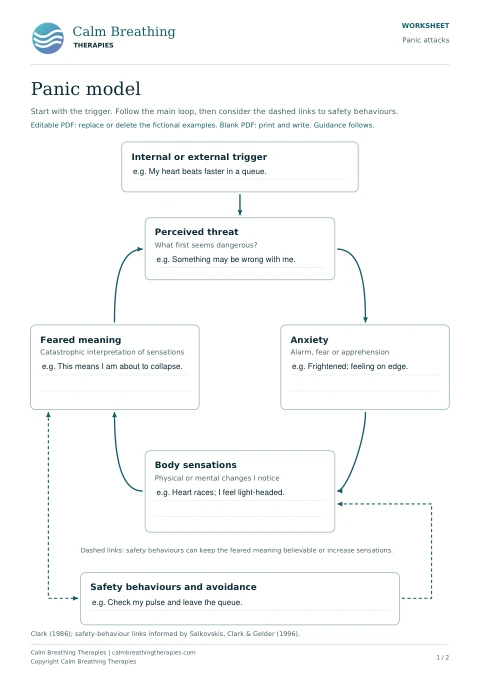
Follow the loop clockwise: anxiety, sensations, feared meaning, then renewed threat. For example, a racing heart is a sensation; "I am about to collapse" is a feared interpretation.
Add avoidance or safety behaviours below the loop. The dashed links show how they may preserve the feared meaning or sometimes add to sensations. Not every link will fit every person.
Discuss uncertain links and one useful question with your therapist. The diagram helps explore a pattern; it cannot establish the cause of physical symptoms.
A fictional worked example
Daniel notices a faster heartbeat while queuing. He thinks something may be wrong, feels anxious and notices more racing and light-headedness. He interprets these sensations as "I am about to collapse", which strengthens the threat and starts the loop again. He checks his pulse and leaves. He later believes leaving prevented collapse, so the feared meaning stays untested. Having discussed recurring symptoms with his GP, he brings the map to therapy. The worksheet cannot decide whether symptoms need medical review.
Keep in mind
Do not assume new, severe, changing or unexplained physical symptoms are panic. Seek appropriate medical assessment; call emergency services for a medical emergency. This map is not an instruction to bring on symptoms, stop medication or remain in an unsafe situation.
Worksheet prompts
Internal or external trigger
Perceived threat: What first seems dangerous?
Feared meaning: Catastrophic interpretation of sensations
Anxiety: Alarm, fear or apprehension
Body sensations: Physical or mental changes I notice
Safety behaviours and avoidance
Reflect
Which part was an observed sensation, and which part was my prediction about it?
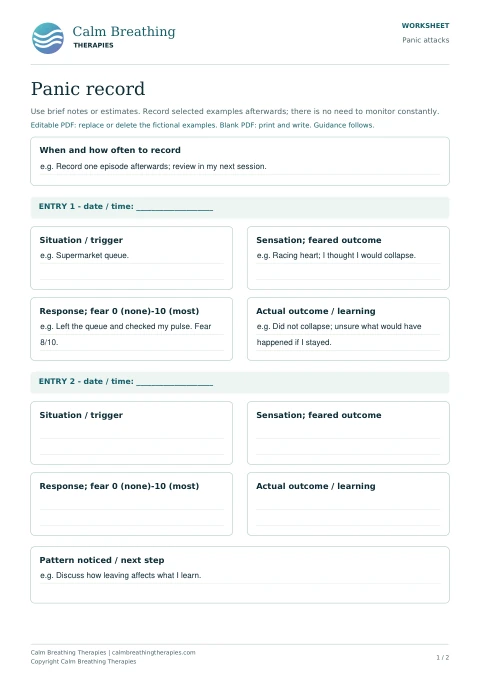
A brief record can make it easier to discuss what happens before, during and after panic. The most useful information is often the feared meaning and your response, rather than a detailed list of every sensation. Complete the diary after an episode, when it feels manageable, instead of monitoring yourself continuously. Include situations you approached as well as those you avoided, so the record shows learning and participation as well as distress.
How to use it
Record a recent episode or a moment when fear of panic changed your plans.
Note the main sensation and feared outcome; rate peak fear from 0-10 if useful.
Record attention, checking, escape, avoidance or other responses.
Write what actually happened and one question or learning point. Review a few entries together.
A fictional worked example
Priya records a bus journey after arriving home. Her main sensation was heat in her face; her prediction was that she would lose control and shout. Fear reached 8/10. She silently rehearsed escape plans and watched the next stop, but remained seated until her destination. She did not shout, although she cannot yet tell whether the mental rehearsal helped or kept the fear central. A second entry shows the same pattern in a queue. In therapy, the repeated prediction and mental safety behaviour provide a more useful target than simply counting how many attacks she has had that week.
Keep in mind
Keep entries short and avoid repeated pulse, breathing or symptom measurements unless a healthcare professional has asked for them. New or concerning symptoms need appropriate medical advice. If writing the diary intensifies distress, reduce its frequency and bring the difficulty to your therapist.
Worksheet prompts
When and how often to record
Situation / trigger
Sensation; feared outcome
Response; fear 0 (none)-10 (most)
Actual outcome / learning
Pattern noticed / next step
Reflect
What does the pattern suggest we could investigate safely in treatment?
A racing heart, dizziness or feeling unreal can quickly acquire a frightening meaning. CBT explores that interpretation rather than asking you to deny what you feel. After appropriate assessment, it may be possible to consider more than one explanation and test predictions in treatment. A balanced alternative acknowledges uncertainty and context. The aim is not to produce a phrase you must repeat until you feel safe or to diagnose physical symptoms yourself.
How to use it
Choose a familiar, assessed episode. Name the sensation without adding an explanation.
Write the catastrophe you feared and how strongly you believed it, from 0-100%.
Review what you observed, relevant clinical advice and possible alternative meanings.
Write a believable working view and a question for a planned experiment. Review what you learn in practice.
A fictional worked example
After assessment of recurring panic, Sam records, “My hands tingled on the train.” His feared meaning is, “I am about to lose control of my body,” believed 90%. He notices that the episode involved rapid breathing and intense fear, but does not use this to diagnose every future symptom. A working view is, “These familiar sensations may fit the panic pattern we discussed; feeling them is not itself proof of the catastrophe.” He wants to explore whether he can continue an ordinary conversation without checking his hands repeatedly. He agrees the next step with his therapist rather than inducing tingling on his own.
Keep in mind
This sheet cannot rule out a physical cause. Use medical advice for symptoms and seek reassessment when symptoms are new, changing or concerning. Avoid repeated evidence reviews that become reassurance rituals. Sensation-focused experiments require an individual suitability and safety discussion with a qualified professional.
Worksheet prompts
Sensation I noticed
Feared meaning / belief 0-100%
What I observed / relevant clinical advice
Another possible explanation
A balanced view
Question or test to agree in therapy
Learning / belief now (0-100%)
Reflect
Am I testing a prediction, or trying to obtain a guarantee that I will never feel panic?
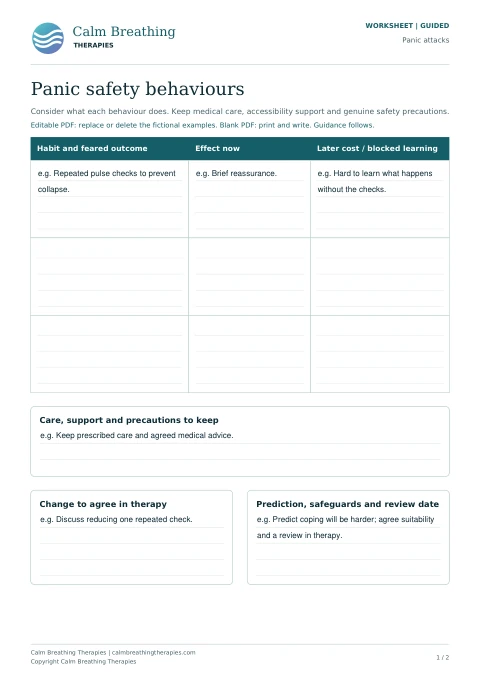
When panic feels dangerous, carrying out a particular action can seem essential. Some actions provide brief relief but make it harder to discover what would happen without them, or keep attention fixed on danger. Whether a behaviour serves this function depends on its purpose and context. This worksheet helps you assess that with your therapist. It does not label all coping, support, accessibility adjustments or medical treatment as a problem.
How to use it
List a few things you do because you believe they prevent a panic catastrophe.
Write what you think each action prevents and the relief it brings.
Consider whether it also changes sensations, attention or what you can learn.
With your therapist, choose one low-risk change and a clear prediction to investigate. Preserve genuine safety and care.
A fictional worked example
Alex always stands beside a shop exit because he believes he would collapse if he could not leave quickly. This reduces anxiety briefly but keeps the exit central to each trip. He and his therapist distinguish this from carrying his prescribed inhaler, which is part of medical care and stays unchanged. They plan a small experiment in a familiar shop: browse one shelf away from the exit while following the agreed medical plan. They will review what happens, including whether scanning for escape continues mentally. The purpose is to examine a belief, not prove bravery or remove every source of support.
Keep in mind
Never stop medication, discard prescribed equipment or ignore necessary precautions to test a safety behaviour. Do not change driving, water, height or other hazard precautions. Fainting history and medical conditions need assessment. Plan reductions collaboratively, and retain support that enables appropriate, safe participation.
Worksheet prompts
Habit and feared outcome
Effect now
Later cost / blocked learning
Care, support and precautions to keep
Change to agree in therapy
Prediction, safeguards and review date
Reflect
What helped me learn, and what may have made me credit safety to the habit alone?
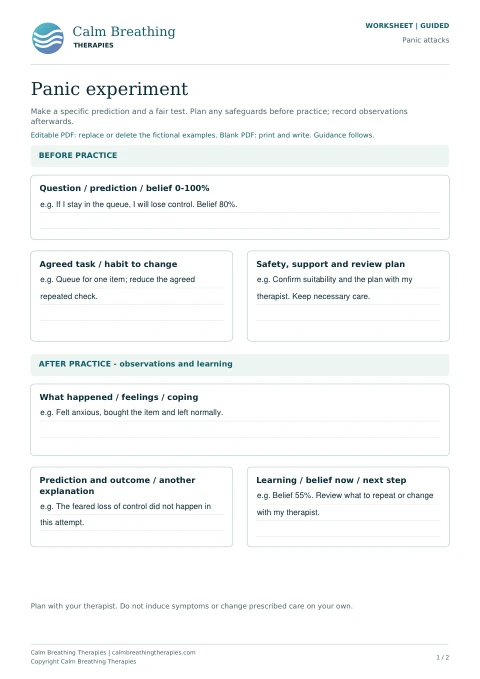
Panic treatment can include experiments that test feared outcomes and help change the meanings attached to sensations. A good experiment has a specific question and a way to observe the answer. It is not a test of how much distress you can endure. This sheet supports planning and review after assessment; it does not prescribe a task. Keep the experiment relevant to the pattern you are working on and manageable enough to generate useful learning.
How to use it
Agree the question, a specific prediction and belief rating from 0-100%.
Choose the situation, one response to change and necessary safeguards. Confirm suitability with your therapist.
Decide what you will observe and when you will review it; avoid continuous body scanning.
Complete the agreed task, compare outcomes with the prediction and consider alternative explanations. Plan the next step.
A fictional worked example
With her therapist, Ella plans to wait in a familiar café queue rather than repeatedly checking her pulse. Her prediction is, “If my heart races and I do not check, I will collapse,” at 85%. Medical considerations have already been reviewed. She agrees to notice what happens while choosing her drink and ordering, without using a new mental reassurance routine. She feels anxious and remains able to order; no collapse occurs. They review the remaining doubt that the task was too easy and decide what a useful next test would be. They do not treat one result as proof about all future physical symptoms.
Keep in mind
Use only a task individually agreed as appropriate. Exercises deliberately changing breathing, balance or bodily sensations need professional assessment and supervision; this sheet gives no induction instructions. Do not experiment in hazardous settings or change medication. Stop and seek help if a genuine medical or safety concern arises.
Worksheet prompts
Question / prediction / belief 0-100%
Agreed task / habit to change
Safety, support and review plan
What happened / feelings / coping
Prediction and outcome / another explanation
Learning / belief now / next step
Reflect
What does this experience suggest about the feared meaning of my familiar sensations?
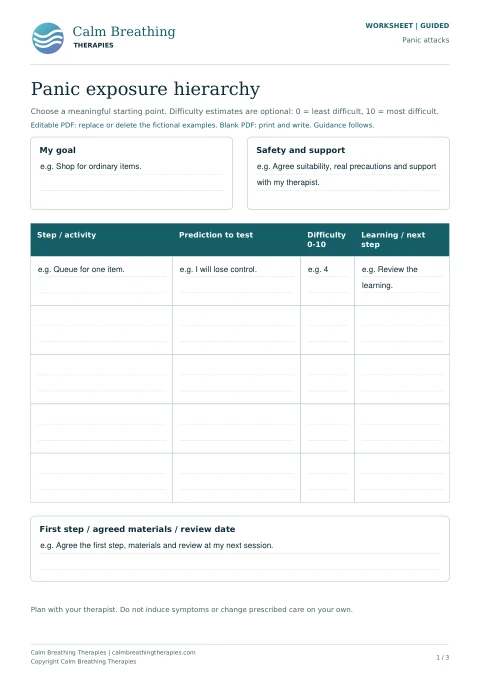
Avoidance can gradually narrow daily life when you fear another panic attack. A graded plan helps reconnect treatment with what you want to be able to do. Choose steps by their usefulness, feasibility and the prediction they allow you to explore, as well as anticipated difficulty. You do not have to wait for anxiety to disappear before reviewing progress. This sheet works alongside your individual therapy plan and any agreed medical advice.
How to use it
Name a valued activity panic has restricted and a realistic destination goal.
Break the activity into several manageable steps; rate expected difficulty from 0-10.
For the first step, identify the feared prediction, safety behaviour to review and appropriate support.
Practise as agreed, record the outcome and learning, then repeat or adapt based on what you discovered.
A fictional worked example
Ruth wants to visit her sister by train again. She and her therapist identify steps: visit the station, take one stop at a quiet time, repeat at a busier time, then build towards the full journey. Each step tests her prediction that she cannot manage panic away from home. They keep ordinary travel planning and any necessary medical arrangements. After the one-stop trip, Ruth records that anxiety rose and she still reached her destination. She notices that constant route checking kept the fear prominent. The next practice focuses on that pattern, rather than simply adding a longer journey before she is ready.
Keep in mind
Plan around physical health, fainting, disability, access needs and actual environmental safety. Do not use driving or other hazardous activities as an unsupervised experiment. Severe avoidance may need more support than a worksheet provides. Adapt the sequence with a therapist; there is no compulsory speed or pass mark.
Worksheet prompts
My goal
Safety and support
Step / activity
Prediction to test
Difficulty 0-10
Learning / next step
First step / agreed materials / review date
Chosen step / prediction
What I will look for
Habit to change / support to keep
When, where and agreed endpoint
What actually happened
Learning / next agreed step
Reflect
What could I do with anxiety present that I previously thought was impossible?
After progress, a return of familiar panic sensations can feel discouraging. A written learning plan can help you recognise the old cycle and choose a useful response without declaring that treatment has failed. Base the plan on your own experiments and what they taught you. Keep medical advice separate and clear: learning about panic does not mean that all future symptoms should be treated as anxiety.
How to use it
Write the main panic prediction you worked on and the experiences that changed your understanding.
Identify early signs such as body scanning, escape planning or giving up activities.
Plan one manageable practice and how you will review it if fear returns.
Record your medical advice, support contacts and signs that mean you need renewed assessment or therapy.
A fictional worked example
After a stressful fortnight, Callum notices a familiar racing heart and the urge to avoid his commute. He reviews what previous experiments showed: familiar panic did not stop him completing ordinary journeys, and repeated pulse checks kept attention on danger. His plan is to resume a manageable journey and review the prediction with his therapist if needed, while continuing his usual medical care. He also notes that new, severe or changed symptoms require appropriate assessment. Instead of reading the plan repeatedly until certain, he reads it once and chooses the next action. His goal is returning to life, not guaranteeing that anxiety never appears.
Keep in mind
Do not use this plan to dismiss new, severe or changing symptoms. Seek suitable medical advice and emergency help for emergencies. If avoidance or distress is increasing, ask for further support. Young people aged 16-17 need a plan adapted with an appropriately qualified professional.
Worksheet prompts
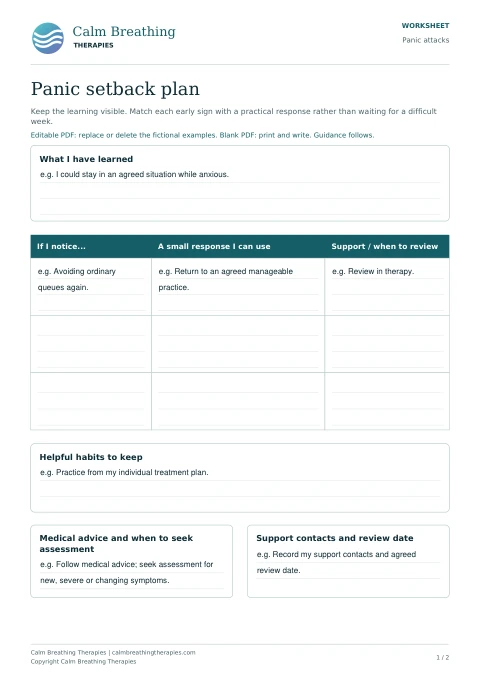
What I have learned
If I notice...
A small response I can use
Support / when to review
Helpful habits to keep
Medical advice and when to seek assessment
Support contacts and review date
Reflect
How can I recognise a setback without turning it into a prediction of failure?
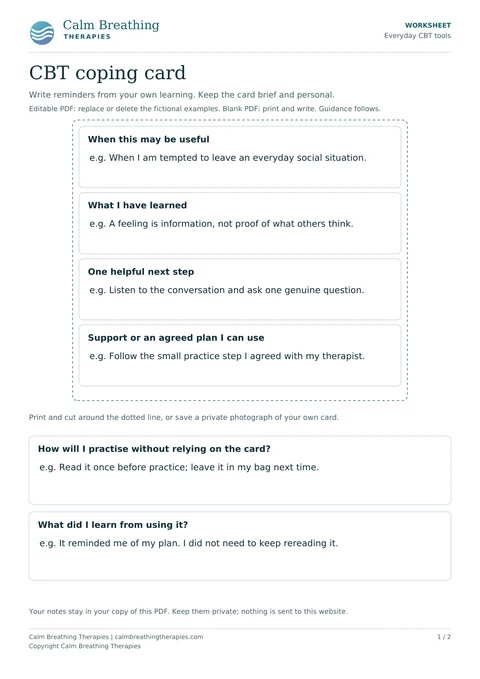
A coping card holds a few words from what you have already learned in CBT. It can help you remember a useful action when the mind is busy. Make it personal and believable. The card is a reminder, not a promise that nothing difficult will happen.
How to use it
Choose one situation and use learning you actually believe, rather than a general positive slogan.
Write a short reminder and one action that fits your treatment plan. Agree any exposure step with your therapist.
Keep a copy or photograph if useful. Practise using the action, sometimes without consulting the card.
Review whether the card supports participation or has become something you feel you must check before you can cope.
In the editable PDF, replace or delete each fictional example. Your notes stay in your saved copy and are not sent to this website.
A fictional example
Alex writes, 'I do not know exactly how I will come across. I can listen and contribute one point.' At a familiar meeting he reads it once, then puts it away. Later he tries the same action without the card. The learning is that he can participate with uncertainty, not that the card protects him from feeling anxious.
Keep in mind
Repeated rereading for certainty can become reassurance or a safety behaviour. If you feel unable to act without the card, review its use with your therapist. This is not a crisis or medical safety plan and must not replace either. Use a separate agreed support plan if urgent help is needed.
Review your learning
Did the card help me use a skill, and can I gradually rely more on the learning itself?
Print or type. The worksheet comes first in every individual PDF, with guidance afterwards. Choose “Editable PDF · examples” for a short fictional example in each box or first diary entry. Select the text to replace or delete it in a PDF reader, then save a private copy. Later diary entries and table rows are blank. Choose “Blank PDF · print” for writing by hand. Browser PDF viewers vary. The complete toolkits contain blank printable sheets.
Read online. Read step-by-step guidance, a fictional example and the worksheet prompts as HTML under “Read the guidance and example”. You can use those prompts in your own notes. Completed answers are not collected by this site.
How to use these panic attack worksheets
The shared coping card can hold learning and a next step from your CBT plan. Use it as a reminder; review it with your therapist if repeated reading becomes something you rely on to feel safe.
Panic can feel frightening, and fear of another attack can begin to decide where you go and what you do. These resources help you separate familiar sensations from feared meanings, recognise avoidance and safety behaviours, and organise therapist-agreed experiments. They use Clark’s cognitive model of panic as the main framework. You do not need to force yourself through an exercise or make symptoms happen to use the library. A panic attack does not automatically mean panic disorder, and physical symptoms need appropriate assessment. Begin with understanding your pattern and the activities you want to reclaim.
The cycle worksheet and episode diary provide a starting point for assessment or therapy. Record a small number of examples after the event, including what you predicted and what you did next. Avoid continuous checking of pulse, breathing or anxiety levels. A useful record helps identify a specific question; it does not need to capture every physical detail.
Use the prediction and safety-behaviour sheets to prepare for collaborative work. The behavioural-experiment sheet is deliberately a planning tool, with no universal symptom-induction instructions. A therapist should assess suitability and help agree the task, medical considerations, support and what counts as learning. Genuine medical care, prescribed equipment and sensible safety precautions remain in place throughout treatment.
Choose everyday goals that matter, such as travelling to a friend or joining an activity. The return-to-activities plan can break that goal into workable steps. Review the prediction, observed outcome and what may still need testing, rather than judging success only by whether anxiety fell. The maintenance plan brings together your evidence, future practice and when to seek renewed help.
Suitability and support
New, severe, changing or unexplained physical symptoms should not be assumed to be panic. Obtain appropriate medical advice and emergency help for a medical emergency. Do not change medication or deliberately provoke breathlessness, dizziness or other symptoms using these sheets. Symptom-focused work requires professional assessment. The adult evidence framework needs age-appropriate adaptation for people aged 16-17.
Clark’s cognitive model of panic: catastrophic interpretations of bodily sensations, increased threat and self-monitoring, with avoidance and safety behaviours that can restrict corrective learning.
Original materials for Calm Breathing Therapies. The cited organisations do not endorse these worksheets. Evidence, use and limitations · Version 3.0 · 26 October 2026.
Support when you want it
Sometimes it helps to work through it together.
These resources can be a useful starting point. If you are considering CBT, a FREE 5–10 minute consultation gives you space to discuss whether it might be suitable for you. There is no pressure to book.
Online CBT for people aged 16 and over across the UK. Suitability and the format of therapy are assessed individually. You can also read about how CBT for panic disorder works.

 View worksheet