Free CBT Worksheets for Trauma & PTSD (Guided Use)
After trauma, reminders can feel as though the event is happening again, and ordinary life can become organised around avoiding threat.
Download free CBT worksheets for trauma and PTSD, such as present-focused coping tools and trigger awareness templates. These materials support guided therapy and are not a standalone programme for processing traumatic memories.
Preview the actual templates below. Worksheets come first in every PDF, with guidance afterwards.
A reminder can make it difficult to stay connected with the room, people or date around you. Present orientation uses ordinary information from your current surroundings to help you re-establish that connection. It is not a demand to feel calm or make memories disappear. A short, personally useful plan can be easier to use than a long checklist. Practise when relatively settled and discuss repeated disorientation with your therapist.
How to use it
Choose two or three neutral present-day cues, such as the room, a familiar object or today’s date.
Decide a brief phrase that states where you are without denying how you feel.
Identify an ordinary action, such as looking around or contacting a trusted person.
Try the plan gently when settled; skip sensations or cues that feel unhelpful.
Record what helped and agree adaptations if it increases distress.
A fictional worked example
After hearing a loud bang outside, Aisha felt briefly pulled away from a conversation. Her therapist had helped her prepare a short orientation plan. She looked towards the window, named the office she was in and noticed her colleague’s blue mug. She reminded herself that she was at work on Tuesday, then asked her colleague to repeat the last sentence. The fear did not disappear immediately, but she felt more connected to the room. She did not close her eyes or focus on her breathing because those approaches had felt unhelpful. They later reviewed the episode together without requiring a detailed account of the trauma.
Keep in mind
Use neutral cues and stop if the exercise increases disorientation or distress. If there is current danger, take practical protective action and seek help. Repeated loss of awareness, severe disconnection from yourself or your surroundings or difficulty staying safe needs professional assessment; this sheet is not sufficient support.
Worksheet prompts
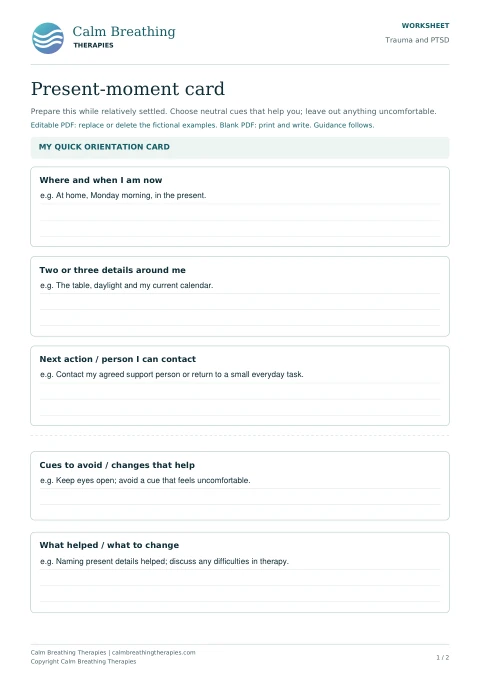
Where and when I am now
Two or three details around me
Next action / person I can contact
Cues to avoid / changes that help
What helped / what to change
Reflect
Which cue helped me connect with the current surroundings, without forcing a particular feeling?
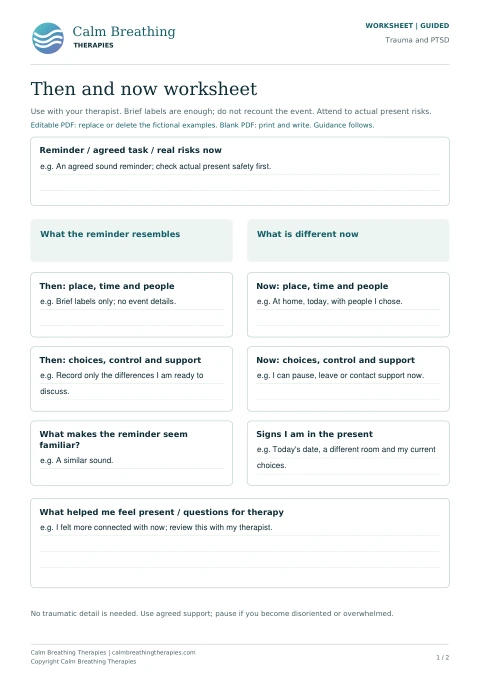
A sound, smell or place can resemble part of a traumatic experience and trigger a strong sense of present threat. Trigger discrimination is a cognitive therapy technique for recognising the reminder while noticing concrete differences in the current situation. It is usually learnt with a therapist before home practice. The task is not to argue with the feeling or repeat that you are safe until convinced; it is to look for actual present-day information.
How to use it
Use only a reminder and practice method already agreed with your therapist.
Name the reminder briefly, without describing the trauma in detail.
Check the current situation for real risk before drawing comparisons.
Notice specific differences in place, people, time, choices or available support.
Record what helped you reconnect and what needs discussion before another practice.
A fictional worked example
Chris noticed that the smell of a cleaning product brought a sudden sense of being back in an earlier frightening situation. In therapy, he learnt to distinguish the reminder from the present. At home he used a brief label for the smell and looked around: this was his own kitchen, daylight was coming through the window and he could decide to leave the room. He did not deliberately intensify the smell or recreate the event. Some distress remained, but the present became clearer. He noted the differences and brought back a question about why one particular cue was still difficult to recognise.
Keep in mind
Introduce this with a trauma-trained therapist. Do not deliberately recreate the trauma or use overwhelming reminders on your own. A current threat must not be dismissed as a memory. Pause if you become detached or disoriented and use the agreed support plan.
Worksheet prompts
Reminder / agreed task / real risks now
Then: place, time and people
Now: place, time and people
Then: choices, control and support
Now: choices, control and support
What makes the reminder seem familiar?
Signs I am in the present
What helped me feel present / questions for therapy
Reflect
Which real difference was most useful, and what needs more guided practice?
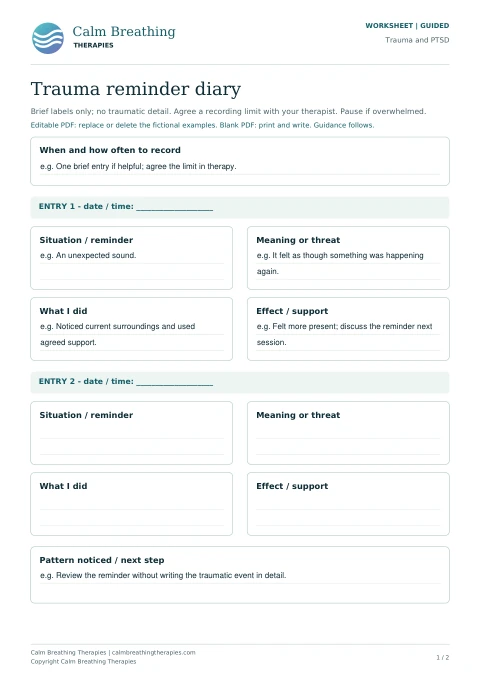
Brief monitoring can make experiences easier to discuss without having to remember every episode in a session. Record only enough to identify a possible trigger and what followed. You may use neutral labels or abbreviations. The aim is to understand a pattern, not to make yourself repeatedly inspect memories or sensations. Agree a manageable amount of monitoring with your therapist and review whether it is helping rather than increasing preoccupation.
How to use it
Agree when and how briefly to record; a few examples may be enough.
Note the situation or possible reminder using a simple label.
Describe the meaning or feeling of threat that appeared in the present.
Record your response and its effect, including any helpful support.
Bring patterns or unanswered questions to therapy; do not analyse every entry alone.
A fictional worked example
Maya could remember feeling unsettled during the week but struggled to explain when it happened. She and her therapist agreed to note up to three examples in a few words. One entry read: “Bus brake sound; felt trapped; got off early; relief, then missed class.” Another recorded a similar sound while walking, when she remained with a friend and continued home. Comparing these examples helped them understand the role of feeling unable to leave. Maya did not write the traumatic event again or monitor every bus journey. The notes were a starting point for their conversation, not a daily performance target.
Keep in mind
Stop monitoring if it increases intrusive memories, detachment or persistent repetitive thinking, and discuss this with your therapist. Do not include identifying or graphic details unless needed in a secure therapeutic context. A worksheet does not replace assessment of new physical symptoms or current danger.
Worksheet prompts
When and how often to record
Situation / reminder
Meaning or threat
What I did
Effect / support
Pattern noticed / next step
Reflect
What pattern is worth exploring together, rather than trying to solve every episode by myself?
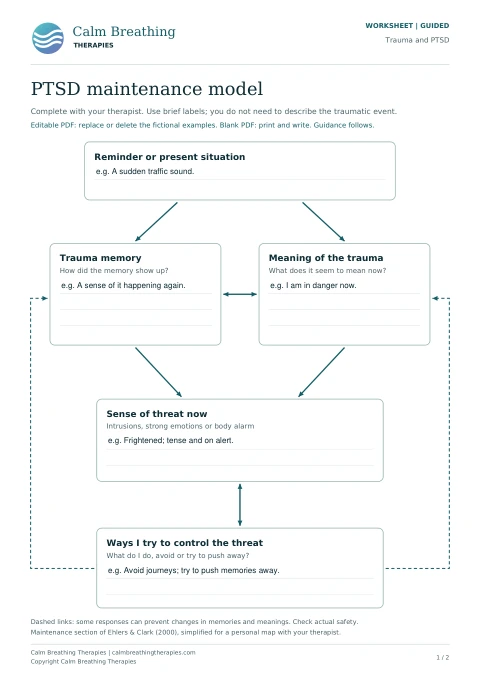
Ehlers and Clark’s model explains how trauma memories and the meanings given to the trauma can create a sense of serious threat in the present. This sheet focuses on those maintaining relationships, rather than the full history of how PTSD develops. Memories and meanings can influence each other. Ways of controlling threat can sometimes keep it going or prevent new learning. A therapist helps distinguish this pattern from actual current danger.
How to use it
With your therapist, use a brief label for a reminder or current situation. No traumatic detail is needed.
Describe how the memory shows up, and what the event or its effects seem to mean now. Follow the two-way link between these boxes.
Add the sense of threat in the present: emotions, body alarm or intrusions.
Describe how you try to control the threat. The two-way link means threat and these responses can affect each other.
Discuss the dashed return arrows: do any responses prevent changes in memories or meanings? Record real risks, support and treatment plans separately with your therapist.
A fictional worked example
A sudden traffic sound gives Tom a sense that a road incident is happening again. He thinks, "I am in danger now", feels alarmed and becomes watchful. He avoids journeys and tries to push the memory away. These understandable responses may stop him learning what is different in the present. His therapist also checks an actual issue: roadworks make his usual route unsafe. They plan around this real risk and select a supported treatment focus. The map is not a request to relive the event alone.
Keep in mind
Complete with a trauma-trained therapist. Do not use the map for unsupported reliving, memory updating or exposure. Actual danger, unstable housing, abuse or unmet health needs must be addressed in their own right. Pause if mapping the pattern becomes overwhelming or disorienting.
Worksheet prompts
Reminder or present situation
Trauma memory: How did the memory show up?
Meaning of the trauma: What does it seem to mean now?
Sense of threat now: Intrusions, strong emotions or body alarm
Ways I try to control the threat: What do I do, avoid or try to push away?
Reflect
Which part of this map feels accurate, and which needs changing or more understanding?
Trauma can take time and attention away from relationships, interests and ordinary routines. Rebuilding life means making space for those things again in manageable ways. It can happen alongside appropriate trauma-focused treatment and does not require you to wait until every symptom has gone. Choose something relevant to your current circumstances. This is not a hidden exposure task: if the activity strongly triggers trauma memories, plan it with your therapist first.
How to use it
Name one part of life you miss or would like to develop now.
Choose a small action that is achievable with current energy and circumstances.
Plan when, where and what support or adaptation you need.
Try the action without demanding that you enjoy it or feel completely calm.
Review participation, connection and any difficulties; adapt the next step.
A fictional worked example
Zara used to cook with her sister but had stopped arranging evenings together. She wanted some ordinary company without having to discuss the trauma. Her first step was making a simple lunch at home while her sister visited for half an hour. She told her sister that conversation about everyday things would help. Zara felt distracted at times and the meal was not especially enjoyable, but she noticed a few moments of connection. Her review recorded that she had done something she valued. They planned another brief visit rather than increasing the task because she felt she ought to be further ahead.
Keep in mind
Choose activities with ordinary safety and your current health needs in mind. If an activity involves a strong trauma reminder or substantial dissociation, agree it in therapy first. Practical barriers may need support or adjustment, not more effort from you.
Worksheet prompts
Activity and why it matters to me
First step / smaller version
When, where / support / health advice
Prediction / likely obstacle
How I will respond and adapt
What I did and what I noticed
Learning / next step
Reflect
What did taking part make possible, even if enjoyment or confidence was limited?
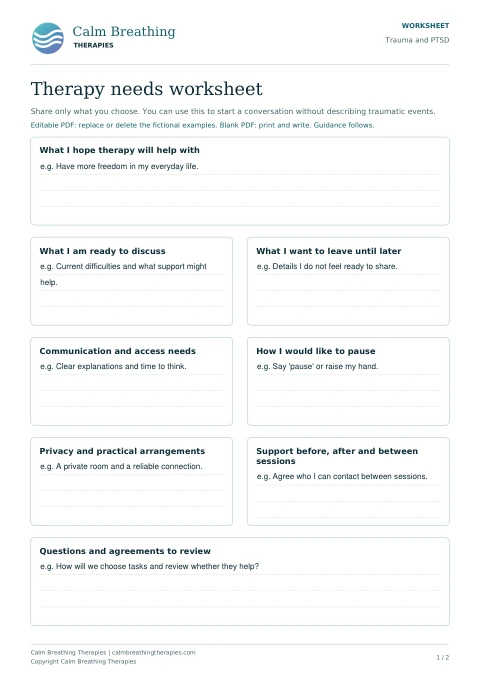
You can ask for support without presenting a full account of what happened. A clear plan can help a therapist understand your current needs and make appointments more manageable. It may include communication preferences, privacy, pacing and practical support. This worksheet also creates room to say what has felt unhelpful before. It does not prescribe treatment or make you responsible for managing every difficulty; assessment and planning are shared work.
How to use it
Write what is most difficult now and what you hope support might change.
Identify information you are ready to share and anything you prefer to discuss later.
Note communication or access needs and how you would signal a pause.
List practical arrangements before and after appointments, including a trusted contact if wanted.
Bring questions about suitability, confidentiality, treatment and support between sessions.
A fictional worked example
Before an online appointment, Daniel wrote that poor sleep and feeling constantly on guard were his main concerns. He did not feel ready to describe the event in detail. He asked the therapist to explain the purpose of questions and agreed a phrase he could use if he needed to pause. He arranged a private room and left some time afterwards before returning to work. His questions included what trauma-focused CBT would involve and what to do if symptoms worsened between sessions. The sheet helped start a conversation; it did not commit him to a particular exercise or require disclosure before he felt ready.
Keep in mind
If privacy cannot be maintained or someone is monitoring your communications, discuss safer contact arrangements with an appropriate service. Current danger and safeguarding needs take priority. This sheet is not a crisis plan; use the support arrangements agreed with your care team when urgent help is needed.
Worksheet prompts
What I hope therapy will help with
What I am ready to discuss
What I want to leave until later
Communication and access needs
How I would like to pause
Privacy and practical arrangements
Support before, after and between sessions
Questions and agreements to review
Reflect
What would help me feel able to ask questions and participate in decisions about treatment?
Progress after trauma is often uneven. An anniversary, stress or an unexpected reminder can bring symptoms back without meaning that all learning has been lost. A review should include everyday functioning, connection and choices, as well as distress. This sheet helps you retain what has been helpful and plan when to seek support. It is not a substitute for treatment review, and it should not make you feel responsible for preventing every difficult day.
How to use it
Identify changes in ordinary life, even if symptoms remain.
Record specific learning or responses developed with your therapist.
Notice early signs that you are becoming more isolated, avoidant or overwhelmed.
Choose a manageable response and a person or service to contact.
Set a review date and agree signs that need prompt professional attention.
A fictional worked example
Ella noticed more nightmares around an anniversary and worried that she was back at the beginning. Her review showed that she was still seeing a friend, recognising some reminders and using the support plan agreed in therapy. She reduced unnecessary commitments for the week and contacted her therapist to discuss the change. She did not independently increase exposure or try to force herself to revisit memories. Together they reviewed what was happening and adjusted the plan. The worksheet helped her see both the increased difficulty and the abilities she had retained, rather than judging recovery by one night’s sleep.
Keep in mind
Seek professional advice for substantial worsening, severe disconnection from yourself or your surroundings or difficulty maintaining safety or daily care. Do not restart intensive trauma-processing exercises independently. If current danger emerges, prioritise practical protection and appropriate urgent support rather than treating it as a routine setback.
Worksheet prompts
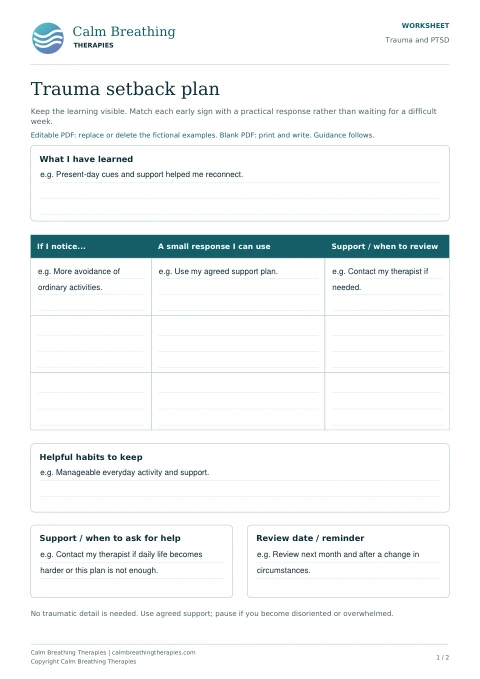
What I have learned
If I notice...
A small response I can use
Support / when to review
Helpful habits to keep
Support / when to ask for help
Review date / reminder
Reflect
What remains available to me during a difficult week, and what support should I use sooner?
Print or type. The worksheet comes first in every individual PDF, with guidance afterwards. Choose “Editable PDF · examples” for a short fictional example in each box or first diary entry. Select the text to replace or delete it in a PDF reader, then save a private copy. Later diary entries and table rows are blank. Choose “Blank PDF · print” for writing by hand. Browser PDF viewers vary. The complete toolkits contain blank printable sheets.
Read online. Read step-by-step guidance, a fictional example and the worksheet prompts as HTML under “Read the guidance and example”. You can use those prompts in your own notes. Completed answers are not collected by this site.
Choosing and using trauma & ptsd worksheets
After trauma, reminders can feel as though the event is happening again, and ordinary life can become organised around avoiding threat. These resources offer a careful starting point for noticing the pattern, reconnecting with the present and preparing conversations with a therapist. They do not ask you to write a detailed trauma account or relive an event on your own. Some sheets are intended to be introduced in therapy before home practice. You can leave sections blank, use a simple label for an experience and decide what feels manageable. Current safety and practical needs come first.
If you are unsure where to begin, use the present-orientation plan or the support-and-needs sheet. Practise a brief neutral exercise when you are relatively settled so you can judge whether it is helpful. You do not need to force attention onto bodily sensations, close your eyes or complete a fixed sequence if any of those increases distress.
Trigger discrimination and a personal maintenance formulation are best introduced with a trauma-trained therapist. These sheets can hold the agreed plan afterwards. The purpose is to notice how a reminder differs from the current situation, while recognising any genuine threat. They do not establish that every fear is a memory, and they are not instructions for independent trauma exposure.
Use the rebuilding-life and review sheets to choose manageable activities and notice changes over time. Persistent PTSD needs an individual assessment and evidence-based treatment. For people aged 16-17, treatment and these materials need appropriate developmental adaptation, consent and support arrangements. Severe dissociation, current danger or rapidly worsening distress may mean a different level of support is needed before practice.
Suitability and support
Do not use these sheets to conduct reliving, imaginal exposure, trauma narratives or memory updating without appropriate therapy. Pause if you become more disoriented, detached or overwhelmed, and follow your agreed support plan. Ongoing abuse, coercion or danger needs practical safeguarding support, not reinterpretation as a false alarm. Seek professional assessment if symptoms persist or substantially affect daily life. These materials do not provide crisis care.
Supportive exercises consistent with Ehlers and Clark’s (2000) cognitive model of PTSD and NICE NG116. They cover selected between-session tasks, not the full trauma-focused CBT treatment protocol.
Original materials for Calm Breathing Therapies. The cited organisations do not endorse these worksheets. Evidence, use and limitations · Version 3.0 · 26 October 2026.
Support when you want it
Sometimes it helps to work through it together.
These resources can be a useful starting point. If you are considering CBT, a FREE 5–10 minute consultation gives you space to discuss whether it might be suitable for you. There is no pressure to book.
Online CBT for people aged 16 and over across the UK. Suitability and the format of therapy are assessed individually. You can also read about how CBT for trauma and PTSD works.

 View worksheet