Stress often reflects real demands as well as the way you respond to them.
Download free CBT self-help worksheets for stress and overwhelm, including problem-solving, coping and activity planning templates. Use these fillable PDFs to identify pressures and consider realistic next steps.
Preview the actual templates below. Worksheets come first in every PDF, with guidance afterwards.
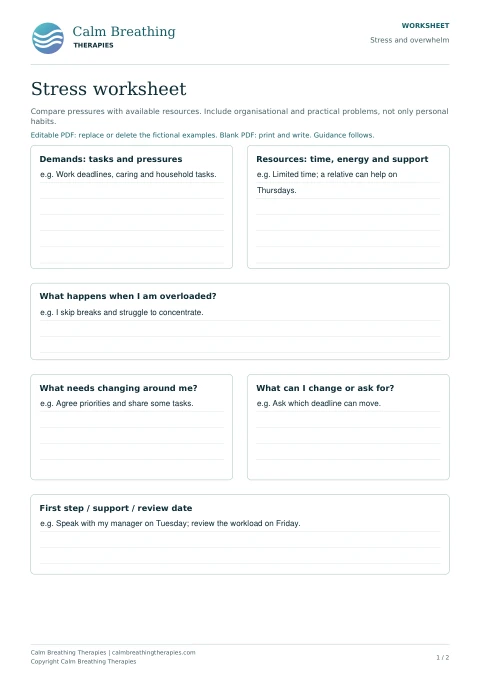
Stress can arise when demands exceed available time, energy, control or support. This map compares the demands around you with the resources you can draw on. It makes room for organisational and practical changes as well as personal responses. It is not a circular disorder model and does not assume that stress is caused mainly by faulty thinking.
How to use it
List the main demands and what each requires from you.
Note the time, energy, control and support actually available.
Identify thoughts or rules that increase pressure, without dismissing genuine obligations.
Record how you respond and what happens to recovery or support.
Choose one practical need and one possible response to discuss or change.
A fictional worked example
Rina was caring for a relative while covering extra shifts. She told herself that asking for help would let everyone down, skipped breaks and answered messages late at night. Her map showed that the workload was genuinely too large, not simply a problem with her attitude. She identified a rota discussion and advice about caring support as practical priorities. She also noticed that replying immediately to every non-urgent message extended the working day. Her first plan combined asking for help with one agreed limit on evening messages. She did not set a goal of becoming calm enough to tolerate unlimited demands.
Keep in mind
Include actual inequalities, illness and unsafe conditions; do not use the map to blame yourself for them. If workload or relationships pose a risk, seek appropriate support. New physical symptoms need suitable healthcare advice rather than being assumed to be stress.
Worksheet prompts
Demands: tasks and pressures
Resources: time, energy and support
What happens when I am overloaded?
What needs changing around me?
What can I change or ask for?
First step / support / review date
Reflect
What needs to change around me, and what small response is within my control?
When several problems compete for attention, thinking harder can become another source of overload. Structured problem solving narrows the task to one specific difficulty and a step you can actually try. It works best for a practical problem with some possibility of action. It is less useful for repeatedly asking what might happen in an uncertain future. You can acknowledge that uncertainty while choosing what is within reach today.
How to use it
Describe one specific problem and a realistic outcome you would prefer.
List several options before judging them, including asking for help.
Compare likely benefits, costs, feasibility and any safety concerns.
Choose one small step; specify who, when and what support is needed.
Review what happened on an agreed date and adapt the plan.
A fictional worked example
Lewis felt overwhelmed by missed household bills and kept reopening the same letters without acting. He defined the immediate problem as not knowing which payment needed attention first. Possible options included making a short list, contacting the providers or asking a trusted relative to sit with him. He chose to list the letters on Saturday morning with support, then contact one provider about available arrangements. The plan did not solve every financial difficulty, but it made the next action clear. At review he noted which information was still missing and decided whether specialist advice would be useful.
Keep in mind
Use qualified advice for financial, legal, employment or medical decisions; this sheet organises thinking rather than providing that advice. If there is immediate danger, act on safety needs first. Problems outside your control may need support and acceptance of limits rather than more planning.
Worksheet prompts
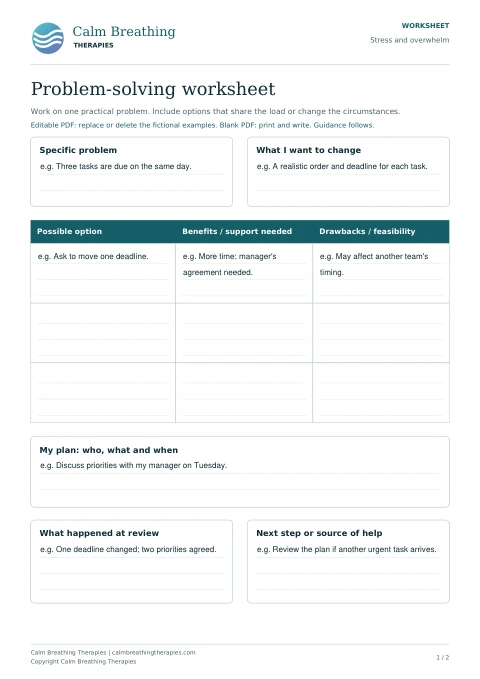
Specific problem
What I want to change
Possible option
Benefits / support needed
Drawbacks / feasibility
My plan: who, what and when
What happened at review
Next step or source of help
Reflect
Did the plan create a useful action, or did I return to repeatedly thinking without acting?
A boundary describes what you can realistically offer or what needs to change. It does not guarantee that another person will agree or feel pleased. Planning the conversation can help you be clear about the demand, its effect and the request, without overexplaining or promising more than you can manage. In situations with a power imbalance, practical support may be needed. A safe and fair context matters as much as wording.
How to use it
Identify the specific demand and its effect on your work, health or responsibilities.
Decide the request or limit in clear, realistic terms.
Draft a brief statement and any workable alternative.
Consider likely responses and how to repeat the request without overcommitting.
Choose timing and support; review what happened and whether further action is needed.
A fictional worked example
Haroon was regularly asked to take on additional tasks near the end of his shift. He prepared a discussion with his manager: “I can complete the urgent report today. If I also take this new task, the other deadline will need to move. Which should I prioritise?” His aim was to clarify workload, not prove that the manager was wrong. He brought a factual list of current tasks and noted the agreed priorities afterwards. The conversation did not remove all pressure, but it replaced an unspoken assumption that everything would be done. He planned to seek further support if the pattern continued.
Keep in mind
Do not use a direct boundary experiment where it could increase abuse, coercion or retaliation. Seek suitable support first, such as a trusted professional or workplace representative. Do not remove essential caring or safety responsibilities without an appropriate alternative arrangement.
Worksheet prompts
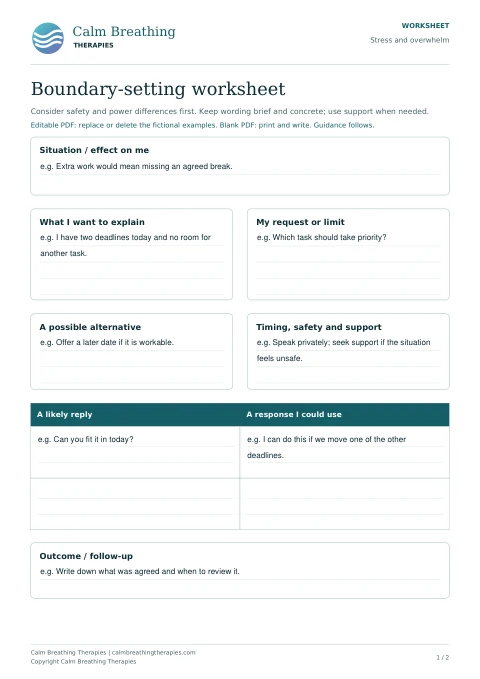
Situation / effect on me
What I want to explain
My request or limit
A possible alternative
Timing, safety and support
A likely reply
A response I could use
Outcome / follow-up
Reflect
Was I able to communicate a realistic need, and what support or structural change is still required?
Personal rules can provide direction, but very rigid standards may make ordinary tasks take far more time and energy than they need. An experiment tests one prediction about changing a rule slightly. It does not ask you to become careless or lower important professional standards. Choose a low-stakes task where a reasonable standard is clear. The learning comes from observing the result, not simply telling yourself to stop being a perfectionist.
How to use it
Write the rule and identify how it affects time, effort or recovery.
Choose a low-risk task and define a reasonable standard in advance.
Predict what would happen if you reduced one unnecessary extra effort.
Try the agreed change without replacing it with reassurance or hidden rechecking.
Compare the result with the prediction and consider a more flexible rule.
A fictional worked example
Sofia spent half an hour rewriting informal messages about social plans because she feared sounding thoughtless. She chose one low-stakes message and agreed a reasonable standard: clear, polite and accurate. Her prediction was that sending it after one ordinary read-through would lead to criticism. She sent the message and returned to another activity without asking a friend to check it. The reply simply confirmed the plan. Sofia noticed that she still felt uncertain for a while, but had saved time. Her new rule was that everyday messages can be considerate without being polished repeatedly. She did not apply the experiment to safety-critical work.
Keep in mind
Choose low-risk tasks only. Retain clinical, legal, safeguarding, technical and other required checks. Do not use this exercise to test genuinely unsafe shortcuts or ignore disability-related support needs. If a rule concerns severe OCD or trauma symptoms, seek an approach matched to your individual difficulty.
Worksheet prompts
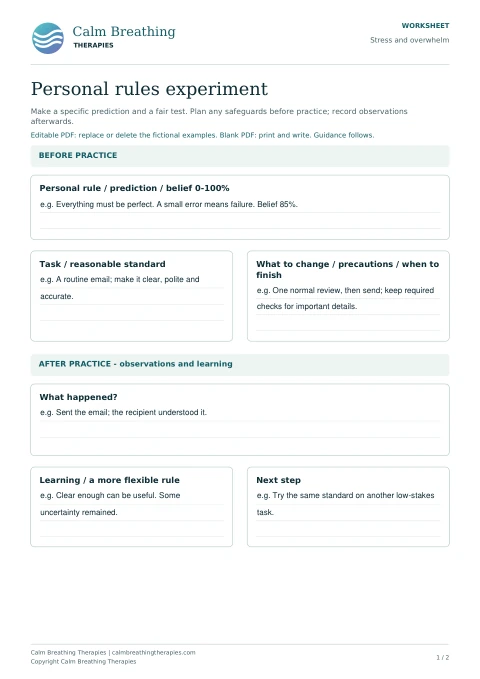
Personal rule / prediction / belief 0-100%
Task / reasonable standard
What to change / precautions / when to finish
What happened?
Learning / a more flexible rule
Next step
Reflect
What standard was genuinely needed, and what extra effort mainly served the fear?
When pressure rises, breaks, meals, connection and sleep routines are often the first things squeezed out. This can leave less capacity for the next demand. Recovery planning is not a promise that a brief break will solve an excessive workload. It helps you protect a few practical needs while identifying what must be reduced, shared or changed. Choose a plan for your actual week, including the possibility that energy will vary.
How to use it
Identify essential commitments and what can be delayed, simplified or shared.
Choose a few recovery actions that feel realistic and restorative to you.
Place them alongside tasks rather than waiting until everything is finished.
Plan a smaller version and support for demanding days.
Review whether the plan helped capacity and what structural pressures remain.
A fictional worked example
Ben worked rotating shifts and cared for his children on days off. A rigid daily wellbeing timetable felt impossible. He instead identified a few flexible anchors: eating during a planned break, a short quiet transition after work and one conversation with a friend each week. He also asked a family member to share one practical task. Some days the quiet transition was only a few minutes. His review focused on whether those changes were useful and achievable, not whether he completed a perfect routine. He noted that staffing pressure still needed a workplace conversation; personal recovery time could not solve that problem alone.
Keep in mind
Adapt plans for health conditions, disability, caring responsibilities and shift patterns. Do not replace treatment or necessary support with self-care tasks. Persistent exhaustion, major sleep disturbance or concerning physical symptoms merit appropriate professional advice. Recovery should not require ignoring essential safety needs.
Worksheet prompts
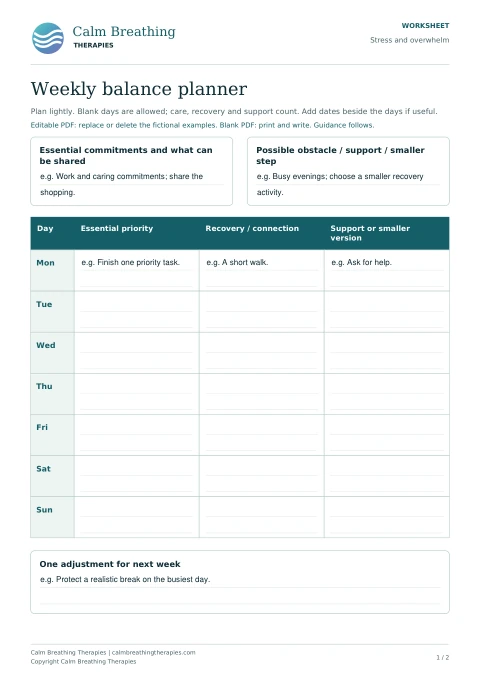
Essential commitments and what can be shared
Possible obstacle / support / smaller step
Essential priority
Recovery / connection
Support or smaller version
One adjustment for next week
Reflect
Did this plan support my capacity, or did it become another demand that needs simplifying?
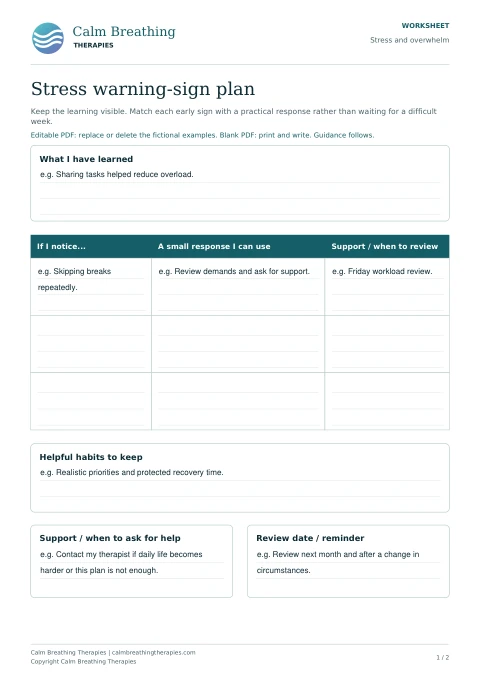
An early-warning plan links signs of overload with actions you can recognise and use. It should include changes in circumstances, not just symptoms inside you. For example, extra responsibilities may call for a workload conversation rather than another calming exercise. Review the plan when things are relatively settled and after demanding periods. It is a guide to noticing and responding sooner, not a way to guarantee that stress will never return.
How to use it
List your early signs in thoughts, body, behaviour and daily routine.
Identify circumstances that make overload more likely.
Match each sign with one realistic action or source of support.
Define what would mean the current plan is insufficient and professional help is needed.
Set a review date and keep the plan somewhere easy to find.
A fictional worked example
Jodie noticed that overload usually began with skipping lunch, rereading emails late at night and becoming short-tempered at home. Her plan linked those signs to a review of current demands, a conversation about priorities and asking for practical help. After several weeks of pressure, she also noticed persistent low mood and difficulty sleeping. Rather than adding more tasks to her self-help plan, she arranged a healthcare discussion. The sheet helped her distinguish an ordinary busy week from a pattern needing more support. She kept useful strategies from earlier weeks while accepting that circumstances and needs could change.
Keep in mind
Seek assessment if distress persists, functioning deteriorates or physical symptoms concern you. This is not a diagnostic checklist or crisis plan. If a situation becomes unsafe, prioritise appropriate protection and urgent support rather than waiting for the scheduled review.
Worksheet prompts
What I have learned
If I notice...
A small response I can use
Support / when to review
Helpful habits to keep
Support / when to ask for help
Review date / reminder
Reflect
What would help me act a little earlier next time, without blaming myself for becoming stressed?
Print or type. The worksheet comes first in every individual PDF, with guidance afterwards. Choose “Editable PDF · examples” for a short fictional example in each box or first diary entry. Select the text to replace or delete it in a PDF reader, then save a private copy. Later diary entries and table rows are blank. Choose “Blank PDF · print” for writing by hand. Browser PDF viewers vary. The complete toolkits contain blank printable sheets.
Read online. Read step-by-step guidance, a fictional example and the worksheet prompts as HTML under “Read the guidance and example”. You can use those prompts in your own notes. Completed answers are not collected by this site.
Choosing and using stress & overwhelm worksheets
Stress often reflects real demands as well as the way you respond to them. These resources help you look at both sides: workload, caring responsibilities and support, alongside rules such as having to manage everything perfectly. They offer practical planning tools, not another list of things you ought to accomplish. Begin with one pressure and choose a small change that is within reach. Some changes require help from an employer, family member or service. Rest, boundaries and asking for support are legitimate parts of a plan, even when circumstances cannot be solved quickly.
Use the demands-and-resources map to identify the pressures you face and what is realistically within your control. Include money, health, discrimination, caregiving and workplace conditions where relevant. The aim is not to reinterpret every difficulty as faulty thinking. Some situations need practical assistance, reasonable adjustments or organisational change alongside psychological support.
Choose one worksheet that fits the next step: structured problem solving for an actionable difficulty, a boundary conversation for an unsustainable demand, or an experiment with an overly strict rule. Keep the task small enough for the week you are actually having. Record the outcome so you can adapt the plan rather than judging yourself by whether it worked first time.
Use the recovery and early-warning plan to make changes sustainable. These sheets can be discussed in CBT or used as brief reflection tools. For people aged 16-17, examples and support arrangements should be adapted with an appropriately trained therapist. If stress is accompanied by persistent low mood, panic, trauma symptoms or severe impairment, seek assessment rather than assuming one generic stress strategy will fit.
Suitability and support
A worksheet cannot resolve unsafe working conditions, abuse, financial hardship or medical problems. Seek appropriate practical or professional support. New or concerning physical symptoms should not automatically be attributed to stress. Avoid boundary or behavioural experiments that could expose you to retaliation or genuine danger. Where a relationship or workplace is unsafe, plan support first rather than trying to manage it through a scripted conversation alone.
Individualised CBT formulation, behavioural experiments and practical problem solving. Stress is treated as a response to demands rather than a separate diagnosis; HSE guidance informs consideration of real workplace pressures.
Original materials for Calm Breathing Therapies. The cited organisations do not endorse these worksheets. Evidence, use and limitations · Version 3.0 · 26 October 2026.
Support when you want it
Sometimes it helps to work through it together.
These resources can be a useful starting point. If you are considering CBT, a FREE 5–10 minute consultation gives you space to discuss whether it might be suitable for you. There is no pressure to book.
Online CBT for people aged 16 and over across the UK. Suitability and the format of therapy are assessed individually. You can also read about how CBT can help with stress and overwhelm.

 View worksheet