11 original resources · Free PDF downloads

Free CBT Worksheets for Phobias & Exposure Planning

A phobia can shrink everyday choices: postponing a blood test, avoiding a room or planning a journey around a fear.

Download free CBT worksheets for specific phobias, including fears of needles, blood and spiders. Resources include fear hierarchies, phobia cycle templates and exposure planning records. Some practices, particularly those involving fainting or medical procedures, require professional guidance.

Preview the actual templates below. Worksheets come first in every PDF, with guidance afterwards.

Resources marked “Plan with a therapist” need individual guidance. Read suitability and support.

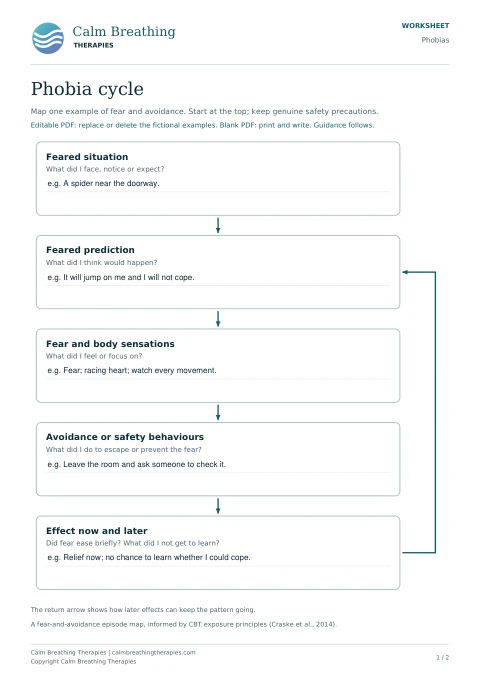
Worksheet with editable fictional examples: Phobia cycle View worksheet
See the sheet before you download

Worksheets and practical tools

Select a preview to enlarge it. Every PDF is free, with no registration.

Worksheet with editable fictional examples: Phobia cycle View worksheet
Free worksheet

Phobia cycle

Follow a fear-and-avoidance cycle: the trigger, prediction, feelings, response and what remains untested.

2 pages · A4 · Fillable PDF · 125 KB

Read the guidance and example

A phobia often involves a particular prediction as well as fear. You might expect harm, loss of control, unbearable disgust or difficulty coping. Escaping or relying on a special routine can bring relief while leaving that prediction untested. This map makes the pattern visible using one ordinary example. It does not assume all danger is imagined, and it does not ask you to start exposure before you have a suitable plan.

How to use it

  1. Choose one recent episode, without deliberately seeking out the feared trigger.
  2. Describe the trigger and finish: “I expected that…” Include what that would mean to you.
  3. Notice feelings, bodily sensations and where your attention went.
  4. Record what you did, including avoidance, checking or asking someone else to take over.
  5. Read from top to bottom, then follow the return arrow. Which link fits your experience? Discuss a possible change separately; the change itself is not part of the maintaining cycle.

A fictional worked example

When a moth entered the hallway, Priya expected it to fly into her face and thought she would be unable to stay in the house. Her stomach tightened and she watched the doorway closely. She shut herself in the bedroom and asked her partner to check every room. She felt relieved when told it was gone, but next evening checked the hallway before entering. Her map showed that repeated checks were becoming part of the problem. She chose to discuss a gradual plan for using the hallway again, rather than demanding that she stop feeling afraid immediately.

Keep in mind

Keep this exercise descriptive. A map alone does not establish that a situation is safe. If fear involves fainting, physical symptoms, animals or medical procedures, include those concerns in assessment before deciding what to practise.

Worksheet prompts

  • Feared situation: What did I face, notice or expect?
  • Feared prediction: What did I think would happen?
  • Fear and body sensations: What did I feel or focus on?
  • Avoidance or safety behaviours: What did I do to escape or prevent the fear?
  • Effect now and later: Did fear ease briefly? What did I not get to learn?

Reflect

What does the pattern help me understand, and what would I like more freedom to do?

Sources: Craske, M. G., Treanor, M., Conway, C. C., Zbozinek, T., & Vervliet, B. (2014). Maximizing exposure therapy: An inhibitory learning approach. Behaviour Research and Therapy, 58, 10-23., NHS. Phobias. Accessed 24 October 2026.
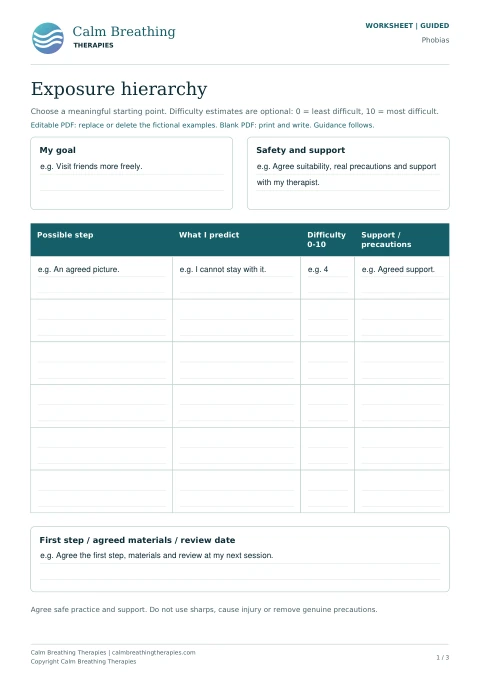
Worksheet with editable fictional examples: Exposure hierarchy View worksheet
Plan with a therapist

Exposure hierarchy

Build personally meaningful practice steps, with predictions, support and genuine precautions.

3 pages · A4 · Fillable PDF · 178 KB

Read the guidance and example

A hierarchy turns a broad goal into practical options. Steps should relate to what you want to reclaim, not to somebody else’s idea of bravery. Difficulty may change with distance, setting, duration or support. Start with a useful, manageable step and adjust after learning from it. A low anxiety score is not the only sign of progress: taking part, testing a prediction and relying less on unnecessary safety habits also matter.

How to use it

  1. Write a goal in everyday terms, such as using a room or attending necessary healthcare.
  2. List possible steps that approach the fear without introducing real hazards.
  3. For each step, record the feared prediction and approximate difficulty from 0 to 10.
  4. Identify ordinary safety precautions and support that must remain.
  5. Choose one step to plan in detail; revise the order after you review experience.

A fictional worked example

Sam wanted to visit a friend who owned a calm dog. With his therapist and the owner, he listed possible steps: discussing the visit, seeing the dog from a distance, sitting in the garden while the dog stayed with its owner, then sharing a room at an agreed distance. His prediction was that he would lose control and be unable to speak. He did not include touching the dog because that was not needed for his goal. The owner’s normal animal-management precautions remained. The first practice step was chosen collaboratively, and Sam planned to record what he actually managed.

Keep in mind

Plan animal encounters with a responsible handler; never approach unfamiliar animals as a test. For blood or needle fears, account for fainting and healthcare advice. A hierarchy does not require real injuries, unnecessary procedures or removal of medical precautions.

Worksheet prompts

  • My goal
  • Safety and support
  • Possible step
  • What I predict
  • Difficulty 0-10
  • Support / precautions
  • First step / agreed materials / review date
  • Chosen step / prediction
  • What I will look for
  • Habit to change / support to keep
  • When, where and agreed endpoint
  • What actually happened
  • Learning / next agreed step

Reflect

Which step would give useful new information, rather than simply feel like a test of endurance?

Sources: Craske, M. G., Treanor, M., Conway, C. C., Zbozinek, T., & Vervliet, B. (2014). Maximizing exposure therapy: An inhibitory learning approach. Behaviour Research and Therapy, 58, 10-23., NHS. Phobias. Accessed 24 October 2026.
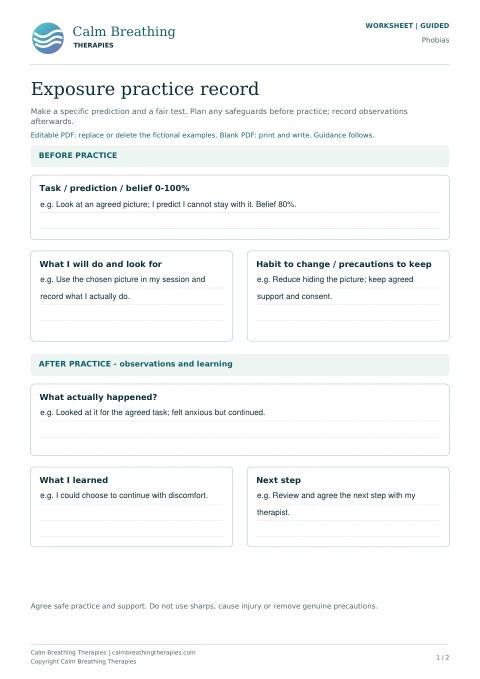
Worksheet with editable fictional examples: Exposure practice record View worksheet
Plan with a therapist

Exposure practice record

Prepare one agreed exposure exercise and review observations, coping and learning.

2 pages · A4 · Fillable PDF · 126 KB

Read the guidance and example

Exposure gives you an opportunity to learn something different about a feared situation. The question is not just “Did I feel calmer?” but “What did I predict, and what happened?” Agree a clear task and a reasonable opportunity to observe it. Anxiety may rise, fluctuate or remain present. Reviewing the outcome helps distinguish what you learnt from the feeling of threat, and prevents a difficult attempt being dismissed as a failure.

How to use it

  1. Specify one agreed task, location, timing and practical precautions.
  2. Write an observable prediction and estimate belief from 0 to 100%.
  3. Agree one unnecessary safety habit to reduce, while retaining genuine protection.
  4. Carry out the planned task with suitable support; record what happened rather than checking anxiety constantly.
  5. Review the prediction, coping and remaining uncertainty. Agree what to repeat or adapt.

A fictional worked example

Leah expected that standing inside a lift for one short journey would make her panic so much that she could not leave at her floor. After assessment, she and her therapist agreed a suitable journey and normal lift precautions. She practised without repeatedly asking whether she looked all right. Her heart raced and she felt a strong urge to escape, but she stayed for the agreed journey and stepped out at the planned floor. Her learning was that feeling trapped did not prevent her taking the next action. They agreed to repeat the task before changing the setting.

Keep in mind

Use only collaboratively agreed, ordinarily safe situations. Do not lock yourself in, restrict exits or rely on strangers to manage an emergency. Stop for a genuine safety or medical concern. Review unexpected difficulties with your therapist before increasing challenge.

Worksheet prompts

  • Task / prediction / belief 0-100%
  • What I will do and look for
  • Habit to change / precautions to keep
  • What actually happened?
  • What I learned
  • Next step

Reflect

What would I tell myself about this experience before the next attempt?

Sources: Craske, M. G., Treanor, M., Conway, C. C., Zbozinek, T., & Vervliet, B. (2014). Maximizing exposure therapy: An inhibitory learning approach. Behaviour Research and Therapy, 58, 10-23.

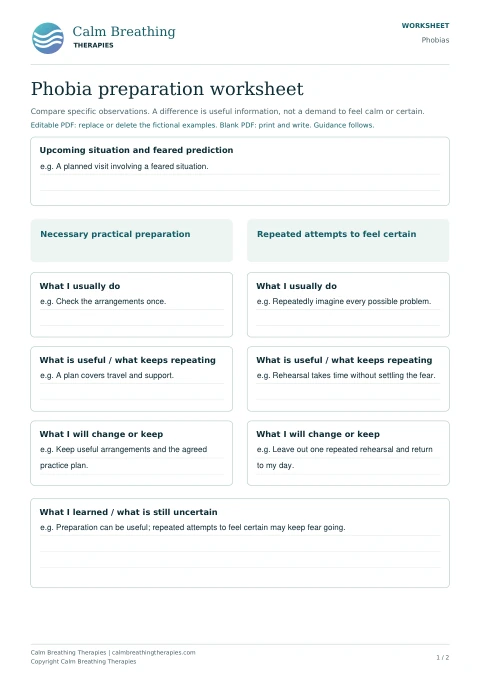
Worksheet with editable fictional examples: Phobia preparation worksheet View worksheet
Free worksheet

Phobia preparation worksheet

Separate necessary preparation from repeated attempts to feel certain before a feared situation.

2 pages · A4 · Fillable PDF · 129 KB

Read the guidance and example

Fear can occupy hours before you encounter the trigger. Replaying worst-case scenes, checking repeatedly or cancelling can make the event feel even more threatening. This worksheet separates useful preparation from attempts to obtain complete certainty. The aim is not to ban anxious thoughts. It is to choose what preparation is actually needed, then return to an ordinary activity while uncertainty and discomfort are allowed to be present.

How to use it

  1. Name the upcoming situation and the main prediction.
  2. List what you do beforehand and whether each action gives practical help or brief reassurance.
  3. Choose necessary preparation, including health or access needs.
  4. Set a realistic point to finish preparation and choose what to do next.
  5. Afterwards, review what was useful and which habits increased the build-up.

A fictional worked example

Owen had agreed to visit a garden where insects might be present. He spent the evening researching every insect he could encounter and repeatedly checking the weather. His therapist helped him separate ordinary preparation from the search for certainty. He checked the travel plan once, packed what he normally needed and stopped searching for insect information. He then cooked dinner despite feeling unsettled. At the visit he still noticed insects, but the evening beforehand had been less dominated by preparation. He recorded that stopping the search did not remove uncertainty; it gave him time back and made attendance more manageable.

Keep in mind

Keep genuine preparation, accessibility arrangements and medical instructions. Do not stop appropriate checking of real hazards. If a planned event is unsafe, changing the plan is appropriate. This sheet does not require you to proceed regardless of your circumstances.

Worksheet prompts

  • Upcoming situation and feared prediction
  • What I usually do
  • What is useful / what keeps repeating
  • What I will change or keep
  • What I learned / what is still uncertain

Reflect

Which preparation helped me participate, and which mainly kept my attention on danger?

Sources: Craske, M. G., Treanor, M., Conway, C. C., Zbozinek, T., & Vervliet, B. (2014). Maximizing exposure therapy: An inhibitory learning approach. Behaviour Research and Therapy, 58, 10-23.

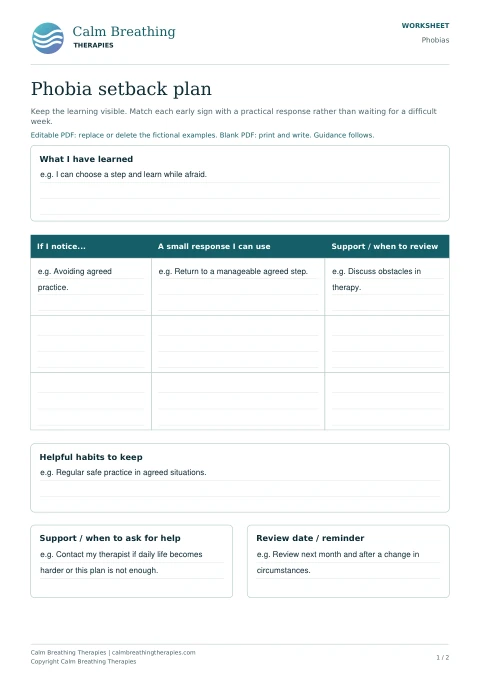
Worksheet with editable fictional examples: Phobia setback plan View worksheet
Free worksheet

Phobia setback plan

Keep learning from experience available and plan manageable ways to resume practice.

2 pages · A4 · Fillable PDF · 132 KB

Read the guidance and example

Fear can return after a gap, a stressful week or an unfamiliar encounter. That does not erase previous learning. A maintenance plan keeps your own evidence easy to find and helps you respond before avoidance spreads. Choose small, relevant opportunities to practise in normal life. Review changes in circumstances and safety rather than automatically repeating old tasks. The goal is continued freedom and confidence in taking useful action, not a promise never to feel afraid.

How to use it

  1. Write your most useful learning in your own words, using actual experiences.
  2. Notice early signs that avoidance, checking or reassurance are returning.
  3. Choose realistic opportunities to keep practising in safe, varied contexts.
  4. Plan a smaller restart step for difficult weeks and identify support.
  5. Set a review date and note when you would seek further professional help.

A fictional worked example

After making progress with escalators, Farah avoided them for several months during a busy period. On her next shopping trip she felt frightened again and thought that therapy had stopped working. Her plan reminded her that she had previously travelled on an escalator while anxious and still stepped off safely. She resumed a manageable, previously agreed step in a familiar place, then reviewed it before varying the location. She kept ordinary safety precautions. Her progress measure was using the shops she wanted to visit, rather than proving she could do every escalator or feel completely calm.

Keep in mind

Reassess new medical problems, fainting or changes in actual risk before restarting exercises. If avoidance grows substantially or previous practice becomes overwhelming, seek support. Maintenance practice should never require unnecessary procedures, unsafe animal contact or ignoring health advice.

Worksheet prompts

  • What I have learned
  • If I notice...
  • A small response I can use
  • Support / when to review
  • Helpful habits to keep
  • Support / when to ask for help
  • Review date / reminder

Reflect

How will I recognise progress in what I can do, even when some fear is present?

Sources: Craske, M. G., Treanor, M., Conway, C. C., Zbozinek, T., & Vervliet, B. (2014). Maximizing exposure therapy: An inhibitory learning approach. Behaviour Research and Therapy, 58, 10-23.

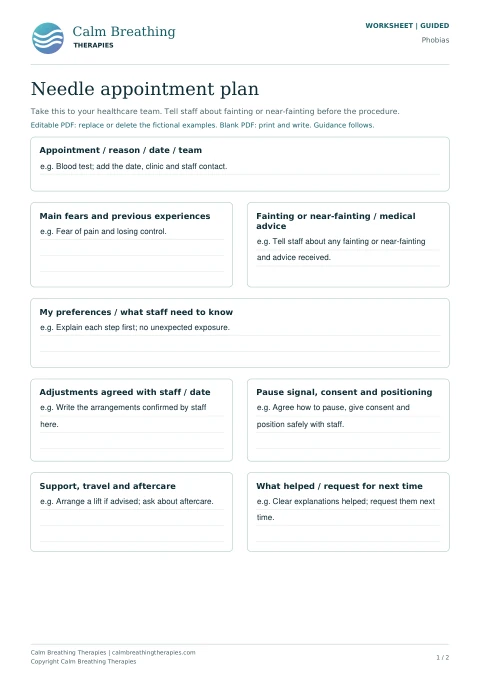
Worksheet with editable fictional examples: Needle appointment plan View worksheet
Plan with a therapist

Needle appointment plan

Tell your healthcare team about fears, fainting and the adjustments you want to discuss.

2 pages · A4 · Fillable PDF · 129 KB

Read the guidance and example

An appointment plan helps the clinical team understand your fear before a procedure begins. Needle fear can concern pain, fainting, loss of control, embarrassment or previous experiences; the helpful adjustments may differ. You do not need to hide these concerns or make yourself manage without support. This sheet organises a clear conversation. It does not replace the clinician’s instructions, consent process or assessment of your physical health.

How to use it

  1. Write what worries you most and whether you have fainted or nearly fainted before.
  2. Contact the service in advance where possible and ask what adjustments they can offer.
  3. Agree how staff will explain each stage, check consent and respond if you feel faint.
  4. Record their instructions about position, preparation and any accompanying person.
  5. After the appointment, note what helped and what you would request next time.

A fictional worked example

Imran had postponed a requested blood test because he feared fainting and feeling embarrassed. He contacted the practice and explained that he had previously lost consciousness during an injection. The nurse arranged to discuss a suitable position and a plan before starting. Imran asked for a clear explanation of the next step without watching equipment being prepared. He followed the practice’s preparation instructions rather than changing his food or medication himself. Afterwards, he recorded that telling the nurse early made it easier to participate. He still felt nervous, but did not have to manage the appointment in silence.

Keep in mind

All injections and blood tests must be performed by qualified healthcare staff. Follow their advice about eating, drinking, medicines and positioning. Do not change medication or delay necessary care because of this worksheet. Unexplained fainting needs medical assessment.

Worksheet prompts

  • Appointment / reason / date / team
  • Main fears and previous experiences
  • Fainting or near-fainting / medical advice
  • My preferences / what staff need to know
  • Adjustments agreed with staff / date
  • Pause signal, consent and positioning
  • Support, travel and aftercare
  • What helped / request for next time

Reflect

What made it easier to communicate my needs and take part in care?

Sources: Guy’s and St Thomas’ NHS Foundation Trust. (2024). Needle phobia and overcoming your fear.

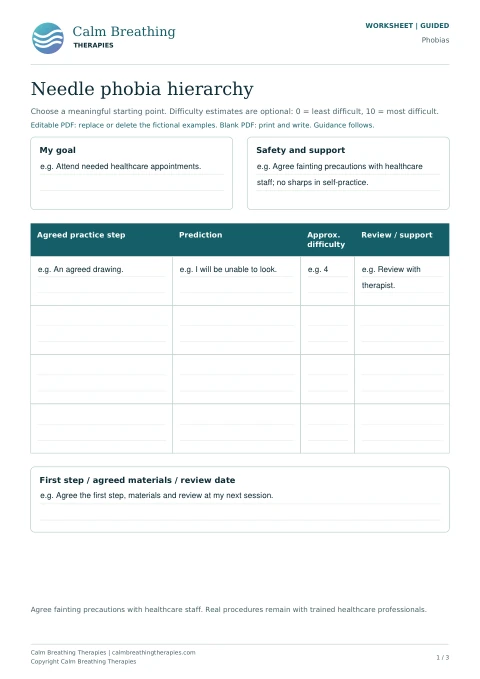
Worksheet with editable fictional examples: Needle phobia hierarchy View worksheet
Plan with a therapist

Needle phobia hierarchy

Plan consent-based, non-procedural practice with appropriate fainting precautions and support.

3 pages · A4 · Fillable PDF · 171 KB

Read the guidance and example

Needle-related practice does not mean handling needles or carrying out procedures yourself. It can begin with words, a conversation or a simple image that you have chosen in advance. The relevant step depends on whether you fear pain, fainting, loss of control or another outcome. Use this planner with a therapist to connect practice to your healthcare goal. Keep necessary clinical support in place and review what each step teaches you.

How to use it

  1. State the healthcare goal and the feared outcome you want to understand.
  2. Agree non-procedural steps and decide exactly what material will be used.
  3. Record fainting considerations and support before any practice.
  4. Choose one step and a clear opportunity to observe the prediction.
  5. Review what you noticed and agree the next step; necessary procedures remain with healthcare staff.

A fictional worked example

Grace wanted to attend a vaccination appointment but felt distressed even hearing the word “injection”. Her therapist helped her describe the prediction: talking about it would become so overwhelming that she would be unable to continue the conversation. They agreed a short discussion, followed later by a simple diagram that Grace had approved. Neither step involved sharp equipment. She noticed anxiety and was still able to describe her questions. They recorded that experience and discussed what support would be needed at the appointment. A photograph or procedure was not introduced unexpectedly, and there was no requirement to complete every step that day.

Keep in mind

Do not obtain, handle or practise with sharps. Do not use videos or images without checking their content and agreeing to them first. Fainting risk and relevant medical conditions need professional assessment. Exposure must not replace or unnecessarily postpone necessary healthcare.

Worksheet prompts

  • My goal
  • Safety and support
  • Agreed practice step
  • Prediction
  • Approx. difficulty
  • Review / support
  • First step / agreed materials / review date
  • Chosen step / prediction
  • What I will look for
  • Habit to change / support to keep
  • When, where and agreed endpoint
  • What actually happened
  • Learning / next agreed step

Reflect

Which part of the fear needs the next conversation or practice step?

Sources: Guy’s and St Thomas’ NHS Foundation Trust. (2024). Needle phobia and overcoming your fear., Craske, M. G., Treanor, M., Conway, C. C., Zbozinek, T., & Vervliet, B. (2014). Maximizing exposure therapy: An inhibitory learning approach. Behaviour Research and Therapy, 58, 10-23.

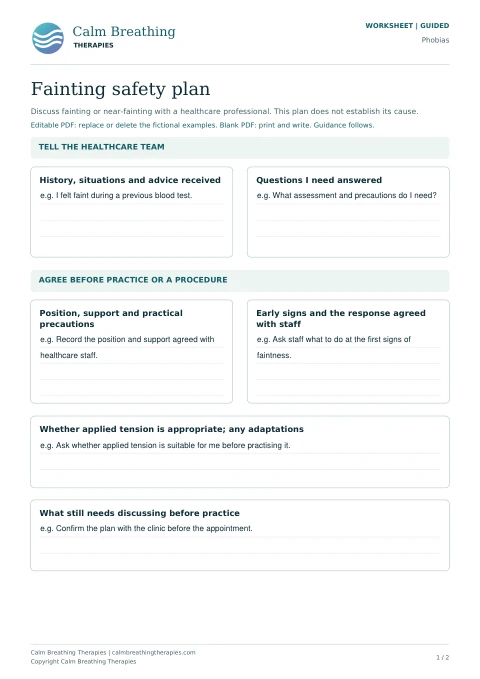
Worksheet with editable fictional examples: Fainting safety plan View worksheet
Plan with a therapist

Fainting safety plan

Prepare your fainting history, questions and a response plan to agree with healthcare staff.

2 pages · A4 · Fillable PDF · 126 KB

Read the guidance and example

Blood-related fear does not produce the same physical response in everyone. Some people experience a drop in blood pressure and may faint; others feel anxious without fainting. Dizziness alone does not tell you the cause. This planning sheet helps you explain your history and agree appropriate safeguards before exposure or healthcare. It is not a test of whether you can remain standing, and it should not be used to diagnose fainting yourself.

How to use it

  1. Describe previous fainting or near-fainting episodes briefly, including any medical advice received.
  2. Identify the triggers you want help with without seeking them out.
  3. Ask a healthcare professional what needs assessing and what warning signs to act on.
  4. Record an agreed position, support and response if you feel faint.
  5. Bring the plan to your therapist before arranging blood-related exposure.

A fictional worked example

Amy avoided films and first-aid discussions because the mention of blood made her feel unwell. She had also fainted once during a procedure but had never discussed the episode. Before planning exposure, she spoke to her GP and told her therapist what had happened. Her plan recorded how to alert staff, the position advised for appointments and what to do if warning signs appeared. Practice then began with a non-graphic conversation, using the agreed support. Amy did not try to prove she could stay standing or assume that every dizzy feeling was simply anxiety.

Keep in mind

Seek medical advice about unexplained fainting or new symptoms. If you feel faint, stop, tell the person supporting you and sit or lie down safely according to medical advice. Do not create bleeding, use injury simulations unexpectedly or attempt exposure alone when fainting is possible.

Worksheet prompts

  • History, situations and advice received
  • Questions I need answered
  • Position, support and practical precautions
  • Early signs and the response agreed with staff
  • Whether applied tension is appropriate; any adaptations
  • What still needs discussing before practice

Reflect

What information or support is still needed before practice can be planned safely?

Sources: Guy’s and St Thomas’ NHS Foundation Trust. (2024). Needle phobia and overcoming your fear.

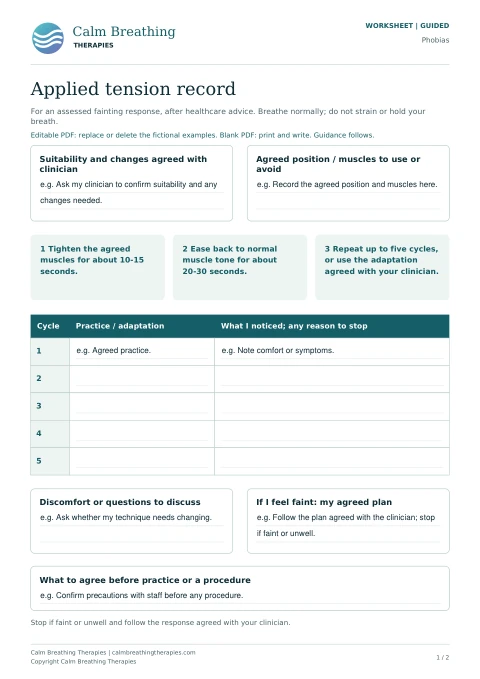
Worksheet with editable fictional examples: Applied tension record View worksheet
Plan with a therapist

Applied tension record

Record clinician-advised muscle tension practice for an assessed fainting response.

2 pages · A4 · Fillable PDF · 136 KB

Read the guidance and example

Applied tension uses brief muscle tightening to help counter a blood-pressure drop in people with an assessed tendency to faint around blood, injury or needles. It is not a relaxation exercise and is not needed for everyone with a phobia. Ask a healthcare professional whether it is appropriate, particularly if you have a medical condition or pain. Learn the technique without a feared trigger first, using the instructions agreed for your circumstances.

How to use it

  1. Confirm suitability, a supported sitting position and which muscles to use with your clinician.
  2. If advised, tighten large muscles in arms, torso and legs for about 10-15 seconds, without straining or holding your breath.
  3. Return to ordinary muscle tone for around 20-30 seconds, without deliberately relaxing deeply.
  4. If advised, repeat up to five cycles. Keep face and head relaxed and adapt any painful area.
  5. Record practice and concerns; only combine it with exposure or a procedure as professionally agreed.

A fictional worked example

Ben had a medically assessed history of fainting with blood tests. His healthcare professional explained applied tension and checked how he could practise comfortably while seated. He initially tried too hard and held his breath, so they adjusted the effort and practised breathing normally. He recorded the agreed timing and how the exercise felt, without looking at blood or needles. Before his next test he told the nurse about his history and followed her positioning instructions. He did not tense the arm being used for the procedure; the nurse advised how to adapt his plan. The aim was safe participation, not eliminating every anxious feeling.

Keep in mind

Use only after professional agreement. Stop if practice causes pain, headache, breathlessness or feeling faint; sit or lie safely and seek advice. Follow staff instructions during procedures, including keeping the procedure arm still. Applied tension does not replace assessment or emergency care.

Worksheet prompts

  • Suitability and changes agreed with clinician
  • Agreed position / muscles to use or avoid
  • 1: Practice / adaptation
  • 1: What I noticed; any reason to stop
  • 2: Practice / adaptation
  • 2: What I noticed; any reason to stop
  • 3: Practice / adaptation
  • 3: What I noticed; any reason to stop
  • 4: Practice / adaptation
  • 4: What I noticed; any reason to stop
  • 5: Practice / adaptation
  • 5: What I noticed; any reason to stop
  • Discomfort or questions to discuss
  • If I feel faint: my agreed plan
  • What to agree before practice or a procedure

Reflect

Can I practise without straining or holding my breath, and what needs further guidance?

Sources: Guy’s and St Thomas’ NHS Foundation Trust. (2024). Needle phobia and overcoming your fear.

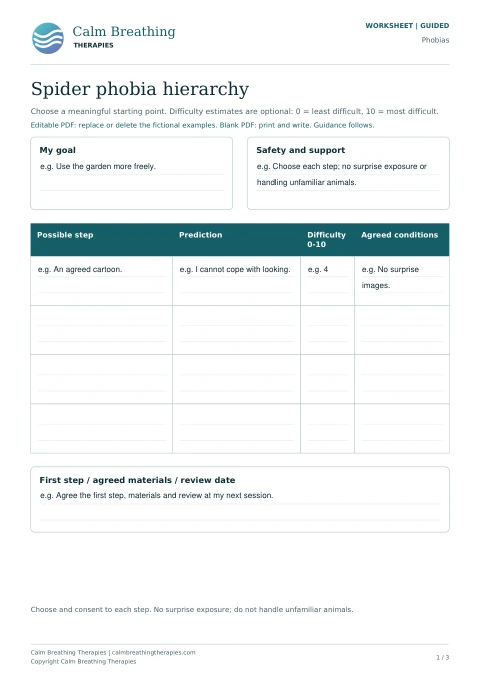
Worksheet with editable fictional examples: Spider phobia hierarchy View worksheet
Plan with a therapist

Spider phobia hierarchy

Choose your own practice steps and agreed conditions, with no surprise images or exposure.

3 pages · A4 · Fillable PDF · 171 KB

Read the guidance and example

Spider fear can concern being bitten, sudden movement, disgust or being unable to cope. Those predictions lead to different practice plans. Begin with a goal that matters in ordinary life and choose each step deliberately. You may start with talking about the fear or an illustration you have approved. This worksheet contains no spider pictures. It helps plan learning; it does not require contact with animals or surprises arranged by somebody else.

How to use it

  1. Describe what fear stops you doing and the prediction behind it.
  2. List graded options using distance, setting or chosen materials.
  3. Agree exactly what will happen; no surprise images, animals or touching.
  4. Plan one safe step and decide what would count as useful observation.
  5. Record what happened and revise the next step around your own goal.

A fictional worked example

Nadia wanted to sit in her conservatory without asking her partner to search it first. Her main prediction was that she would be unable to remain there if she thought a spider might appear. She and her therapist began with discussing the room, then sitting near the doorway for an agreed activity without a repeated search. Later they considered a simple drawing that Nadia chose herself. Her goal did not include catching or holding a spider. She recorded that she could read a few pages while feeling uneasy. The next step was based on that experience rather than a fixed ladder from the internet.

Keep in mind

Keep ordinary environmental and animal safety precautions. Do not handle unknown spiders, use venomous species or arrange an animal encounter without suitable expertise. Nobody should place spiders or images in your space unexpectedly. Discuss severe reactions or fainting before practice.

Worksheet prompts

  • My goal
  • Safety and support
  • Possible step
  • Prediction
  • Difficulty 0-10
  • Agreed conditions
  • First step / agreed materials / review date
  • Chosen step / prediction
  • What I will look for
  • Habit to change / support to keep
  • When, where and agreed endpoint
  • What actually happened
  • Learning / next agreed step

Reflect

What did this teach me about taking part while uncertainty or disgust was present?

Sources: Craske, M. G., Treanor, M., Conway, C. C., Zbozinek, T., & Vervliet, B. (2014). Maximizing exposure therapy: An inhibitory learning approach. Behaviour Research and Therapy, 58, 10-23., NHS. Phobias. Accessed 24 October 2026.
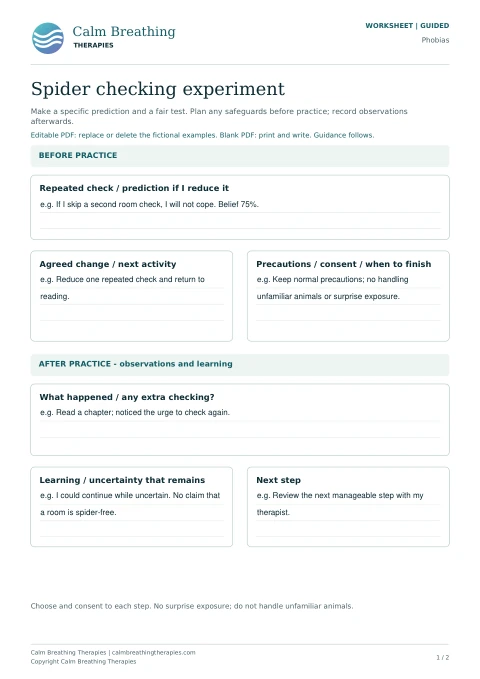
Worksheet with editable fictional examples: Spider checking experiment View worksheet
Plan with a therapist

Spider checking experiment

Plan a change to repeated checking while keeping ordinary environmental precautions.

2 pages · A4 · Fillable PDF · 127 KB

Read the guidance and example

Checking a room may briefly reduce fear, then leave you needing another search before you can settle. The relevant question is whether the habit helps with an actual practical problem or mainly promises certainty that never lasts. This worksheet supports a small experiment with repeated checking, agreed where needed with your therapist. You are not being asked to ignore a real hazard or prove that a spider can never be present.

How to use it

  1. Choose one repeated checking habit and note its immediate and later effects.
  2. Write what you predict would happen if you reduced one unnecessary repeat.
  3. Keep ordinary household precautions and agree a manageable change.
  4. Return to a chosen activity rather than replacing the check with reassurance or scanning.
  5. Review time reclaimed, coping and what remains uncertain.

A fictional worked example

Alex checked behind the sofa four times each evening and asked his flatmate to confirm the room was clear. The reassurance helped briefly, but he soon wanted another check. With his therapist he agreed to leave out one repeated search and spend that time listening to music. He predicted he would be unable to concentrate at all. He still noticed an urge to look and did not feel certain about the room, but followed several songs without asking his flatmate. His review focused on tolerating that uncertainty and reclaiming the evening, rather than proving the room could never contain a spider.

Keep in mind

Use this only for excessive anxiety-driven checking. Preserve ordinary precautions and any professional advice about genuine environmental hazards. Do not turn the exercise into covert scanning or a test involving an animal. If checking is extensive or disabling, seek therapist support.

Worksheet prompts

  • Repeated check / prediction if I reduce it
  • Agreed change / next activity
  • Precautions / consent / when to finish
  • What happened / any extra checking?
  • Learning / uncertainty that remains
  • Next step

Reflect

Did the change help me do something meaningful without obtaining complete certainty?

Sources: Craske, M. G., Treanor, M., Conway, C. C., Zbozinek, T., & Vervliet, B. (2014). Maximizing exposure therapy: An inhibitory learning approach. Behaviour Research and Therapy, 58, 10-23.

Keep the collection together

Download the complete toolkit

11 distinct resources · 26 pages · Printable PDF · 3.3 MB. Choose the sheets that fit your needs.

Download phobias toolkit

Print or type. The worksheet comes first in every individual PDF, with guidance afterwards. Choose “Editable PDF · examples” for a short fictional example in each box or first diary entry. Select the text to replace or delete it in a PDF reader, then save a private copy. Later diary entries and table rows are blank. Choose “Blank PDF · print” for writing by hand. Browser PDF viewers vary. The complete toolkits contain blank printable sheets.

Read online. Read step-by-step guidance, a fictional example and the worksheet prompts as HTML under “Read the guidance and example”. You can use those prompts in your own notes. Completed answers are not collected by this site.

How to use these phobia worksheets safely

A phobia can shrink everyday choices: postponing a blood test, avoiding a room or planning a journey around a fear. This toolkit helps you understand your particular pattern and prepare gradual, agreed practice. It includes shared planning sheets plus resources for needle fear, blood-related fainting and spider phobia. There are no unexpected photographs or graphic examples. You choose a meaningful goal, such as attending healthcare or using your home more freely. The aim is to learn from experience, rather than force anxiety to disappear. Not every sheet or exercise will suit every person.

Begin with the fear-cycle map and identify one goal that matters to you. A hierarchy helps organise possible steps, but it is not a test you must complete in order. Write down what you predict will happen. Ratings are rough planning tools; you do not need to monitor anxiety repeatedly or achieve a particular score before moving forward.

Use the exposure plan with your therapist when fears are severe, fainting is possible or the situation has practical risks. Agree what the exercise tests, appropriate precautions and how you will review it. New learning can occur while some fear remains. You may repeat or vary a step after reviewing what happened; the aim is useful experience rather than endurance.

Choose the needle, blood or spider sheets that fit your own difficulty. Healthcare procedures belong with qualified healthcare staff and must follow their instructions. For ages 16-17, an appropriately trained therapist should adapt materials and agree support and consent arrangements. The general goals, behavioural experiment and progress resources can be reused alongside this toolkit rather than completing every worksheet.

Suitability and support

Do not use sharp equipment, create injuries, handle unknown animals or disregard ordinary safety precautions for an exercise. Explain fainting, new symptoms or medical conditions to your healthcare professional before practice. Applied tension is specifically for an assessed fainting response, not a general relaxation exercise. Stop if you feel faint and follow the agreed safety plan. These materials support assessment and treatment; they are not a complete self-treatment programme.

Useful across different difficulties

The Five Areas map, goal-setting sheet and between-session practice review can support your individual plan. Choose them with your therapist where useful; you do not need to duplicate the work.

Models and sources

Exposure-based CBT for specific phobias, informed by inhibitory learning principles (Craske et al., 2014). Blood-injection-injury fears require separate consideration of vasovagal fainting and appropriate applied tension.

Original materials for Calm Breathing Therapies. The cited organisations do not endorse these worksheets. Evidence, use and limitations · Version 3.0 · 26 October 2026.

Support when you want it

Sometimes it helps to work through it together.

These resources can be a useful starting point. If you are considering CBT, a FREE 5–10 minute consultation gives you space to discuss whether it might be suitable for you. There is no pressure to book.

Online CBT for people aged 16 and over across the UK. Suitability and the format of therapy are assessed individually. You can also read about how CBT for specific phobias works.

Worksheet preview

WhatsAppFree first call