7 original resources · Free PDF downloads

Free CBT Worksheets for Health Anxiety

Health anxiety can involve repeated symptom searches, body checking, reassurance or avoiding healthcare and everyday activities.

Download free CBT worksheets for health anxiety, including templates for noticing body checking, reassurance seeking and interpretations of bodily sensations. These tools support reflection, not diagnosis or assessment of medical symptoms.

Preview the actual templates below. Worksheets come first in every PDF, with guidance afterwards.

Resources marked “Plan with a therapist” need individual guidance. Read suitability and support.

Worksheet with editable fictional examples: Health anxiety cycle View worksheet
See the sheet before you download

Worksheets and practical tools

Select a preview to enlarge it. Every PDF is free, with no registration.

Worksheet with editable fictional examples: Health anxiety cycle View worksheet
Free worksheet

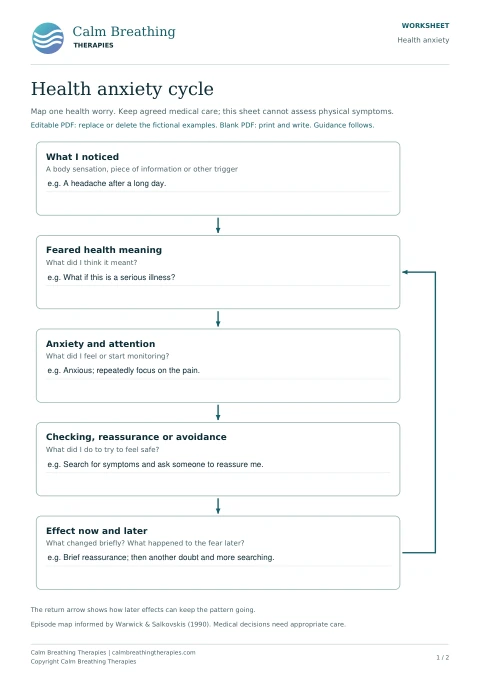
Health anxiety cycle

Map a health worry, attention, checking or reassurance, and the effects that can keep fear going.

2 pages · A4 · Fillable PDF · 126 KB

Read the guidance and example

Health anxiety concerns how health-related uncertainty is interpreted and managed; it does not mean that symptoms are invented or that physical illness is impossible. In the cognitive-behavioural model, checking, reassurance and avoidance can keep threat prominent even when they bring temporary relief. This worksheet helps map one example without deciding what a symptom means medically. Include diagnosed conditions and agreed care so that therapy supports, rather than replaces, appropriate healthcare.

How to use it

  1. Start with one sensation, event or piece of information.
  2. Write the health problem you feared it meant.
  3. Add the anxiety, body focus or monitoring that followed.
  4. Record checking, reassurance seeking or avoidance, then the short-term and later effects. Keep agreed medical care separate from repeated attempts to feel certain.
  5. Follow the return arrow to consider whether the fear stayed believable. Discuss a possible change separately, without delaying needed healthcare.

A fictional worked example

Farah reads an article about illness and notices a familiar ache. Her interpretation is, “The earlier assessment must have missed something.” She examines the area repeatedly and searches the same symptom with slightly different wording. Each search reassures her briefly before another doubt appears. Her map includes the follow-up already agreed with her GP, which stays in place. It also shows that the extra searches increase her focus on the ache and interrupt family time. The treatment question is how to respond to repeated doubt outside that care plan, not whether an online worksheet can prove that she is healthy.

Keep in mind

Continue prescribed treatment, screening, monitoring and follow-up. New, worsening or concerning symptoms need appropriate medical advice. Health anxiety can coexist with physical illness. This worksheet cannot rule out disease or tell you whether to seek care; discuss uncertainty about that with a healthcare professional.

Worksheet prompts

  • What I noticed: A body sensation, piece of information or other trigger
  • Feared health meaning: What did I think it meant?
  • Anxiety and attention: What did I feel or start monitoring?
  • Checking, reassurance or avoidance: What did I do to try to feel safe?
  • Effect now and later: What changed briefly? What happened to the fear later?

Reflect

What part of this cycle concerns my response to uncertainty, rather than a medical conclusion?

Sources: Warwick, H. M. C., & Salkovskis, P. M. (1990). Hypochondriasis. Behaviour Research and Therapy, 28(2), 105-117., NHS. Health anxiety. Accessed 24 October 2026.
Worksheet with editable fictional examples: Health checking diary View worksheet
Free worksheet

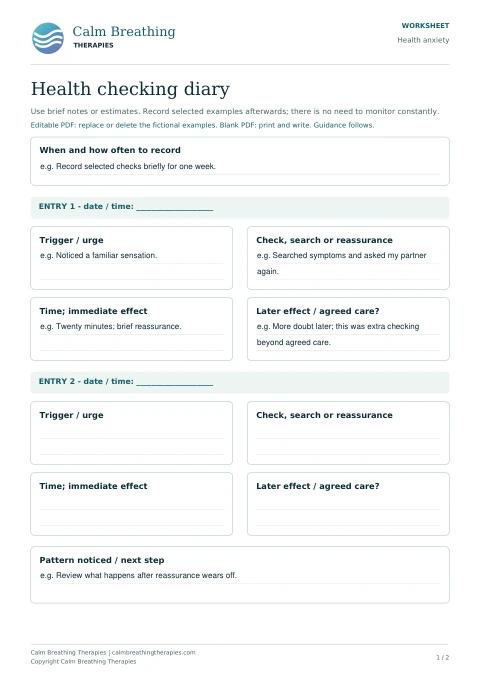
Health checking diary

Notice repeated checks, searches and reassurance, distinguishing them from agreed medical monitoring.

2 pages · A4 · Fillable PDF · 132 KB

Read the guidance and example

Checking may feel like a way to settle uncertainty, yet the urge often returns after a brief period of relief. A limited record can show this sequence and help choose a manageable treatment target. The aim is to understand the function of the behaviour, not to count every sensation. Keep clinician-advised monitoring clearly separate. Repeated mental reviewing, comparison and asking the same question in new ways may also be relevant.

How to use it

  1. Choose a short recording period, such as three days, and a brief daily review time.
  2. Record the trigger and the extra check, search, reassurance request or mental review.
  3. Estimate time spent and note what happened to the urge immediately and later.
  4. Mark any clinician-advised care separately. Review one repeated pattern and a possible next step with your therapist.

A fictional worked example

George notes that he searches a familiar symptom after seeing a health post. The first search takes ten minutes and brings relief for around five minutes. He then adds “but what if” details and spends another half-hour searching. His record also includes a blood-pressure check specifically requested by his clinician; this is marked as agreed care and is not a target for reduction. After three days, he can see that unplanned searches tend to grow without answering a new question. He chooses to discuss a small experiment on repeated searching, while continuing the monitoring schedule he has been given.

Keep in mind

This is not a symptom-surveillance chart. Avoid extra physical checks for the purpose of filling it in. Do not reduce prescribed monitoring or needed help-seeking. If you cannot distinguish necessary care from anxiety-driven repetition, clarify a plan with your clinician before making changes.

Worksheet prompts

  • When and how often to record
  • Trigger / urge
  • Check, search or reassurance
  • Time; immediate effect
  • Later effect / agreed care?
  • Pattern noticed / next step

Reflect

How long did relief last, and what did the repeated checking cost me?

Sources: Warwick, H. M. C., & Salkovskis, P. M. (1990). Hypochondriasis. Behaviour Research and Therapy, 28(2), 105-117., NHS. Health anxiety. Accessed 24 October 2026.
Worksheet with editable fictional examples: Healthcare plan View worksheet
Plan with a therapist

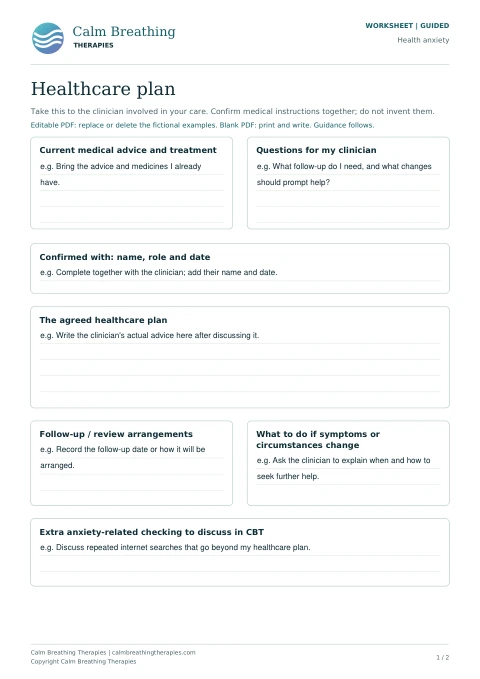
Healthcare plan

Prepare questions and record a healthcare plan confirmed with your clinician.

2 pages · A4 · Fillable PDF · 127 KB

Read the guidance and example

It can be difficult to judge whether you are following medical advice or repeatedly checking because uncertainty feels unbearable. A shared plan with an appropriate healthcare professional can clarify what care is needed and what to do if symptoms change. This sheet is a discussion aid, not a medical protocol. Your therapist can help with anxiety responses; the relevant healthcare professional should guide medical monitoring, treatment and escalation.

How to use it

  1. List existing advice, treatment and follow-up, using the wording you were given.
  2. Note what is unclear: what to monitor, how often, and which changes need help.
  3. Ask your healthcare professional to clarify the plan and record when it should be reviewed.
  4. With your therapist, identify extra reassurance or checking outside this plan and a suitable response to the urge.

A fictional worked example

Nadia has a diagnosed condition and also finds herself checking repeatedly between scheduled appointments. She brings this sheet to her healthcare professional and asks what monitoring is needed and what changes should prompt contact. She records their advice in her own words and checks that she has understood it. In therapy, she works on searches that repeat the same question without new information. If a relevant change occurs, she follows the care plan rather than treating every urge as anxiety. She does not ask her therapist to decide medication or use the worksheet to invent a universal rule about when symptoms matter.

Keep in mind

Leave medical instructions blank until clarified with the relevant clinician. Do not use a fixed “wait” rule for new or concerning symptoms. Continue treatment and seek emergency care for a medical emergency. This sheet cannot replace clinical judgement, triage or an individual medical assessment.

Worksheet prompts

  • Current medical advice and treatment
  • Questions for my clinician
  • Confirmed with: name, role and date
  • The agreed healthcare plan
  • Follow-up / review arrangements
  • What to do if symptoms or circumstances change
  • Extra anxiety-related checking to discuss in CBT

Reflect

Does this plan support appropriate care without becoming a repeated demand for reassurance?

Sources: NHS. Health anxiety. Accessed 24 October 2026., Warwick, H. M. C., & Salkovskis, P. M. (1990). Hypochondriasis. Behaviour Research and Therapy, 28(2), 105-117.

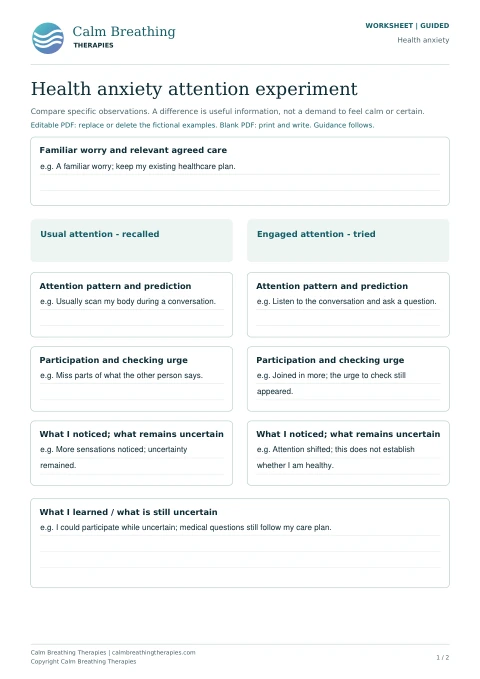
Worksheet with editable fictional examples: Health anxiety attention experiment View worksheet
Plan with a therapist

Health anxiety attention experiment

Compare habitual symptom attention with engagement in an ordinary activity.

2 pages · A4 · Fillable PDF · 129 KB

Read the guidance and example

When attention keeps returning to the body, familiar sensations may become more prominent. Exploring attention can help you understand this part of your anxiety cycle. The experiment is about how attention and engagement change your experience, not about proving that a symptom is harmless. Observe your usual pattern briefly in retrospect, then practise engaging with an ordinary external task. Avoid deliberately increasing symptom monitoring to create a stronger comparison.

How to use it

  1. Choose a familiar health worry and confirm any relevant care plan with your clinician or therapist.
  2. Describe a recent period of habitual body attention and its effects. Do not recreate extra checking.
  3. Choose an ordinary task for a brief period, letting sensations be present while attending to the task.
  4. Compare engagement, urge to check and learning. Do not use repeated physical measurements to judge success.

A fictional worked example

Louise notices that a familiar, assessed sensation becomes the centre of her attention while she reads health forums. Her prediction is, “I cannot focus on anything else while this is here.” Instead of checking more closely as a test, she records the pattern from yesterday. She then spends ten minutes helping her niece choose a birthday card, allowing the sensation to remain in the background. She notices that her attention shifts in and out of the task, and she still contributes to the conversation. She learns something about flexibility of attention; she does not conclude that the sensation’s cause has been medically established.

Keep in mind

This exercise is not a diagnostic test and must not delay needed care. Continue agreed monitoring. Choose an ordinary, safe activity and do not induce symptoms or deliberately intensify body scanning. If symptoms are new or concerning, seek appropriate medical advice rather than testing attention.

Worksheet prompts

  • Familiar worry and relevant agreed care
  • Attention pattern and prediction
  • Participation and checking urge
  • What I noticed; what remains uncertain
  • What I learned / what is still uncertain

Reflect

Was I able to do something meaningful without first resolving every sensation?

Sources: Warwick, H. M. C., & Salkovskis, P. M. (1990). Hypochondriasis. Behaviour Research and Therapy, 28(2), 105-117.

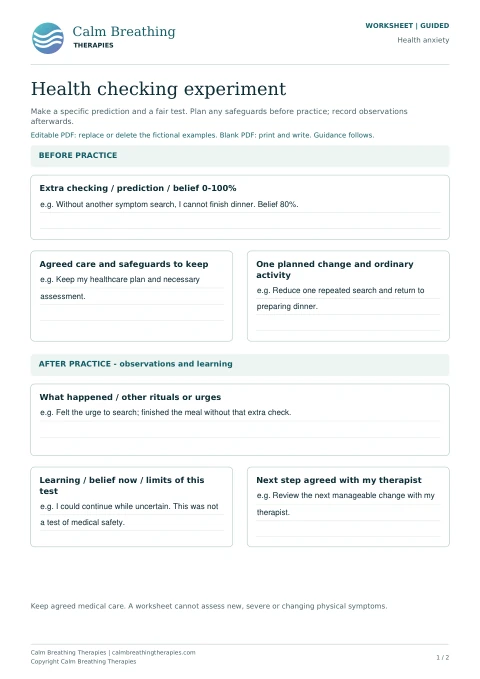
Worksheet with editable fictional examples: Health checking experiment View worksheet
Plan with a therapist

Health checking experiment

Plan a modest change to an extra anxiety-driven check, keeping agreed medical care.

2 pages · A4 · Fillable PDF · 127 KB

Read the guidance and example

Changing a checking habit is easier to evaluate when you know what you are testing. You might predict that uncertainty will become unbearable or that you cannot continue your day without another search. This experiment investigates that coping prediction. It does not ask you to prove that illness is impossible. Start with a familiar repeated behaviour, clearly outside required healthcare, and plan the change with your therapist where appropriate.

How to use it

  1. Identify one repeated extra check, search or reassurance request and the prediction attached to it.
  2. Confirm what medical care must continue. Choose a modest change to the extra habit.
  3. Plan an ordinary activity to continue while allowing the urge, without replacing the check with another ritual.
  4. Record the outcome, what you coped with and any limits to the evidence. Review before increasing the task.

A fictional worked example

Oliver wants to repeat the same online symptom search after receiving no new information. His medical plan remains unchanged. He predicts, “If I do not search again, I will be unable to finish dinner,” believed 80%. With his therapist, he agrees to leave that repeat search and continue preparing food, without asking his partner the same question instead. The urge comes in waves, and he finishes the meal while still uncertain. His learning concerns his ability to carry on without that extra search. The exercise does not establish whether he has a medical condition or remove the need to follow agreed care.

Keep in mind

Only target extra anxiety-driven repetition, not new symptoms, urgent help-seeking, screening, prescribed checks or follow-up. If the boundary is unclear, consult your clinician first. Do not replace checking with repeated self-reassurance, symptom comparisons or asking someone else to check. Review excessive distress with your therapist.

Worksheet prompts

  • Extra checking / prediction / belief 0-100%
  • Agreed care and safeguards to keep
  • One planned change and ordinary activity
  • What happened / other rituals or urges
  • Learning / belief now / limits of this test
  • Next step agreed with my therapist

Reflect

What did I learn about tolerating the urge, without making a medical claim?

Sources: Warwick, H. M. C., & Salkovskis, P. M. (1990). Hypochondriasis. Behaviour Research and Therapy, 28(2), 105-117., NHS. Health anxiety. Accessed 24 October 2026.
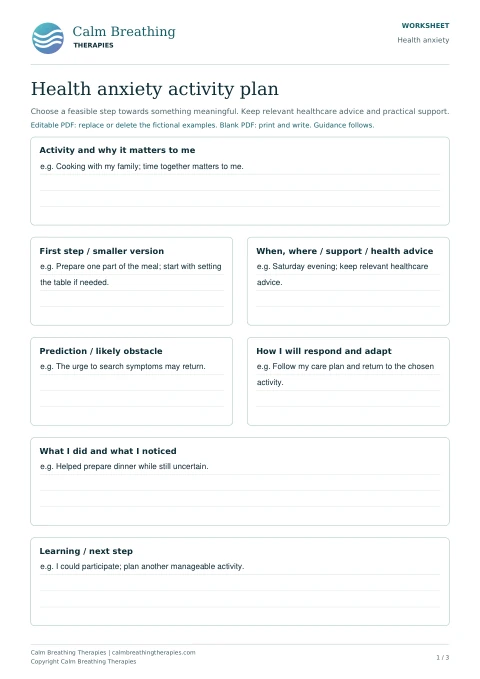
Worksheet with editable fictional examples: Health anxiety activity plan View worksheet
Free worksheet

Health anxiety activity plan

Plan a return to valued activities, then prepare for familiar triggers and setbacks.

3 pages · A4 · Fillable PDF · 167 KB

Read the guidance and example

Health anxiety can take time away from relationships, work and activities, through checking or avoidance. A maintenance plan should therefore include what you want to return to, not only what you want to reduce. Choose activities consistent with your health advice and review the learning from small steps. Future health news or symptoms may bring worry back; a plan can help you distinguish using CBT skills from following medical guidance.

How to use it

  1. Name one activity that health worry has restricted and why it matters to you.
  2. Check relevant health advice, then choose a manageable return step and date.
  3. Record what you predict, what happens and what you learn about engagement or coping.
  4. List likely future triggers, early signs of repeated checking, useful CBT responses and when to seek further professional support.

A fictional worked example

Helen has stopped meeting friends because she spends evenings searching health information. Her clinician has not advised restricting social activity. She plans a short café visit and predicts that health worries will make conversation impossible. During the visit, worries appear, but she also listens and laughs. Her setback plan names health headlines as a trigger and repeated late-night searches as an early sign. She will return to agreed care, review her checking experiment and reconnect with an activity. If symptoms change, she will seek appropriate advice; if anxiety again substantially restricts life, she will contact her therapist or GP for support.

Keep in mind

Adapt activity to medical advice, disability and energy limits; this is not an instruction to push through symptoms. Keep screening and follow-up. Seek advice for new or worsening symptoms and further psychological support when anxiety limits functioning. For ages 16-17, arrange age-appropriate professional guidance.

Worksheet prompts

  • Activity and why it matters to me
  • First step / smaller version
  • When, where / support / health advice
  • Prediction / likely obstacle
  • How I will respond and adapt
  • What I did and what I noticed
  • Learning / next step
  • What I have learned
  • If I notice...
  • A small response I can use
  • Support / when to review
  • Helpful habits to keep
  • Support / when to ask for help
  • Review date / reminder

Reflect

What would living more fully look like, even with some uncertainty about health?

Sources: Warwick, H. M. C., & Salkovskis, P. M. (1990). Hypochondriasis. Behaviour Research and Therapy, 28(2), 105-117., NHS. Health anxiety. Accessed 24 October 2026.
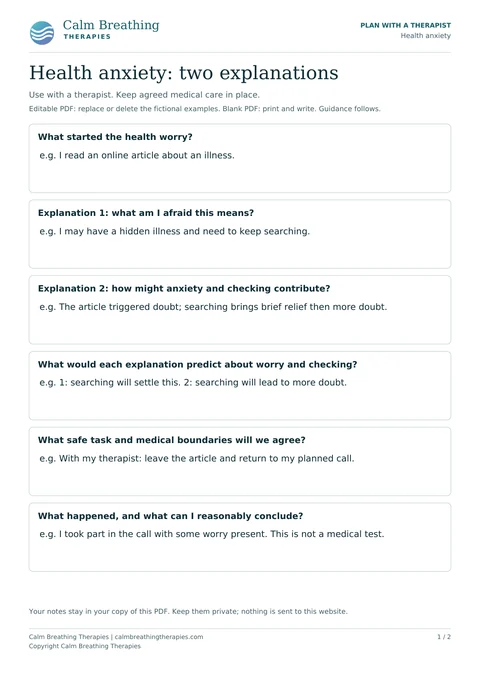
Health anxiety: two explanations: six clear prompts with short editable fictional examples View worksheet
Plan with a therapist

Health anxiety: two explanations

Compare a feared health interpretation with an anxiety-and-checking explanation, then agree a safe learning task with a therapist. Medical care remains separate.

2 pages · A4 · Fillable PDF · 842 KB

Read the guidance and example

Health anxiety can make a feared interpretation feel like the only explanation. With your therapist, consider whether anxiety, attention and checking also help explain the pattern. This sheet examines the worry process; it cannot establish whether a physical illness is present or absent.

How to use it

  1. Choose one episode and separate what you noticed from what you feared it meant.
  2. Write the feared explanation and an alternative about the anxiety process. Both anxiety and a physical health condition can be present.
  3. With your therapist, compare predictions about attention, checking, reassurance and daily activity. Do not create symptom tests or try to prove the absence of illness.
  4. Agree a safe small task within your medical care plan, then record what it teaches about the worry process and what remains uncertain.

In the editable PDF, replace or delete each fictional example. Your notes stay in your saved copy and are not sent to this website.

A fictional example

Priya reads about an illness and repeatedly searches for further signs. Her feared explanation is that stopping would be irresponsible. An alternative is that searching is increasing doubt and the urge to check. Within her agreed care plan, she closes the article and returns to a phone call. She learns she can remain involved despite uncertainty; the exercise tells her nothing definitive about her medical health.

Keep in mind

Keep prescribed treatment, necessary tests and agreed medical appointments. Do not use this sheet to decide whether a symptom needs assessment or to delay urgent care. Seek appropriate medical advice for new, severe, changing or unexplained symptoms. A therapist-guided experiment must not involve unsafe exertion, stopping medicines or withholding needed care.

Review your learning

What did this show about attention, reassurance or checking, without turning learning into a guarantee?

Sources informing this original worksheet: Warwick, H. M., & Salkovskis, P. M. (1990). Hypochondriasis. Behaviour Research and Therapy, 28(2), 105-117. doi:10.1016/0005-7967(90)90023-C.; NHS. Health anxiety.. These sources do not endorse the resource.

Keep the collection together

Download the complete toolkit

7 distinct resources · 16 pages · Printable PDF · 0.2 MB. Choose the sheets that fit your needs.

Download health anxiety toolkit

Print or type. The worksheet comes first in every individual PDF, with guidance afterwards. Choose “Editable PDF · examples” for a short fictional example in each box or first diary entry. Select the text to replace or delete it in a PDF reader, then save a private copy. Later diary entries and table rows are blank. Choose “Blank PDF · print” for writing by hand. Browser PDF viewers vary. The complete toolkits contain blank printable sheets.

Read online. Read step-by-step guidance, a fictional example and the worksheet prompts as HTML under “Read the guidance and example”. You can use those prompts in your own notes. Completed answers are not collected by this site.

How to use these health anxiety worksheets

Use the two-explanations worksheet with a therapist to explore the anxiety and checking process. It does not determine whether illness is present or replace your medical care plan.

Health anxiety can involve repeated symptom searches, body checking, reassurance or avoiding healthcare and everyday activities. These resources focus on that response pattern while respecting the possibility of physical illness and the importance of appropriate care. They draw on the cognitive-behavioural approach described by Warwick and Salkovskis. The aim is not to prove that you are healthy or persuade you to ignore symptoms. It is to help you understand how fear and uncertainty are affecting your day, agree clear healthcare boundaries where needed, and test small changes to extra anxiety-driven habits.

Begin by identifying one recent health-worry episode. The cycle and checking log help distinguish observations, feared meanings and the attempts to settle uncertainty. Use short entries rather than detailed symptom surveillance. If you have a diagnosed condition, include the care you have been advised to follow so that therapy targets extra anxiety-driven habits without disrupting medical management.

If the boundary between appropriate monitoring and repeated reassurance is unclear, take the shared-plan worksheet to your healthcare professional. Record their advice rather than inventing rules about how long to wait. Your therapist can then help select a suitable experiment around attention, repeated searching or reassurance outside that plan. A worksheet cannot determine whether a physical symptom is medically significant.

Choose a small return to an activity that worry has displaced, consistent with any health restrictions. Review what happens to engagement and your ability to cope with uncertainty, rather than treating an exercise as proof that disease is absent. The planning-ahead sheet links these gains with early signs of checking returning, continued medical follow-up and routes back to psychological support.

Suitability and support

Health anxiety and physical illness can coexist. Continue medication, screening, monitoring and follow-up recommended by your healthcare professional, and seek advice for new, worsening or concerning symptoms. Experiments must not delay needed care or involve provoking symptoms. If self-help increases checking or reassurance, pause and discuss it. People aged 16-17 need age-appropriate support and adaptation.

Useful across different difficulties

The Five Areas map, goal-setting sheet and between-session practice review can support your individual plan. Choose them with your therapist where useful; you do not need to duplicate the work.

Models and sources

Warwick and Salkovskis’s cognitive-behavioural model of health anxiety: threatening interpretations of health information, selective attention and repeated safety-seeking or avoidance. Medical assessment and necessary care remain distinct from therapy experiments.

Original materials for Calm Breathing Therapies. The cited organisations do not endorse these worksheets. Evidence, use and limitations · Version 3.0 · 26 October 2026.

Support when you want it

Sometimes it helps to work through it together.

These resources can be a useful starting point. If you are considering CBT, a FREE 5–10 minute consultation gives you space to discuss whether it might be suitable for you. There is no pressure to book.

Online CBT for people aged 16 and over across the UK. Suitability and the format of therapy are assessed individually. You can also read about how CBT for health anxiety works.

Worksheet preview

WhatsAppFree first call